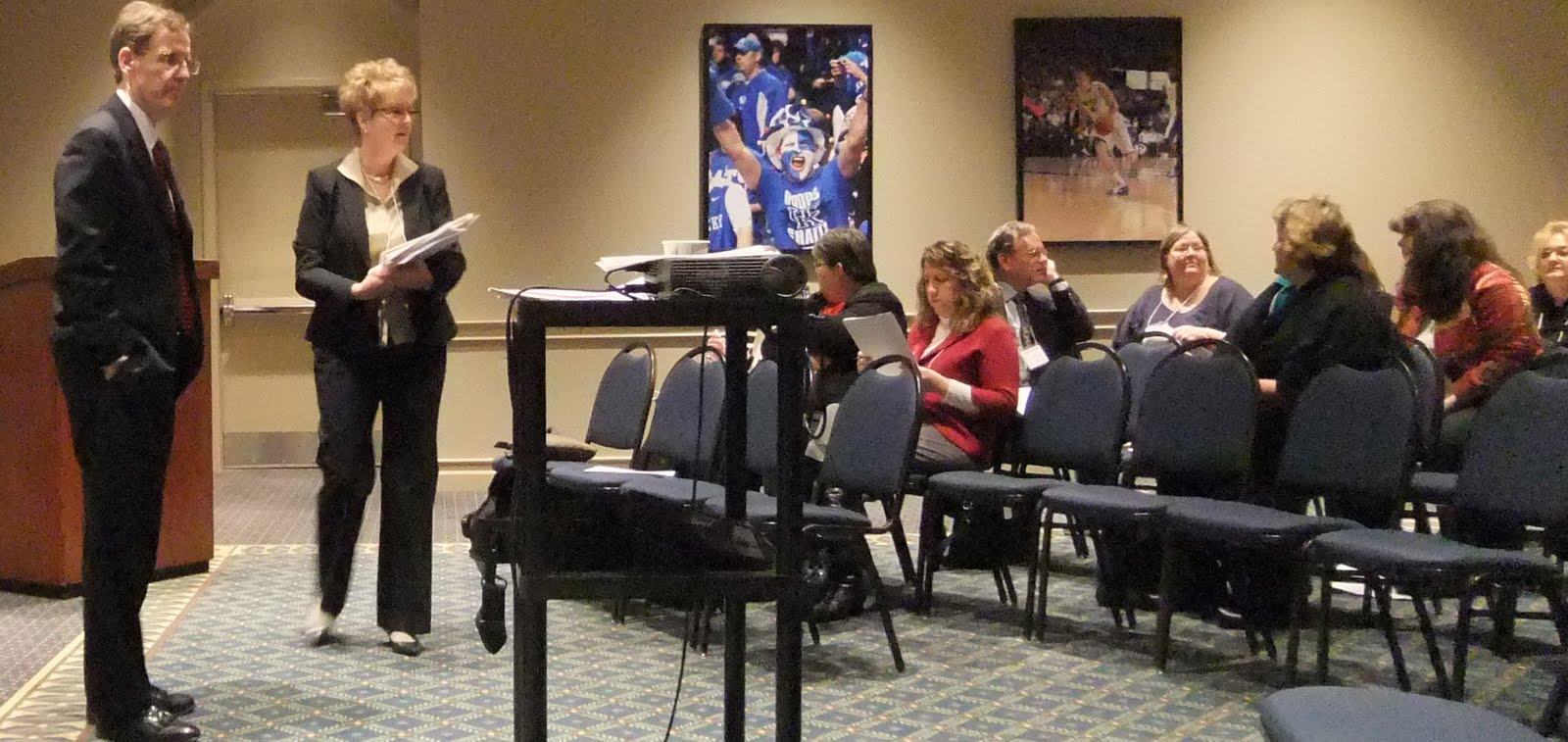
...and, an old secret revealed.
Last Saturday's memorial celebration of Bob Sexton's life was a moving tribute to an historic figure in Kentucky education. Surpassing his mentor, Ed Prichard, in terms of impact, Sexton stands with Bert Combs, and above all others, for his influence on modern schooling in the Commonwealth. His fingerprints were on every piece of school legislation that moved and other state leaders looked to him for guidance before committing to their own positions on educational issues. Opponents also wanted to know where Sexton stood on the issues of the day. He was the very definition of influential.

Saturday's tributes came from across the state and around the country. The beautiful fall afternoon at Transylvania University was marked by a mixture of smiles and tears. Laughter was frequently followed by an impenetrable lump in speakers' throats as they tried to express what Bob had meant to their lives, and our children.
I can't imagine any Kentucky-lover not being moved by the stories of Sexton's work and the enormity of the effort he undertook.
Sexton's story is all the more astounding since he didn't like school - despite being "one of those kids who got all the breaks because of who I was." Bob found high school boring and when he began his school reform advocacy, he couldn't see how it had changed much in far too many Kentucky classrooms. High quality teachers existed but they were too few and far between.
Too little was being asked of Kentucky students, Sexton believed. Disadvantaged and struggling students found too little support. Capable students were not being challenged. And since Sexton was not challenging himself at the time, he initially found himself underprepared for Yale.
Anecdotal evidence suggests that he did benefit from the social life, which he enjoyed. He quickly became a BMOC at the fledgling Waggoner High School rubbing shoulders with Seneca's young Mitch McConnel, with whom he worked on a few service projects. In those days, both boys were Republicans. Perhaps it was there that he began to learn his remarkable interpersonal skills.
Once Sexton's children entered the Fayette County schools in the late 70s he remained unimpressed. Students with learning difficulties, for example, found little support. But when he transferred one of his children to a private school for a better education he was disappointed. "They just didn't want him," Sexton said. "They didn’t know a hell of a lot in the public school, but at Sayre they knew zero."
Sexton's advocacy was born of twin interests in political movements and improving public education. But one of the most surprising lessons he learned was how painstakingly long and hard the work is.
MAKE THEM HEAR YOU
Scenes from a Celebration
of Bob Sexton's Life
This from H-L:
Robert F. Sexton was remembered Saturday for the several decades he spent lobbying for better schools for Kentucky children, sometimes in the face of public apathy and official hostility...Sexton, who died Aug. 26 at age 68, following a long battle with cancer, was executive director of the Prichard Committee for Academic Excellence and a leading force for education reform in Kentucky as well as nationally.
Several hundred people attended a memorial service for Sexton at Transylvania University's Mitchell Fine Arts Center. Leaders in academia, business, government, the arts and the news media lined up to speak about Sexton's legacy, as did his widow, Pam Sexton, and his five children. Gov. Steve Beshear and others sent videotaped tributes.
"Bob was trusted by all factions in the education community," said former Lexington Mayor Pam Miller, a past chairwoman of the Prichard Committee, an independent nonprofit group that pushes for continuing school improvements in Kentucky.
"He was frequently the only person who could assemble different powerful interests on an issue," Miller said. "Why? Because they could see his sincerity and his determination to move beyond pettiness toward the larger goal. He was not afraid to criticize and point out shortfalls, but he was never mean..."
 Bob's favorite - The Reel World String Band
 Few people have the will and courage to tackle problems that have become so entrenched as to become accepted. Few people have the intellectual honesty to examine a problem form all angles, down to its roots, unafraid to broach topics that others shy away from. And fewer still can communicate with passion, urgency, and zeal in language anyone can understand and move people to join together to help solve these problems. This is what Bob Sexton did with regard to education in the Commonwealth through the Prichard Committee for Academic Excellence.
---Reginald & Linda Thomas
 I recall with pride the alignment of the "stars" across the state
as the reform "train" began to move - the equity lawsuit
on behalf of the Council for Better Education;
the appeal to the Supreme Court; the expose' in Cheating our Children;
the outrage and "constructive dissatisfaction"
that was created across the Commonwealth.
And in the background, stirring the pot,
was Bob Sexton and the Prichard Committee.
--Lois Adams Rogers
 " The last time I talked to Bob, on the afternoon that he died,
he was in the hospital sneaking a call to me when the nurses had left him alone.
We talked for a few minutes and suddenly he said, 'I've gotta go.' Click.
He called back about 15 minutes later and said, 'OK, I can talk now.
Where were we?'"
--Cindi Heine

Bob was the one who scripted, directed and produced.
We were simply the characters.
--Lois Weinberg
 Bobisms: from the Prichard Staff
Be careful about what not to say.
Don't gather people just to see us and talk. Give them something to do.
Don't take the attacks personally.
The job got done didn't it. It doesn't matter who gets the credit.
Thank people for what they're going to do.
Think openly. Don't let emotions cloud your judgment.

This afternoon we share one thing in common.
At one point or another, to a small degree or large,
the life of Bob Sexton has been woven into our own in myriad ways...
In gathering together today, and in the days ahead, to tell stories,
sing songs, laugh at our humanity, ache over our mortality;
the depth of sorrow can subside to an awareness
of gratitude and an abiding trust in love's immortality;
in love's consecrating power.
---Rev Kelly Flood

Reading 1 Corinthians 13:1-13 (the same passage read during
Bob & Pam's wedding)and passages from Kahlil Gibran -
the children of Bob and Pam Sexton:
Rebecca, Robert, Ouita, Paige and Perry.
(Photo by Jason Sankovitch at H-L.)

(Bob Sexton's granddaughter, Willa Dru Michel, 6, played her violin
at his memorial service Saturday. Photo by Jason Sankovitch.)

Everett and Alicia Helm McCorvey

"Bob possessed, and I with him, an abiding faith in the goodness of people,
the richness of work done in the community,
and the creative and lasting effects of both.
I know that he believed and expected that all of us in this room,
and beyond, would continue to concern ourselves
with educating our children and grandchildren...
I am asking...that you do so.
And I think you from the bottom of my heart - and his -
for trying with us all these years and in the future.
Make them hear you."
--Pam Sexton

Rest assured that those of us involved with the Prichard Committee.
whether they be staff, board members, committee members, parents,
or financial supporters will continue to monitor public education closely,
identifying areas of concern, and advocate of improvement.
bob was relentless in pursuit of these goals. He would expect no less of us.
--Current Prichard Chair, Sam Corbett
"He talked to me, in our first meeting, about his love
for his home state, Kentucky. He was proud
and he was hopeful about what we were about to
venture into together on behalf of the children of the Commonwealth...
Tom Boysen, Bill Cody, Kevin Noland and Gene Wilhoit can attest
that over the last quarter of a century,
every single piece of education reform in Kentucky
had its influence from Bob Sexton."
---Gene Wilhoit

Bob's focus on results that matter
- real learning for Kentucky's kids -
should be a lesson to all of us who care
about leaving this country a better place."
--Vicki Phillips

"More than anyone else in America, he and his band of Kentucky citizens
exemplify Margaret Meade's adage about
the power of a small group of people to change the world.
Nor only did they bring about change in Kentucky,
but they inspired similar activists all over the country."
--Kati Haycock

Bob's roommates at Yale:
"We knew Bob in a little different context,
some of which we'll share
and some of which we won't..."
On Sexton's toughness and persistence:
"He simply would not give up.
And we saw this at Yale when he would continue to turn out for football
long after it was clear that he was not going to be one of the stars on the team.
When football didn't work, he then turned to rugby.
So, he was one tough, tough man."

"Invariably, I would call...and ask, 'Where is Bob on this issue?
Where is the Prichard Committee?' because that would help me calibrate
what a responsible position would be."
--David Atkisson, Ky Chamber of Commerce

[The press corps has been decimated.
There's no one on the education beat in Frankfort anymore.
The Herald-Leader and Courier-Journal cover education from the newsroom
and are increasingly focused on local schools.
Nobody has the time to stay up on the issues at the state and national level.]
"Bob Sexton was a crusading influential voice for schools.
When the media revolution sifts out content quality
will still be critical for democracy. We will need
champions of our children's future, like Bob.
And journalists who know how important it is to
listen, challenge, and report what they say."
--Al Smith

Many years ago, when KERA was first implemented,
many people were bent out of shape...
[Bob] called me one morning and asked me if I would go to a distant town.
And that's just what Bob would do. He'd ask you to do this
and then after you said 'Yes', he'd tell you what he wanted you to do.
The superintendent there had his foot on the neck of teachers
and the teachers were fighting back. The teachers
wanted the Prichard Committee to send an observer to the meeting.
I said, 'I'd be glad to go, Bob.' He said, 'Now, you're not going to be very welcome.
You have a license plate from out of county, and I want you to
park at the bottom of the hill and walk up to the school.'
And I said, 'Bob, will they shoot at me?'
And he said, 'Walk faster.'
--Elissa May-Plattner

"The low was in the late 80s when we we getting some momentum going and the Prichard Committee had no money to pay Bob or the part-time secretary." [Bob turned to consulting to keep the enterprise going.] "The high was in 1990" when the legislature passed and the governor signed KERA.
---Wade Mountz, Prichard Chair
and self-described conservative "with a big R after my name"
who Ed Prichard described as being 'of the other persuasion.'
"Never in 30 years did that divide come between us," Mountz said.

(L to R) Kati Haycock, Education Trust
Virginia Edwards, Education Week
Vicki Phillips, Bill & Melinda Gates Foundation

" Bob had 'IT' - that special something that sets a person apart from the crowd."
--Judith Clabes

While [many] argued that it was time for despair and disengagement,
Bob Sexton staked out the opposite claim,
marshaled his evidence and made his case.
He strengthened our shared institutions, expanded civic engagement,
and accomplished large things through democratic institutions.
He changed our state and inspired new effort across our nation,
at a time when many claimed such things were no longer in reach.
--Susan Perkins Weston at
the Prichard Blog"He was that rare public intellectual who actually loved people.
He knew that being an effective agent of change
requires more than statistics and righteous indignation."
--Phillip & Audrey Shepherd

"The Capitol will long miss Bob Sexton's brand of advocacy:
a supurb combination of skill, temperament, and knowledge.
He never lost his calm, but most importantly,
he never lost his compass."
--Ernesto Scorcone

"As Kentucky's first Education Commissioner from 1991 to 1995,
I came to understand how essential Bob Sexton was to the advent
of the Kentucky Education Reform Act and to its implementation and sustainability.
Working quietly on many fronts...and with disparate and sometimes
disputatious personalities and parties, Bob kept his head up and his vision strong.
His good will, civility, persistence and practical know how were inspirational."
---Thomas Boysen

(L to R) Mary Dean, Assoc Commish for Communications under Boysen
Kentucky's First Education Commissioner, Thomas Boysen
Vicki Phillips, Education Director, Bill & Melinda Gates Foundation
Kevin Noland, Oft-Interim Kentucky Education Commissioner and co-KERA author

"'Call Sexton.'
I wish I had a dollar for every time some variation of those words
was spoken in a Kentucky newsroom.
Journalists relied on Bob for several reasons:
He was smart. He was honest. He always called us back."
--Jamie Lucke, Herald-Leader editorial writer

(Photo by Jason Sankovitch at H-L.)
... and a mystery revealed.
I caught Lois Combs Weinberg after the celebration and asked her a question that has been on my mind for more than a decade; one of those little loose ends from earlier research on Kentucky school reform.
The Prichard Committee's signature strategy - the first big thing that launched the committee as a force to be reckoned with - was the 1984 Prichard Town Forum which I wrote about in
my dissertation. That telecast and the initial funding to kick-start Prichard came from an anonymous donation collected by Weinberg. Saturday, I asked her if she would reveal the donor's identity.
"I don't think there's any secret," Weinberg said. "He's passed on. It was
B F Reed."
Boyd F Reed was "
a self-made man who started out shovelling coal himself" and rose to become the largest coal operator in Floyd County by the 1960s, and Weinberg "was advised to go visit him."
That little chore was assigned by her father, Bert Combs. Reed was a friend of Combs who had an extra $50,000 laying around.
This means that, even before he agreed to become lead attorney for the Council for Better Education, Bert Combs was already laying the groundwork for what would become the grassroots movement that ultimately made KERA possible. Political scholars are in agreement. The conditions that existed in Kentucky at the time of KERA were unprecedented. The Supreme Court decision was one thing. But getting the legislature to move on reform legislation required what many have called a "perfect storm." Bert Combs and Bob Sexton were rainmakers.