As a public school administrator, I have been a steadfast critic of the legacy of No Child Left Behind. But I’ve recently figured out a way that school reformers can get me on their side. It’s very simple.
My concern has long been that the test-based focus of NCLB and the insistence on assigning labels to struggling schools has really been about convincing Americans that public schools are failing in order to justify privatizing the system — to the benefit, of course, of investors, not children. Why think anything else, when “higher standards” are accompanied by slashed education budgets, continuing inequities in school funding, and continued efforts to roll back public sector employee rights?
But reformers such as former Washington D.C. Schools chancellor Michelle Rhee and Sandy Kress — a lawyer who was a principal architect of the school accountability system in Texas (during the administration of then gov. George W. Bush) which served as the basis for NCLB — assure us that all their reforms are really about the children.
They repeatedly call on get teachers and administrators to quit making excuses and hold themselves accountable for the educational outcomes of poor and minority students. Who could be against that?
Well, I’m calling their bluff. Let’s see if it really is all about the children.
NCLB has done one important thing: By disaggregating data, it has forced teachers and administrators like me to agonize over the outcomes of our neediest students.
But after 10 years, it is clear that NCLB’s reforms haven’t spurred miracles, and it is time that the profound problem of inequality is addressed. The deck is stacked against kids who live in poverty not just because their schools are on average worse than others, but also because of the circumstances of their lives when they leave campus.
Itt’s time that we admit that it isn’t just teachers holding back poor and minority students back. The problems are societal.
So I’m calling on reformers — Kress and Rhee included — to lend support for a new kind of reform, one that steps outside the schoolhouse and shares the onus for achievement with more than just teachers.
I’m calling for data-driven equality, modeled on Kress’s work, expanding it to force greater societal changes that will help teachers bridge the achievement gap.
Let the 50 states disaggregate equality-related data by ethnicity, gender, and socioeconomic status, and let us rank the states and reward them for closing all the societal inequalities that are truly at the heart of our achievement gap. There should be an incentive for voters to elect lawmakers who will craft policies that minimize inequalities.
Let’s have national benchmarks for equality in incarceration, equality in college enrollment, equality in health coverage, equality in income levels, employment rates, rates of drug addiction and child abuse.
Let the states figure out how to close their gaps, but reward results. Citizens in states whose data shows progress toward equality benchmarks should be rewarded with a lower federal income tax rate.
Note that the states can figure out how to get there, so no one can accuse me of urging socialist fixes to inequality. I don’t care how you fix it, just fix it. As a teacher I am calling on society to do its part to save these kids! The kind of plan I am describing leaves mechanisms to the states — it merely incentivizes equality.
We should all insist that our leaders build a system that guarantees the demise of inequity on these shores. Let’s move together toward a broader social accountability, driven by data and gauged by progress toward statistical, measurable, social equality.
Here’s an incentive: As a state moves closer to demonstrable equality according to data, then Washington could reduce the federal income tax rates charged to citizens in that state. Let citizens who opt for equality in so doing opt for lower taxes and more individual liberties. Incentivize equality, and see if kids don’t do better in school.
Let’s publish the data in newspapers. Let’s label all 50 states once a year. Let the states stand on their records and compare their progress. Let’s ensure that no more American Dreams get deferred because of unequal opportunity.
Today some 22 percent of American children live in poverty. Are we going to pretend forever that it is acceptable to ignore the needs of children outside the schoolhouse and blame teachers and principals for everything that happens inside?
As soon as the data shows that the average black student has the same opportunity to live and learn and hope and dream in America as the average white student, and as soon as the data shows that the average poor kid drinks water just as clean and breathes air just as pure as the average rich kid, then educators like me will no longer cry foul when this society sends us children and says: Get them all over the same hurdle.
And so I as an educator now say to a nation exactly what it has said to me for years: No excuses! Just get results.
Disaggregating data forced me to pay attention to minority students. Let’s force society to agonize over equality like teachers now agonize over test scores!
Give me equal children, and I guarantee you that my fellow public school teachers and I will produce graduates who will create a brighter future for this nation than you or I ever dreamed possible.
Showing posts with label school reform. Show all posts
Showing posts with label school reform. Show all posts
Saturday, December 17, 2011
A superintendent calls school reformers’ bluff
This from John Kuhn, (the superintendent of a small public school district in Texas) The Answer Sheet:


Why Are the Rich So Interested in Public-School Reform?
They want to remake America's students in their own high-achieving image, but they're overlooking socioeconomics
This from Judith Warner in Time:
This from Judith Warner in Time:
It was perhaps inevitable that the political moment that has given birth to the Occupy movement, pitting Main Street against Wall Street and the 99% against the financial elite, would eventually succeed in making some chinks in the armor of the 1%’s favorite feel-good hobby: the school reform movement.
It’s been a good decade now that the direction of school reform has been greatly influenced by a number of highly effective Master (and Mistress) of the Universe types: men and women like Princeton grad Wendy Kopp, the founder of the Teach for America program, her husband, Harvard graduate Richard Barth, who heads up the charter school Knowledge Is Power Program, the hard-charging former D.C. schools chancellor (and Cornell and Harvard grad) Michelle Rhee and the many hedge fund founders who are now investing significant resources in the cause of expanding charter schools. Excoriating the state of America’s union-protected teaching profession and allegedly ossified education schools, they’ve prided themselves upon attracting “the best and the brightest” to the education reform cause, whether by luring recent top college graduates into challenging classrooms or by seducing Harvard Business School or McKinsey-trained numbers-crunchers away from Wall Street to newly lucrative executive positions in educationally themed social entrepreneurship.
The chief promise of their brand of reform — the results of which have been mixed, at best — seems to be that they can remake America’s students in their own high-achieving image. By evaluating all students according to the same sort of testable rubrics that, when aced, propelled the reformers into the Ivy League and beyond, society’s winners seem to believe they can inspire and guide society’s losers, inoculating them against failure with their own habits of success, and forever disproving the depressingly fatalistic ’70s-style liberal idea that things like poverty and poor health care and hunger and a chaotic family life can, indeed, condemn children to school failure.
And yet as schools scramble to keep up with these narrow demands, voices are emerging to suggest that perhaps the rubric-obsessed school reform game, as it’s been played in the Bush and Obama years and funded and dressed-up by the well-heeled Organization Kids, is itself perhaps due for a philosophical shake-up.
Earlier this year, S. Paul Reville, the Massachusetts Secretary of Education, blogged in Education Week that reformers need now to think beyond the numbers and “admit that closing achievement gaps is not as simple as adopting a set of standards, accountability and instructional improvement strategies.” In Massachusetts, he wrote, “We have set the nation’s highest standards, been tough on accountability and invested billions in building school capacity, yet we still see a very strong correlation between socioeconomic background and educational achievement and attainment. It is now clear that unless and until we make a more active effort to mitigate the impediments to learning that are commonly associated with poverty, we will still be faced with large numbers of children who are either unable to come to school or so distracted as not to be able to be attentive and supply effort when they get there.” Reville called for “wraparound services” that would allow schools to provide students with a “healthy platform” from which they could begin to work on learning...
Thursday, September 16, 2010
Tenuous Tenure
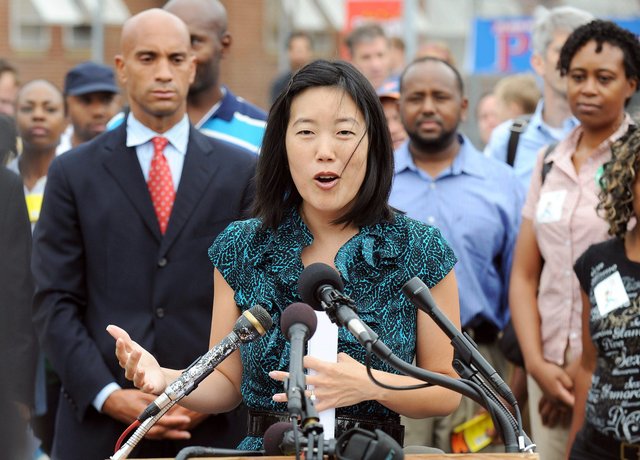
Those who track the political fortunes of school reform nationally have been watching the massive overhaul taking place in the Washington DC schools where dynamic chancellor Michelle Rhee has modeled the reformer's playbook. Her "go to" strategy mirrors that of an increasing number of superintendents these days - use student achievement data to measure teacher performance, and then, fire a bunch of teachers. Rhee was given her job by out-going mayor Adrian Fenty. If Rhee gets tossed out of the DC schools, what message, if any, will that send to similarly-minded superintendents?
This from the Washington Times:
Michelle A. Rhee wasn't on the ballot in Tuesday's primary, but the hard-charging D.C. schools chancellor - and the cause of overhauling one of the nation's most
troubled public school systems - took a major hit when the votes were counted.Ms. Rhee, whose efforts to shake up the city's school system generated national attention, was closely tied to defeated D.C. Mayor Adrian M. Fenty. Her drive to overhaul and streamline the school system - in the face of fierce opposition from the powerful teachers union - now has an uncertain future under presumptive mayor-to-be Vincent C. Gray, the current D.C. Council chairman.
Education reformers on the ballot in races in New York City also lost to candidates with financial and logistical support from teachers unions.
"The lesson here is that the unions are going to protect their own, but that doesn't mean you have to knuckle under to them," said Peter Murphy, policy director for the New York State Charter Schools Association, many of whose endorsed candidates in
New York City lost.
As he did throughout the campaign, Mr. Gray on Wednesday refused to say whether he would retain Ms. Rhee, who personally campaigned for Mr. Fenty in the primary's final weeks. He told reporters Wednesday that a decision on Ms. Rhee won't be made until "after we sit down," and he wants to hold the meeting "ASAP." ...Randi Weingarten, president of the American Federation of Teachers (ATF), congratulated Mr. Gray on his primary victory and pledged to "help ensure victory" for him in November. She didn't refer to Ms. Rhee, but praised Mr. Gray for his "willingness to listen and engage" and get everyone "rowing in the same direction."
Ms. Rhee generally has been at odds with the ATF's local, the Washington Teachers' Union, since she became chancellor in June 2007. The union spent heavily in support of the Gray campaign...
School reformers and education analysts said the Washington mayoral vote was not the only outcome that could alter the national debate over reform Tuesday night. In New York, several races turned on a battle between union interests and school reformers.
In Harlem/Upper West Side, Brooklyn and Queens, union-backed state Sens. Bill Perkins, Velmanette Montgomery and Shirley Huntley soundly defeated reform-backed opponents.
But two New York state assemblymen - Jonathan Bing of Upper Manhattan and Sam Hoyt of Buffalo - won their races, even though they had bucked education unions on reform issues.
In Baltimore, political newcomer and teacher Bill Ferguson, an aide to city schools chief executive Andres Alonso, unseated a veteran Democratic incumbent, said Joe Williams, executive director of Democrats for Education Reform...
Wednesday, July 14, 2010
Ky. education cuts undermine gains
 This from Bob Sexton in the Enquirer:
The recently enacted state budget is another step backward for Kentucky kids. And it comes at a particularly bad time - just when the state is poised to move student achievement to the next level and help lead the nation on the most important education reforms in a generation.
Our ranking on key indicators of progress has moved from the cellar (43rd in 1992) to closer to the middle (32nd in 2009), according to an index compiled by the Kentucky Long-Term Policy Research Center. Kentucky students scored above the national average in science, reading and fourth-grade math on the most recent National Assessment of Educational Progress.
Kentucky legislation enacted in 2009 requiring new, tougher academic standards positioned Kentucky to be the first state to commit to common standards developed by a consortium of 48 states. This summer, Kentucky educators are working to move those higher standards into classroom use, and new statewide tests will be administered in 2012 to reflect the changes.In short, we're setting higher expectations and giving educators more to do, but our schools have fewer resources to work with.
Two cuts deserve special mention. First, cuts in professional development come at the very moment we are asking teachers to master new standards and develop more effective ways to teach them in the classroom. We say, "Learn more, do more," but then we strip away most of the funding to help teachers do that.
Second, the 2012 budget will eliminate all funding for highly skilled educators - people of great talent and expertise who help the state turn around Kentucky's weakest schools. Education Commissioner Terry Holliday had hoped to use these funds to deploy people to help build local capacity to ensure classroom success with the new standards. Instead, the new budget includes bad cuts to the funding we need to implement some very good reforms.
As direct funding to help kids learn is cut, one big thing is still growing - health insurance costs. These show up in the direct cost of employee health insurance, the health-driven share of current retirement premiums, and the state's continuing obligation to pay back the retirement system for the legislature's past borrowing. From 2009 to 2012, those benefit costs will increase by $138 million. Meanwhile everything else the state spends on P-12 education goes down by $107 million.
Clearly, the recession and an outdated revenue system are not the only things undermining Kentucky's ability to do what it needs to do in education. Indeed, the unsustainable growth in health insurance costs could be the worst revenue problem we have.
Kentucky's governor and legislators must do two things if we are to stop eating our seed corn.They must reform our antiquated tax system so state education revenue can keep up with economic growth. And they must get control of spiraling health insurance costs while ensuring that teachers and other public employees receive fair and sustainable benefits. None of this will be easy.
We need more thinking - and action - to meet our obligations to Kentucky's school children and to the future of our commonwealth.
Monday, December 01, 2008
Lessons From 40 Years of Education 'Reform'
 Here's a big government solution to the problems of education reform from former IBM CEO Louis V. Gerstner Jr. He seems to worry that following significant reform efforts the relative performance of American students hasn't performed any better than IBM stock.
His solution?
Dismantle local School autonomy and establish national standards.
National standards can be created quickly from existing national and international programs.
Pay for it by consolidating school governance. He says,
"This is a complex problem, but countless experiments and analyses have clearly indicated we need to do four straightforward things to bring fundamental changes to K-12 education:This from the Wall Street Journal:
1) Set high academic standards for all of our kids, supported by a rigorous curriculum.
2) Greatly improve the quality of teaching in our classrooms, supported by substantially higher compensation for our best teachers.
3) Measure student and teacher performance on a systematic basis, supported by tests and assessments.
4) Increase "time on task" for all students; this means more time in school each day, and a longer school year."
Let's abolish local school districts
and finally adopt national standards
While the economic news has most Americans in a state of near depression, hope abounds today that the country may use the current economic crisis as leverage to address some longstanding problems. Nowhere is that prospect for progress more worthy than the crisis in our public education system.So, from someone who realized rather glumly last week that he has been working at school reform for 40 years, here is a prescription for leadership from the Obama administration.We must start with the recognition that, despite decade after decade of reform efforts, our public K-12 schools have not improved. We can point to individual schools and some entire districts that have advanced, but the system as a whole is still failing. High school and college graduation rates, test scores, the number of graduates majoring in science and engineering all are flat or down over the past two decades.Disappointingly, the relative performance of our students has suffered compared to those of other nations. As a former CEO, I am worried about what this will mean for our future workforce.It is most crucial for our political leaders to ask why we are at this point -- why after millions of pages, in thousands of reports, from hundreds of commissions and task forces, financed by billions of dollars, have we failed to achieve any significant progress? ...
Wednesday, March 05, 2008
Overhauling Education Reform in Kentucky
 This from Pat Crowley at the Cincinnati Enquirer:
School reform on tapDraud plans task forceon overhaul of testingFRANKFORT - Kentucky Education Commissioner Jon Draud said Tuesday that he plans to form a task force to study overhauling public school testing and might expand the effort to include the state's landmark education reform act.
Draud, a former state lawmaker from Edgewood, made the comments after appearing before the Senate Education Committee. The panel is considering but failed to act on legislation that would replace the Commonwealth Accountability Testing System, or CATS, the testing component of the 18-year-old Kentucky Education Reform Act known as KERA.
Draud said it appears that the bill is stalled and will not come up for a vote because of strong disagreements among committee members.
"The plans are for the Kentucky Department of Education to create a task force to look at all the issues with assessment and accountability, and maybe look at the total issue of school reform," Draud said.
"It's obvious with Senate Bill 1 that there is still a lot of disagreement among Republicans and Democrats on the assessment and accountability, and there is a lot of disagreement in the field with teachers and administrators that aren't comfortable with certain parts of our CATS system," he said.
Draud said his goal is to "look at those issues and get the interested parties involved." "Teachers, administrators, key legislators, people like that," he said."We don't want to have any new assessment system without having, particularly, teachers and administrators involved in the process."
Draud said he will likely form the task force "after the General Assembly gets out of town" in mid-April. The panel would study the testing system and make recommendations to legislators and the Department of Education. It could also take a look at potential changes to KERA, which was last changed in 1997.
"I think something needs to be done," Draud said, adding that many educators are unhappy with the writing portfolios that are part of the reform package.
But, knowing how Frankfort operates from his decade as a legislator, Draud also realizes that winning support in the legislature for change will be difficult.
"We still don't have consensus from Republicans and Democrats on a lot of issues," he said. "I tried to point out (to the Senate Education Committee) that this should be a nonpartisan issue, trying to move education forward in this state.
"If there isn't common ground," Draud warned, "it is going to be detrimental to the state. That's the reason to create this task force; to try to find that common ground."
And from Raviya Ismail at the Herald-Leader:
Testy exchange marks hearing on CATS change
FRANKFORT --Sen. David Williams, R-Burkesville, admonished the state secretary
of education Tuesday for telling a committee that she would come to testify about important legislation only if invited to do so.
Then, Williams apparently tried to pick a fight.
"I respect the prerogative of this body to set its own agenda and to invite the people that it would care to have participate in the process," Mountjoy began. She said she has spoken before the legislature for 15 years "and I don't think I've ever come without a specific invitation to present to you."
Williams interrupted the testimony: "Are you taking a slam at the committee?"
Huh?
Tuesday, April 03, 2007
Kentucky's Whirlwind Campaign, 1907. Is history repeating itself?
On February 13th, Franklin County Circuit Court Judge Thomas Wingate issued an order granting summary judgment to the legislative defendants in the school funding case, Young v. Williams. With that order the push for adequate funding of Kentucky's public schools was derailed. Getting the train back on track will require more educators to express (again) the courage of their convictions. But ultimate success will require even more support. It will require broad public outcry.
This has happened twice before in Kentucky's history. At the turn of the last century, public support for school reform flared...and within a decade, died out.
More recently, The Prichard Committee's 1984 Town Forum on KET helped launch the current reform effort. Now again, 17 years after enactment of the Kentucky Education Reform Act - has the flame died yet again?
John Grant Crabbe was elected Superintendent of Public Instruction in 1907. He brought to office an active imagination and boundless energy. In that year well over half of the school aged children were not enrolled in school. Only 311,192 or approximately 42% of the students enrolled were said to have maintained a satisfactory average daily attendance. In the first decade of the twentieth century, illiteracy in Kentucky was the highest in the southern states. Crabbe declared that the Kentucky school system was still beset with the deficiencies of the previous century.[1]
To underscore his observations and generate grassroots support for better schools, Superintendent Crabbe stumped statewide in what he called The Whirlwind Campaign. He called upon the Kentucky Confederation of Women’s Clubs, the Kentucky Commission for Improvement of Education and the teachers’ associations to visit every community in the state. The Press was a willing supporter of the movement.[2] “The campaign was a continuous cyclone bombardment against illiteracy and ignorance, for a period of nine days... Twenty nine speakers...[delivered] nearly three hundred public set addresses...The entire state was covered and every county was visited...”[3]
The campaign had the desired effect of publicizing and popularizing the need for improved schools. Crabbe called for an educational commission to make a thorough investigation of the school system. The commission was to make a report to the General Assembly including such suggestions, recommendations, revisions, corrections, and amendments, as its members deemed necessary.[4]
The General Assembly responded by passing the Sullivan Bill, more commonly known as the County School District law. The new law called for the establishment of a high school in every county, changed the name of Kentucky State College to Kentucky State University, increased collegiate appropriations, provided funds to normal schools to enhance teacher preparation, established a State Education Commission and charged it with the responsibility to make a report on the schools, instituted compulsory attendance for children in cities of the fourth class and larger, and passed a child labor law.[5]
The educational commission began a thorough study of the education laws of Kentucky and those of other states. The school laws already in force were rewritten, rearranged, codified and became the new school code. After consultation and deliberation with educational leaders, a code was outlined that covered the whole common school system of the state. This code was submitted to the General Assembly of 1910 as the report of the commission.[6]
The principal recommendations in the report were: (a) the ex-officio, three- member State Board of Education should be supplanted by a seven-member State Board of Education, consisting of the state Superintendent of Public Instruction and six experienced educators; (b) the powers and duties of the State Board of Education and the Superintendent of Public Instruction should be extended; (c) the examination of applicants for certificates and the grading of papers should be under the direction of the State Board of Education; (d) provisions should be made for the certification of high school teachers on the basis of training and for the issuance of certificates in special fields; (e) the powers and duties of the county Superintendent should be increased; and (f) institute instructors should be licensed.
Historian James Klotter, summarized Kentucky’s efforts in the early 1900s. “In 1900, Kentucky stood fourth in the South in per capita income devoted to education, and had the only compulsory education law in the South. The 1908 legislature required every county to establish a high school, strengthened attendance rules, and poured more money into the newly created teacher training colleges at Bowling Green (now Western Kentucky University) and Richmond (now Eastern Kentucky University). Legislators and education advocates launched a statewide campaign in support of education, and bright days seemed to lie ahead. But it was a false light that soon dimmed. Funding did not continue at an adequate level, and as Kentucky ambled toward education reform, other states ran ahead. By 1920, Kentucky's ranking had fallen from fourth to eleventh. The cost of this lack of progress was incalculable because it drove many of the best and brightest students and teachers out of the state.”
[1] Thomas D. Clark, in James C. Klotter, ed. Our Kentucky: A Study of the Bluegrass State (Lexington: University Press of Kentucky, 1992), 286.
[2] Thomas D. Clark, A History of Kentucky (Ashland, Kentucky: The Jesse Stuart Foundation, 1988), 367.
[3] Barksdale Hamlett, History of Education in Kentucky (Frankfort: Kentucky Department of Education, 1914), 200.
[4] Sessions Act 1908, Chapter 65, 171.
[5] Barksdale Hamlett, History of Education in Kentucky (Frankfort: Kentucky Department of Education, 1914), 205.
[6] Moses Edward Ligon, A History of Public Education in Kentucky (Bulletin of the Bureau of School Services, XIV no. 4, 1942.)
Subscribe to:
Posts (Atom)