Showing posts with label John McCain. Show all posts

Monday, November 10, 2008

K-12 issues will await president

This from Ed Week by way of KSBA:

Victor faces NCLB rewrite, but economy claims priority
At the end of a presidential campaign in which education received some attention but never emerged as a top-tier issue, analysts were trying to look beyond this week’s election to the K-12 issues awaiting the next president and gauge where they might fit as a new administration prepares to grapple with a global economic crisis.

“There can be a case to be made that education becomes the vehicle that helps fuel the economy,” said MaryEllen McGuire, the director of the education policy program of the New America Foundation, a Washington think tank. “Education is the building block, and we can’t lose sight of that now.”

And while education never registered high in surveys assessing the issues that would sway voters in the 2008 election, the American public wants the country’s schools to improve and would rally around a president who set out to help them do so, one pollster said.

“Education is an issue that people want everybody focused on,” said David Winston, the president of the Winston Group, a Washington polling firm that works for Republican candidates. “They see it as critical for the future of the country.”

But others suggest that education’s low standing as an issue in the latest election cycle foreshadows four years in which the next president won’t make it a high priority.

“It probably continues to be a back-burner issue as we deal with the bigger, more pressing things,” said Gary M. Huggins, the director of the Commission on No Child Left Behind, a bipartisan group of policymakers and educators formed by the Aspen Institute that has recommended changes to the nearly 7-year-old No Child Left Behind Act.

The Missing Issue

Whether education will rise to prominence in the next administration remains to be seen. But it’s clear that it never became a top concern of this year’s voters.

In a poll of 1,101 registered voters by The Washington Post, just 1 percent said “education” when asked: “What is the single most important issue in your choice for president?”

Fifty-three percent answered “economy/jobs”—not surprisingly, given the turmoil in U.S. and foreign financial markets and ominous signs of an economic downturn. No other issue was cited by even 10 percent of respondents to the telephone survey, which was conducted Oct. 8-11 and had a margin of error of plus or minus 3 percentage points.

If nothing else, though, the new president and the 111th Congress will work to decide the future of the NCLB law. The law, which is generally seen as one of President Bush’s biggest domestic accomplishments, was scheduled to be reauthorized in 2007, but the current Congress never got very far on a bill to amend and renew the law. (“Final NCLB Rules Require Uniform Graduation Rates”...)

“It’s the one thing that the next president will definitely have to respond to,” said Joseph P. Viteritti, a professor of public policy at Hunter College in New York City.

The law requires states to set goals for student proficiency in reading and mathematics and hold schools accountable for meeting them by the end of the 2013-14 school year.

Neither Sen. John McCain, the Republican nominee, nor Sen. Barack Obama, the Democratic nominee, gave a detailed outline of how he would change many of the law’s most criticized requirements. For example, both candidates said they wanted to shift the law’s emphasis from identifying low-performing schools to rewarding high-performing ones. But neither said specifically how he would propose to make that happen.

One reason both candidates were vague on the future of the law is that factions within their political parties disagree on some of the law’s important elements, said Mr. Viteritti, who made his comments at a panel discussion on Oct. 21 at Teachers College, Columbia University, in New York City.
The panel, moderated by Education Week, followed a debate between education advisers to the McCain and Obama campaigns that was hosted by Teachers College and webcast by edweek.org.

The next president and Congress will need to make significant decisions about the future of the law, Mr. Viteritti and several others said. One of them is how to increase the rigor of states’ academic standards, or even establish a process for setting national standards.

Although education hasn’t been at the front of voters’ minds in 2008, the public considers setting standards an important ingredient in efforts to improve the quality of schools, said Mr. Winston, the pollster.

“They want standards,” he said. “If the states are not going to step up to the plate, maybe there will be support for national standards.”

Congress may take the lead on efforts to decide the future of standards and other important issues facing the NCLB law, said Lorraine McDonnell, a professor of political science at the University of California, Santa Barbara, who studies the politics of education.

“The new president will have so many other things on his plate that it will essentially be a congressionally led effort,” she predicted.

Economy Tops Agenda

The next president will almost certainly give most of his early attention to jump-starting the economy and managing the recent $700 billion federal assistance plan for the financial sector.

Spending on the rescue package is likely to restrict the amount of money available for federal K-12 programs, Ms. McDonnell said.

“The big question is whether, in the short run, education … can expect any additional appropriations,” she said. “I would guess not.”

That could force difficult choices for states and local communities, which furnish the vast majority of funding for education, said David Shreve, the federal-affairs counsel for education at the Denver-based National Conference of State Legislatures.

States will be looking to the federal government, which provides roughly 8 percent of total K-12 school spending, as a stable funding stream.

“I can’t imagine where they’re going to come up with the money,” Mr. Shreve said of the federal government. “I think their hands may be tied.”

That may even be the case for programs, such as special education, that both major-party tickets identified for increases in funding.

In the last days of the campaign, Alaska Gov. Sarah Palin, the Republican vice presidential nominee, proposed “fully funding” the Individuals with Disabilities Education Act. Sen. Obama pledged to do so as well.

Under the 2004 renewal of the idea, the federal government is authorized to cover up to 40 percent of the states’ excess special education costs, based on the national average per-pupil expenditure. That 40 percent is what is considered “full funding.”

But annual federal appropriations have fallen far short of that goal. In fiscal 2008, which ended Sept. 30, the federal government covered 17 percent of such costs.

While the incoming president and the new Congress may support the principle of full funding for the law, even strong advocates for the idea don’t expect them to have the money to keep those promises.

“I just don’t think the money is going to be available,” said Nancy Reder, the deputy executive director of governmental relations of the National Association of State Directors of Special Education, based in Alexandria, Va.

“All the money is being pumped into the war in Iraq and the economic crisis,” she said.

Possible Opening

But Ms. McGuire of the New America Foundation said that the new president could make the argument that education is the vital ingredient of economic competitiveness.

“If we had leadership making the case,” she said, “I think people will be more receptive for that.”
In the second presidential debate, on Oct. 7, Sen. Obama hinted he would tie education to economic concerns if he were elected president. In answering moderator Tom Brokaw’s question about choosing among health care, entitlement reform, and development of new energy sources as the top issue to pursue, the Democrat mentioned health care and energy, and added that he would address education, too.

“We’ve got to deal with education so that our young people are competitive in a global economy,” Sen. Obama said.

Mr. Winston said polling suggests that Americans would be receptive to such a message, even if they weren’t casting their votes based on Sen. McCain’s and Sen. Obama’s education platforms.

“There’s not a decreasing concern about education in our country,” the pollster said.

“There’s going to be a focused discussion in the post-Bush environment,” he added, “about what’s next” for the No Child Left Behind law and the overall federal role in education.

A Young Voter Schools his Father

Fathers and Sons: The love; the expectations; the independence. We rear our sons to not need us anymore - to become fully functioning and independent people who make their own choices and live with the consequences of their decisions. Tough love in a tough world.

But we never quit being our father's sons. And that matters deeply.

(I have half-jokingly told friends and KSN&C readers that if I were to start a political party in America it would be the Radical Moderate Party. It would insist upon equality for all citizens but would generally reject extremism from the far right as well as the far left. It would court the middle 60 percent of Americans who see both sides of issues. I think Andrew might make a fine charter member.)

This from journalism and economics senior Andrew Waldner in the Kentucky Kernel.

An open letter to my father:
You’ll take your own advice some day
Dear Dad,­

I know you find my Democratic ideas silly and immature. You always say, “One day you’ll be a Republican, just wait and see.” But I don’t think you understand. I don’t think you understand my beliefs and I don’t think you understand the actualities of your own party.

You think the GOP is something that it’s not. It is not, as you think, the party for free-market ideals and do-it-yourself energy. It used to be, but it isn’t anymore. They’ve abandoned that creed for another: Fear. They incite fear in the electorate using social, “family” issues and ride that wave to power. It’s a wonderful short-term strategy and it worked extremely well for a while. It kept them in power for nearly two decades, all under the watchful eyes of people like Karl Rove.

I’m an economics major, so I know how the free market works. I believe in its ability to regulate itself and run efficiently, the recent credit crisis notwithstanding. I believe that if you lower taxes, you can spur consumer spending and investing and improve the economy. These are all historically conservative and/or Republican ideas, but they’ve been put on the backburner.

They haven’t been on the agenda for the last two decades.Today’s Republican “base” is predominantly white, lower-class and socially conservative. As exit polls are showing, the Republicans have slimmed down this base and are now losing nearly all demographics outside of these people. In the latest election, they only won 3 percent of blacks and 30 percent of Hispanics. They lost every single age group except voters over 65. How’s that for a super-majority, Rove?

Rove and his ilk took advantage of the basic fears of these poor, uneducated Southern and Midwestern voters and spun it into getting George W. Bush elected twice. Politically, it was a genius move. Realistically, it was a short-term solution that created a long-term problem. This strategy further marginalized their base and made people like myself, socially liberal and educated upper-middle class whites, even more scared of the goals of the party. Their views on immigration, related to this idea of fearing all “foreigners,” probably cost them just as many votes with other
demographics.

The GOP isn’t the free-market, small-government party it was supposed to be. It’s now, both in practice and how it’s viewed, the anti-abortion, anti-gay marriage and anti-anything not born in America party that focuses on little else. There are good conservatives who have similar views; the Andrew Sullivans, the David Frums, my own father; but they aren’t the ones in power.

The doomed campaign of John McCain is a perfect example. Here you have a moderate Republican who stands for everything good about the GOP and actually appeals to those moderates that you need to win an election. And yet, over the course of the last few years and during his campaign, in an effort to appeal to that base, he’s had to compromise his own beliefs.

Nothing shows this more than the choice of Sarah Palin. I won’t get into attacking her ignorance or “diva” tendencies, because it’s irrelevant. The important thing is that she’s nothing like McCain. He’s a relatively non-religious moderate and he’s forced to choose a hyper-religious neo-con as his vice presidential candidate. I don’t buy the arguments that she ruined his chances. In fact, I think she gave him the only chance he ever had at winning. Joe Lieberman or someone else would’ve just turned off the base and handed Barack Obama the presidency.

But, to moderates and liberals, she represents everything that’s wrong with the party. She has little policy knowledge and doesn’t seem interested in learning, she just wants to thrust her family and moral values on the rest of the country; real policy and issues be damned. Just like Bush, she seems to be an empty vessel that fundamentalist forces can work through to keep their belief systems in power. Rather than work to make the country better for its citizens in realistic ways, they want to control and remake their citizens into their ideal, “true” Americans.

So sorry Dad, but I can’t bring myself to join such a party. This GOP that basically ignores real issues like health care, taxation and the security of our nation just to wage an ideological holy war against Democrats and the rest of the world isn’t something I want to be a part of. The Democrats aren’t perfect. I don’t buy into some of their economic proposals, Nancy Pelosi is an evil succubus and they have their own nutty members to deal with. However, they’ve been smart and have begun to move towards the center away from their crazier tendencies. They also haven’t played into the most basic, religious fears of some of the poorest, least-educated people in our country just to keep in power.

If you haven’t guessed by now, I’m not saying that you or anyone that thinks like you is evil.

Being conservative is and should stand for the belief that people make their lives and fortunes on their own hard work, that we should carefully and skeptically embrace change and that the government shouldn’t give handouts. It shouldn’t mean controlling people’s lives, marriages, bodies and who knows what else. So if you’re a true conservative, defend yourself and take back your party. If you’re a fundamentalist Christian, that’s fine too, just remember that “fundamentalist” does not equal “conservative,” it’s something entirely different.

So for now, unless something big happens, I’ll continue to be a moderate Democrat and be happy with it. On a side note, I voted for Obama and would have done so wholeheartedly whether a registered Republican or Democrat, and I couldn’t be more thrilled that he won.

Someday, hopefully, the GOP will sort itself out and become the party of Abraham Lincoln and Ronald Reagan again; not the party of Bush and Rove. Until then, I cannot, in good conscience, be part of the Republican Party.

So don’t worry Dad, I believe in you. Someday you’ll be a Democrat, just wait and see.

Wednesday, November 05, 2008

Predicting Obama

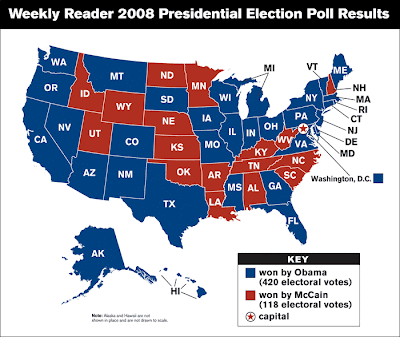
In response to the recent Weekly Reader poll (and children's ability to reflect their parents' attitudes and therefore predict their presidential preferences) I tried my hand at electoral prognosticating, and feel pretty good about the effort.

I said, "If my math and my crystal ball are correct - I see it closer to 352 for Obama, and 186 for McCain."

As it stands this morning President-elect Barack Obama has 349 electoral votes with Missouri and North Carolina not settled. If a recanvas confirms the current vote Obama will take North Carolina (2,101,986 to 2,089,826) and John McCain will take Missouri (1,442,577 to 1,436,724).

If that holds true, it'll be 364 for Obama and 173 for McCain.

Over all I made two bad calls and one particularly good one. I thought North Carolina and Missouri would each go the opposite way. But, I did see Indiana trending blue.

So congratulations to Barack Obama and to America for this historic result. Obama will need our support to clean up the current mess in Washington and get the economy working again.

And finally, in his concession speech, we got a glimpse of the real John McCain - the guy I thought we'd see during the campaign. The straight shooter who was attractive to moderates - gracious and classy in defeat.

Thank you. Thank you, my friends. Thank you for coming here on this beautiful Arizona evening.

My friends, we have — we have come to the end of a long journey. The American people have spoken, and they have spoken clearly.

A little while ago, I had the honor of calling Senator Barack Obama to congratulate him.

(BOOING)

Please.

To congratulate him on being elected the next president of the country that we both love.

In a contest as long and difficult as this campaign has been, his success alone commands my respect for his ability and perseverance. But that he managed to do so by inspiring the hopes of so many millions of Americans who had once wrongly believed that they had little at stake or little influence in the election of an American president is something I deeply admire and commend him for achieving.

This is an historic election, and I recognize the special significance it has for African-Americans and for the special pride that must be theirs tonight.

I've always believed that America offers opportunities to all who have the industry and will to seize it. Senator Obama believes that, too.

But we both recognize that, though we have come a long way from the old injustices that once stained our nation's reputation and denied some Americans the full blessings of American citizenship, the memory of them still had the power to wound.

A century ago, President Theodore Roosevelt's invitation of Booker T. Washington to dine at the White House was taken as an outrage in many quarters.

America today is a world away from the cruel and frightful bigotry of that time. There is no better evidence of this than the election of an African-American to the presidency of the United States.

Let there be no reason now ... Let there be no reason now for any American to fail to cherish their citizenship in this, the greatest nation on Earth...

Saturday, November 01, 2008

Shirely Nagel: Sounds like Witch

No Candy For the Children of Obama Supporters

This from WJBK-TV, FoxNews 2 Detroit:


This from the Detroit Free Press:

A Grosse Pointe Farms woman has doled out political tricks by refusing Halloween treats to children whose parents support Democratic presidential candidate Barack Obama.

Shirley Nagel passed out candy Friday — but only to those who shared her support for Republican presidential candidate John McCain and running mate Sarah Palin.

Fox 2 News says a sign posted outside Nagel's house, about 12 miles west of Detroit, served notice to all trick-or-treaters. It read: "No handouts for Obama supporters, liars, tricksters or kids of supporters."

Nagel tells WJBK-TV that "Obama's scary." When asked about children who'd been turned away empty-handed and crying, she said: "Oh well. Everybody has a choice."

Friday, October 31, 2008

Political Experts see Obama Landslide

Now call me crazy, but it is my studied opinion that children reflect their parent's attitudes very well. And the younger they are, the more accurately they reflect those attitudes. Pretty obvious really.

Therefore, when asked to vote in mock elections, their votes tend to run along the lines of their parents. They may not know why, but they almost always know who.

Students are very accurate with local elections, and prettty accurate with state elections, but one should remember - many voters do not have children in school.

This from the Hartford Courant:

As Kids See It, A Landslide Win For Obama

WASHINGTON — - The nation's children seem to be pulling for Sen. Barack Obama.

The Weekly Reader survey of U.S. students has correctly predicted the outcome in 12 of the last 13 presidential elections, and this time more than 125,000 participants — from kindergarten age to high school seniors — gave it to Obama with 54.7 percent of the vote. Sen. John McCain received 42.9 percent, and the "other" category pulled in 2.5 percent.

More significantly, Obama won 33 states and Washington, D.C. — a massive Electoral College victory."The kids have spoken," said Clara Colbert, a senior managing editor at Weekly Reader....
Obama won every grade level except high school Juniors, where McCain eeked out a narrow margin.

The survey has been conducted since 1956, with the only faulty prediction coming in 1992, when Bill Clinton defeated the first President Bush. (The ballot that year didn't include popular third candidate Ross Perot, who pulled votes from Bush in the general election.)

"Who says today's kids aren't smart?" said Tobe Berkovitz, associate dean of the communications college at Boston University. "Probably the 54 [percent] is going to be pretty accurate. These kids must be living on the blogs," he said, laughing. "Art Linkletter's thing was: 'Kids say the darndest things.'

In this case: Kids might be the darndest pundits."

For the Democratic Party, the kids' electoral college map has some surprises that are too good to be true - really. I mean, they're not likely to be true.

I doubt McCain will lose Mississippi, Texas, Arizona or Georgia, althought Georgia (and Arizona for that matter) seems close. Arkansas and Oklahoma? No way.

On the other hand, the students say Obama will lose Minnesota and New Hampshire. Sorry kids.

They say Virginia will go for Obama and North Carolina will go to McCain - and they're right.

If my math and my crystal ball are correct - I see it closer to 352 for Obama and 186 for McCain.

Wealth

Walt Handelsman at Newsday.

Tuesday, October 28, 2008

Charters Gaining "Big Mo"

This from This Week in Education:

Here's an image from an ad that the National Alliance of Public Charter Schools is running in 5 states including Ohio:

More and more education outfits are getting into the the political game, it seems -- not just EDIN08 and DFER and the unions. That's good thing, I'd argue, for people who want education taken seriously.

As KSN&C readers may know, I'm conflicted about Charter Schools. As a principal, and looking out for the interests of one school only, I tried to get permission to turn my elementary school nto the state's first charter - and failed. But looking at the state as a whole, it's hard for me to see how charters won't be disequalizing, and thus, unconstitutional.

But alas, nationally charters do seem to be gaining some momentum. And, Kentucky can't resist federal dollars.


Saturday, October 25, 2008

Palin Promises Choice for Disabled Students

This from the New York Times, photo by Kate Zernike:

ST. LOUIS — In her first policy speech of the presidential campaign, Gov. Sarah Palin vowed Friday that a McCain administration would allow all special-needs students the choice of attending private schools at public expense, a controversial and potentially costly proposal likely to be welcomed by many parents and bitterly opposed by many school districts.

Ms. Palin, the Republican nominee for vice president, also promised that she and Senator John McCain would finally provide public schools the federal money that was promised when the law covering students with special needs was passed in 1975. Her pledge was intended to address the top concern of many school districts, and is one that has been made by many other politicians but never fulfilled...

Wednesday, October 22, 2008

Presidential Education Advisers Go Head-to-Head in Live Debate

This from the Principal's Policy Blog:

During a recent debate at Columbia University, the chief education advisers to the presidential nominees went head-to-head on the issue of education, putting to rest some of the ambiguity expressed by both candidates during a race that has been marked by a clear lack of priority on the topic of education.

The debate featured Linda Darling-Hammond, education adviser to Democratic presidential nominee Sen. Barack Obama, and Lisa Graham Keegan, chief education adviser to Republican nominee Sen. John McCain, and was webcast live on www.edweek.org with support from NASSP...

  • On federal funding, the advisers lambasted each other on the opposing candidate’s fiscal plans
  • When it comes to No Child Left Behind (NCLB), the saga continues as neither adviser provided concrete examples of how their candidate would change the law if elected.
  • Sen. Obama is a strong supporter of using career ladders as an incentive for teachers, Darling-Hammond said. Keegan, on the other hand, does not see how career ladders will effectively motivate teachers.
  • Both candidates support charter schools, yet vouchers prove to be an entirely different animal among the campaigns.

Tuesday, October 21, 2008

Obama Questioned On Vouchers

This from the National Journal:

Many minority parents are at odds
with the Democratic nominee
on the issue of school choice

Minority voters have long favored the Democratic Party's push for increased federal funding for public schools. But over the past few years, some of these voters have embraced the conservative-backed idea of private-school vouchers for low-income students.

Pro-voucher voters among racial minorities overwhelmingly support Barack Obama, but they are baffled by the Democratic nominee's opposition to vouchers. They also say they are frustrated that Democratic leaders appear to be more concerned about keeping the peace with teachers unions -- which adamantly oppose vouchers -- than about finding alternatives that could advance desperately needed education reforms for minority students.

Obama's "change" message has attracted millions of minorities, particularly African-Americans. Yet he cannot afford to lose minorities who are demanding greater school choice for their children.

In February, Obama seemed open to the idea of private-school vouchers. In an editorial board meeting with the Milwaukee Journal-Sentinel, he was asked about his opposition to Wisconsin's voucher program. If he saw more proof that vouchers are successful, Obama said, he would "not allow my predispositions to stand in the way of making sure that our kids can learn.... You do what works for the kids."

But at the American Federation of Teachers convention this year, Obama repeated his attack against spending government money to help low-income students attend private schools. He criticized John McCain's school-choice reform as "using public money for private-school vouchers," and he called instead for overhauling public schools.

The blogosphere has been buzzing over Obama's perspective on vouchers. Pro-voucher blogs praise the Democratic nominee for showing some willingness to consider vouchers as a viable alternative. Some critics, meanwhile, say that Obama flip-flopped in the Milwaukee interview, and some argue that the interview did not indicate a shift toward vouchers...


Hat tip to DFER:

Monday, October 20, 2008

Big differences in candidates' education plans

This from the San Francisco Chronicle:

Here's the biggest difference between the education plans of presidential candidates John McCain and Barack Obama: $18 billion.

That's how much more Democrat Obama says he'd spend than Republican McCain to transform schools, from quadrupling the number of kids eligible for public preschool programs to strengthening long-neglected science education. Obama claims he can implement his long list of reforms without raising the federal deficit.

McCain's package would add less than $1 billion to the education budget. His message is about doing more with the nearly $70 billion in federal education funding already flowing to California and the other states: giving principals more say over funds while redirecting cash to online schools, home schools and tuition vouchers.

"McCain is really distinctive - his program is minimalist, featuring choice and efficiency," said Mike Kirst, professor emeritus of education at Stanford University and former president of the California Board of Education. "Obama's is more robust, with significant investments focusing on disadvantaged, low-achieving children."

McCain proposes to freeze education spending as part of his plan to suspend and scrutinize all non-military discretionary spending for one year, while Obama has said he would cut costs elsewhere in the federal budget - such as auctioning off surplus federal property and reforming federal contracting procedures - to finance his plan.

The stark differences between the candidates' education plans can best be seen in their vision for the nation's youngest children. While Obama would sink the bulk of his added funding into "a preschool agenda that begins at birth," McCain wants to improve efforts already under way...

Saturday, October 18, 2008

People Get Ready for the Charter Schools may be coming

J. P Greene's snapshot of the impact of presidential politics on the schools is worth a read.

Education finally came up in a presidential debate and I heard something that I never heard before — the standard-bearers for both parties agreed that competition was good for public schools. Sure, past Democratic candidates have endorsed school choice with charters, as Obama did. But Obama did something new.
He specifically said that competition from charter schools was important for improving traditional public schools.

Clinton, Gore, and Kerry embraced school choice with charters as an escape hatch for students condemned to failing public schools, sounding very much like Sol Stern, Mike Petrilli, and Rick Hess. But Obama left previous Democratic candidates and these fellows at market-oriented (?!) think tanks in the dust by saying that choice was desirable because of competition...
Greene recalls Barack Obama's remarks from last week's debate:

Charter schools, I doubled the number of charter schools in Illinois despite some reservations from teachers unions. I think it's important to foster competition inside the public schools.

He points out that Obama and McCain agree on "the big idea" that public schools are improved when they have to compete.
But there is at least one important difference between the two. Obama, "wants to limit choice and competition to public schools (which include charters), while McCain wants to include private schools in the mix. "
This is an important distinction, and vouchers should continue to be resisted.
Kentucky has also resisted a charter school law. And it's not clear that charter schools would fully comply with the school equity language in the state constitution. Unless the General Assembly maintained strict accountability over funds and student achievement results of all schools in the state, charter schools could become very disequalizing.

But maybe Kentucky's Constitution doesn't matter. No matter who wins the presidential election, Kentucky schools may be in for expanded choice options.

That all depends on the approach used by the new president. Will he choose to continue the trend toward a more centralized system of schools in America? Will he abuse the Constitution by spending public money on private interests?

Does the reserve clause of the Tenth Amendment prohibit a president from trumping whatever a state determines to be best for its citizens?

Or, does the Constitution require the government to not only provide for the common defense, but also to promote the general welfare?

Those who, simultaneously, champion the "reserve clause" argument against federal intrusion over states rights, while wishing for a presidential expansion of choice options, may be conflicted in this case.

Or maybe not. Folks do tend to use the most convenient argument to support their short-term desires. The need for logical consistency is a distant second.

But history suggests that all a president needs to do is offer enough funding and the parsimonious states will fall in line. The president need only set a course.
Obama's plan splits the difference between the teacher's unions and progressives.

McCain jerks the wheel to the right by supporting welfare for private schools in the form of vouchers.
When the primary campaign began, my my first impulse was to support one my preferred moderates; Joe Biden or John McCain. Biden's campaign failed to ignite, but he got the nod as Obama's VP. McCain reinvented himself as someone much less moderate and threw caution to the wind with his Sarah Palin pick.
Whether Palin or vouchers, McCain's move to the right is wrong for moderates and independents.

Tip of the hat to David Adams at Kentucky Progress.

Friday, October 17, 2008

Live Debates: Education and the Next President

Education Week is hosting a couple of education events related to the upcoming presidential campaign.


Live Debate: Education and the Next President

Exclusive webcast, Tuesday, October 21, 7 p.m. to 8:30 p.m. Eastern time

Live from Teachers College, Columbia University: "Education and the Next President," a debate between Linda Darling-Hammond, education adviser to Democratic nominee Barack Obama, and Lisa Graham Keegan, education adviser to Republican nominee John McCain.

Register now to watch the live debate.

THEN

Analyzing the Election: What’s at Stake for Schools?

Available online Wednesday, Oct. 22, 12 p.m. Eastern time

Education Week’s David J. Hoff moderates a post-debate discussion with leading education analysts.

Watch this exclusive Ed Week video here.

Thanks to Dorie and the NASSP.

Wednesday, October 01, 2008

Salvaging Accountability

This from Thomas Toch & Douglas N. Harris in Ed Week:

George W. Bush rode to the White House pledging high standards for all students. He’ll leave Washington with the nation’s public education system focused on teaching basic skills to disadvantaged student populations, with the United States lagging in international comparisons of educational attainment, and with his signature education law plagued by so many problems and mired in so much controversy that it has put at serious risk two decades of work to improve public schooling by making educators accountable for their students’ success.

The most important thing Barack Obama or John McCain could do quickly to salvage the accountability movement is change the way that the federal No Child Left Behind Act judges schools. Not by abandoning NCLB’s focus on students’ meeting standards, a move that would be unwise on both policy and political grounds, but by making the law a more legitimate report card of school performance, one that provides a fair and accurate gauge of educators’ contribution to their students’ achievement. Since its inception, NCLB has instead held schools responsible for factors they can’t control and perversely encouraged states to set standards low....

NCLB on the Sidelines

This from Education Week:
New President to Shape Law’s Next Phase

The No Child Left Behind Act has been the subject of intense debate in school board meetings, state legislatures, and Washington policy circles. Everywhere, it seems, but the presidential campaign—the winner of which may have the most important voice in reshaping the federal role in K-12 education.

In their education proposals, Democratic Sen. Barack Obama and Republican Sen. John McCain have outlined specific plans to address provisions of the almost 7-year-old federal education law...But neither candidate has said what he would do to address significant questions about the NCLB law’s future, such as whether to keep its goal of universal student proficiency in reading and mathematics by the end of the 2013-14 school year, how to increase the rigor of states’ academic standards, and how to improve the interventions in schools failing to meet achievement goals...

Wednesday, September 24, 2008

Poll: People prefer Obama over McCain as teacher

This from Education Week:

WASHINGTON (AP) — If this election were about which candidate Americans wanted as their child's schoolteacher, Barack Obama would be moving to the head of the class. They'd also rather watch a football game with him, but only by inches.

People picked the Democrat over Republican John McCain to catch a game with by 50 percent to 47 percent, according to an Associated Press-Yahoo News poll released Friday. Asked which they'd choose to be their child's teacher, Obama was the choice by a more decisive 55 percent to 44 percent, including a markedly stronger performance by the Illinois senator among whites...

Monday, September 15, 2008

The Candidates on Education

This from the Baltimore Sun:

Education policy has gotten short shrift so far in this year's presidential campaign season, yet both Democratic nominee Sen. Barack Obama and GOP hopeful Sen. John McCain have offered visions of education reform, and the differences between them could not be more striking.

Mr. Obama wants to strengthen public schools by boosting funding for early childhood education, rewarding good teachers with higher pay and offering tax credits for college tuition. Mr. McCain's plan centers on giving parents vouchers for private schools, eliminating most federal regulation of education and expanding online programs that let students take advanced math and science courses in schools where they aren't offered.

Both candidates agree that American education is in crisis. Currently, 6 million middle and high school students read below grade level, and only 70 percent of high school students graduate with a diploma. Nearly a third of new teachers quit within their first five years on the job. And soaring college costs have left millions of students unable to afford higher education, the principal key to success in today's information-based economy. Even those who can pay often leave school with crippling debt.

Senators Obama and McCain also both acknowledge that the federal No Child Left Behind Act passed under the Bush administration is inadequate. The law requires schools to make steady improvements in instructional quality each year as measured by student performance on standardized achievement tests. But it doesn't provide
money for schools to hire better teachers, upgrade curriculum and equipment or
create after-school enrichment programs. The law is a classic example of an
unfunded mandate that leaves struggling states and local governments to pick up
the tab for costly federal initiatives...
Who's ahead...according to the NY Times poll?

Tuesday, September 09, 2008

Obama unveils plans for education reform

This from USA Today:
WASHINGTON (AP) — Democrat Barack Obama is attacking Republican presidential rival John McCain about his track record on improving education, focusing on a key voter concern as he looked to pick up support of independent voters in a crucial swing state and regain the lead in the polls.

Obama's push into a subject Republicans have typically focused on reflects how the first-term Illinois senator is trying to recapture some of the momentum in a White House race where McCain has seen support increase largely because of his choice of running mate, Alaska Gov. Sarah Palin.

In the aftermath of both parties' national conventions, polls show McCain with a small lead or about even with Obama, who has surrendered what had been his minimal advantage. That effectively resets an already extended campaign with eight weeks remaining until election day on Nov. 4.

Obama planned on Tuesday to move in on a Republican theme, vowing to double federal funding for privately run charter schools and accusing opponent John McCain of having done nothing in his long Senate tenure to improve education for American students.

Charter schools, so-called because they are privately run, are a campaign issue because they generally conflict philosophically with the long U.S. tradition of providing federal education funding to public schools that are run by local governments...

Saturday, September 06, 2008

McCain Calls for School Choice and Shakeup of Education Bureaucracy

This from Campaign K-12:

Sen. John McCain called for a shakeup of "failed school bureaucracies" and greater parental choice in education as he accepted the Republican presidential nomination Thursday night.

"Equal access to public education has been gained. But what is the value of access to a failing school?" Sen. McCain said at the Xcel Energy Center in St. Paul., Minn. "We need to shake up failed school bureaucracies with competition, empower parents with choice, remove barriers to qualified instructors, attract and reward good teachers, and help bad teachers find another line of work."

The crowd gave those lines one of the loudest roars of approval of the nominee's lengthy acceptance speech.

Calling education "the civil rights issue of this century," the Arizona senator said that parents deserve to choose a new school for their children a public school "fails to meet its obligations to students."

"And I intend to give it to them," Sen. McCain said. "Some may choose a better public school. Some may choose a private one. Many will choose a charter school. But they will have that choice and their children will have that opportunity." ...

Friday, August 29, 2008

Survey Gives Obama Edge on Education

The presidential candidate better able to
strengthen public education?
Survey says,
Barack Obama 46%
John McCain 29%
Undecided 25%
Twenty-five percent undecided means that this is still an unresolved issue for many Americans...but not by a lot.

This from Education Week:

Two polls also show a public divide on NCLB

A larger proportion of the American public thinks that the Democrats are more likely to strengthen public schools than Republicans, according to a pair of opinion polls released recently.

The two polls also show that the public is divided as to what extent Congress should reshape the No Child Left Behind Act.

A poll released last week by Phi Delta Kappa International and the Gallup Organization reports that 46 percent of respondents viewed Sen. Barack Obama, D-Ill., as the presidential candidate better able to strengthen public education, compared with 29 percent for Sen. John McCain of Arizona, the presumptive Republican nominee. Twenty-five percent of respondents said they didn’t know which candidate would be better able to handle school policy.