Wednesday, October 13, 2010

Michelle Rhee resigning as D.C. schools chancellor

This from the Washington Post:

D.C. Schools Chancellor Michelle A. Rhee announced Wednesday that she is resigning at the end of this month, bringing an abrupt end to a tenure that drew national acclaim but that also became a central issue in an election that sent her patron, Mayor Adrian M. Fenty, to defeat.

Video interview: (Michelle Rhee talks with Washington Post education columnist Jay Mathews about about D.C.'s school system issues, and what her kids learned from the new documentary "Waiting For Superman.")

Rhee survived three contentious years that made her a superstar of the education reform movement and one of the longest-serving school leaders in the city in two decades. Student test scores rose, and the teachers union accepted a contract that gave the chancellor sweeping powers to fire the lowest-performing among them.

But Rhee will leave with considerable unfinished business in her quest to improve teaching, close the worst schools and infuse a culture of excellence in a system that has been one of the nation's least effective at educating students...

Also from WaPo:

Michelle Rhee likely to have pick of top education jobs,
but would she want one?

The Republican candidate for governor of Iowa thinks she'd be a great head of the state's department of education. Political chatter in New Jersey has her on Gov. Chris Christie's list of candidates for the top job there. Others see her as secretary of education in a second Obama administration, if there is one...

The Republican candidate for governor of Iowa thinks she'd be a great head of the state's department of education. Political chatter in New Jersey has her on Gov. Chris Christie's list of candidates for the top job there. Others see her as secretary of education in a second Obama administration, if there is one...

Some education advocates who share the core of her agenda in the District - which includes tougher teacher evaluations, more control over teacher assignments and linkage of pay to student performance - see her staying in the public sector. Others expect her to return to the nonprofit world, where she worked before Mayor Adrian M. Fenty named her chancellor in June 2007.

They also see the political reaction to her reform efforts in the District, which culminated with significant union support for Gray, as a powerful narrative to share...
And...here's what DC parents are saying:

Among D.C. parents, Michelle A. Rhee remained a stubbornly polarizing figure on the day she announced her resignation as schools chancellor. The divisions were evident Wednesday as children were being dropped off at two elementary schools in two corners of the city.

At Thomas Elementary in Northeast Washington, some parents, grandparents and others were happy to see her go. Others worried about what will happen without her. Some weren't sure what to think. Remarkably, a few still didn't know who Rhee was after three years of nonstop newsmaking.

From the Nations Cartoonists

This from Steve Kelly in Slate:
This from Clay Jones:
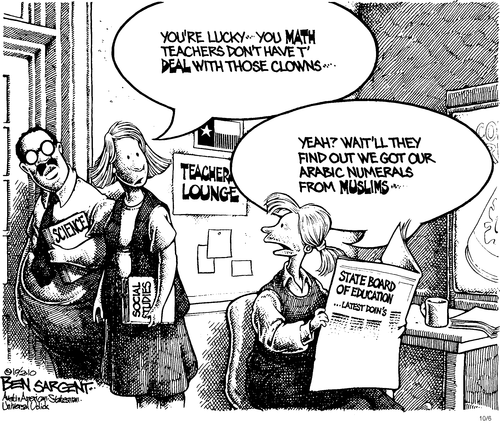
This from Ben Sargent:
This form Chip Bok:
This from Don Wright:
This from Chuck Asay:
This from Joel Pett in the Herald-Leader:

This from R. Byrnes in the New Yorker:

Tuesday, October 12, 2010

Challenging Assertions

What is clear,
and Kentucky has 20 years of experience that shows it,
is that for any test that is adopted
teachers will be coerced into teaching to it.
Despite all the work with national standards,
students may emerge from schools
expected to know only what is on tests.

-- Skip Kifer

In a Monday Herald-Leader Op Ed titled, "New standards alone won't improve education," assessment guru Skip Kifer challenged a couple of ideas offered by Educati0on Commissioner Terry Holliday and CPE head Bob King.

At issue was their Sept.19 column, "Smarter standards; Ky. tackling challenges to meet ambitious goals".

Education Commissioner Terry Holliday and Council on Postsecondary Education President Bob King in their op-ed focus on national education standards and related issues....They say, "It has been common that students who have been earning A's and B's in high school have been placed in remedial courses in college." They say students have not been learning the right stuff in high school and that national standards will solve the problem.

... decades of research has shown the single best predictor of success in college is a student's high school record. Doing well in a rigorous college preparatory curriculum is the key to doing well in higher education. How have or will national standards change that?

Perhaps these hypothetical students were not in college preparatory classes. In that case, one would not expect them to be related to success in college.

Then Kifer disputed international comparisons. Holliday and King stated that, "Among the 40 most industrialized nations, American students perform in the bottom quartile on international math and science examinations."

In the latest 2007 Trends in International Mathematics and Science Study (TIMSS), U.S. fourth graders were ranked 11th of 36 in mathematics. Their eighth grade counterparts were ranked ninth of 48...

Kentucky did not participate as a state in TIMSS. However, the commonwealth's fourth and eighth graders participate in the National Assessment of Educational Progress (NAEP) assessments. Their scores are at about the national average. It is likely then that Kentucky performance on TIMSS would be similar to the U.S. as a whole; they would be in the top one-third in 4th grade and the top 20 percent in 8th grade.

Similarly in science Kifer finds that Kentucky's performance on the TIMSS could be in the top 20 percent: sixth or seventh at fourth grade and ninth or 10th in eighth grade.

Holliday and King stated that, "Since early this summer, teams of teachers and college faculty have been translating sophisticated technical language (of the national standards) into objectives students and their parents can understand." But Kifer wonders,

Suppose another state were doing the same thing. Is there any reason to believe the two groups would come up with the same statements? It would appear the process is a way to turn national standards into state curricula, a problem national standards were meant to solve.

Saturday, October 09, 2010

Sunny and Eighty-Five


New Dance Policy Brings HS Dance to Grinding Halt

This from The Press (photo, Kim & Reggie demonstrate):

The 2010 Lake High School Homecoming Dance came to a grinding halt last Saturday night – or rather, it came to a “no-grinding halt.”

By around 9 p.m., well before the dance was scheduled to end, a number of students had left in protest of a recently instituted “no-grinding” policy that prohibited the popular form of dancing that school officials feel is sexually provocative and a little too “up-close-and-personal” for a school setting.

Sophomore Dakota Jakey said he feels it wasn’t just the policy, but the timing of the announcement that grinding would be prohibited at the dance added to the students’ frustration.

“When we heard the announcement Friday morning, we were mad,” he said. “People had already bought their tickets to the dance. This type of dancing had been allowed in previous years, so why not announce the policy earlier so we could decide whether or not we even wanted to go?”

Though Jakey admitted it may be “awkward” to describe grinding, he said many students enjoy the dance style. “The principal said they were issuing a no-grinding policy because they didn’t want students’ genitals rubbing against one another,” he said. “That made some kids laugh, but many of us were upset that our choice of how to dance was taken away.” ...

[Lee Herman, Lake principal, said students] did a good job for 1.5 hours and then we had a problem...The DJ was told that this was a school dance and that he should play appropriate music. The kids were asking why they could not hear certain songs,” the principal said. “The DJ, knowing the message in some of the songs, would not play them. The song choice was not my decision." ...“I don’t have an issue with songs as long as there is appropriate language. A song that has the ‘f’ word being used in it 15 times is not appropriate.”

Students, in protest of the music that was being played, held a “sit-in” of sorts, sitting on the gym floor for several minutes. “When the DJ started playing all country music, stuff like ‘Cotton-eyed Joe’ and older songs, everyone sat down because they didn’t want to dance to any of the songs,” said senior Alexa McNamee...

“It’s not only our school that does this – everyone does,” she said. “So for us to say we can’t do it, it’s like saying we can’t dance. What are you going to go to homecoming and do? Stand there?”

“Some of my friends were talking about leaving and going back to a friend’s house to have our own homecoming,” McNamee said, adding that she and her date chose to rent some movies and spend the rest of the evening at home....


“A “big issue” at Clay


Jeff Thompson, principal at Clay High School in Oregon, said the school had the same issues with some students dancing inappropriately.

“This was a big issue for us last year,” Thompson said. “I called other schools in other states and schools in Ohio asking what they did to put policies in place for dances. We want our kids to take a respectful stance on how they conduct themselves at a dance as well as in our hallways, in their lives and in how they dress.”

Thompson said he fielded questions from parents last year concerning the school’s stance on dancing and even the dress code for the dances. “I don’t think many parents totally understood what grinding meant,” Thompson said. “I told parents that when you see your daughter bending over and guys, not one but two to three behind them grinding up against her, you will change your mind on grinding.

Over the summer, Clay wrote formal dance guidelines that are included in the student Handbook as well as online at the high school’s website. The guidelines include specific policies for dress as well as what will be considered inappropriate dancing, which includes “moshing,” “body-surfing,” “slam-dancing,” and any style of dancing that suggests sexual innuendo.

“Sexually-suggestive dancing will result in the student's removal from the event, and may hinder or prevent his or her participation in future school dances and events,” the policy says.

Clay has also written Formal Dance Guidelines, complete with photos of what types of clothing will be considered appropriate and inappropriate dress...

HT 2 KSBA

1 Ohio school, 4 bullied teens dead by own hand

This from the Herald-Leader:

Sladjana Vidovic's body lay in an open casket, dressed in the sparkly pink dress she had planned to wear to the prom. Days earlier, she had tied one end of a rope around her neck and the other around a bed post before jumping out her bedroom window.

The 16-year-old's last words, scribbled in English and her native Croatian, told of her daily torment at Mentor High School, where students mocked her accent, taunted her with insults like "Slutty Jana" and threw food at her.

It was the fourth time in little more than two years that a bullied high school student in this small Cleveland suburb on Lake Erie died by his or her own hand - three suicides, one overdose of antidepressants. One was bullied for being gay, another for having a learning disability, another for being a boy who happened to like wearing pink....

Now two families - including the Vidovics - are suing the school district, claiming their children were bullied to death and the school did nothing to stop it. The lawsuits come after a national spate of high-profile suicides by gay teens and others, and during a time of national soul-searching about what can be done to stop it....

Related cases:

DA to look into suicide of teen said to be bullied
Prosecutors said Friday they will look into what led to the suicide of a 13-year-old Houston boy whose parents say was relentlessly bullied at his middle school for two years because of his religion and sexual orientation. Asher Brown's parents, who claim school officials ignored their pleas for help, said they hope "justice will be served" by the investigation by the Harris County District Attorney's Office. "Once they find out what's been hidden, we would want the people responsible to be prosecuted to the full extent of the law," said Asher's stepfather, David Truong.

Calif teenager who endured gay taunts memorialized
More than 500 people attended a memorial service for a 13-year-old central California boy who hanged himself after enduring taunts from classmates about being gay. Seth Walsh was remembered Friday night in Tehachapi as a warm-hearted teen who loved to laugh. His mother, Judy Walsh, says the family doesn't want to cast blame and wants the service to be a call for tolerance. Walsh died Tuesday, nine days after he was found unconscious in his backyard. He had been in a coma.

Activists partner to address suicide among gay teens
Middle school is tough for most young people, but for Elijah Hartgrove "it was the worst three years of my life," he said. He was gangly and tall, he was artistic in a town where boys were supposed to be tough, and he was gay. "I was afraid, like, if I wore nail polish, it would be like, 'He's a faggot, let's throw rocks at him,'" said Elijah, now a senior at Henry Clay High School. He moved to Lexington from a small town in Eastern Kentucky to live with his father. "I was just tired of hiding." The stress of being gay and a teen has been brought to light recently with a well-publicized alleged bullying incident involving a lesbian teen in McKee and the suicide this spring of a gay Lexington high school student.

When Seth Walsh was in the sixth grade, he told his mother he had something to say. "I was folding clothes, and he said, 'Mom, I'm gay,'" said Wendy Walsh, a hairstylist and single mother of four. "I said, 'OK, sweetheart, I love you no matter what.'" Last month, Seth went into the back yard of his home in the desert town of Tehachapi, Calif., and hanged himself, apparently unable to bear a relentless barrage of taunting, bullying and other abuse at the hands of his peers. He was 13.

Kentuckians fight back against alarming rise in suicides

Suicides outnumber homicides in Kentucky nearly three to one

Elfrida Johnson sat on the stairs of her porch crying. One trembling hand held a lit cigarette; the other absently stroked an orange cat. This is what a broken woman looks like, she said... Johnson's sister, Aletha King, took her own life. She died Aug. 17 after she lay on the railroad tracks behind her home at Ponderosa Mobile Home Park off Lisle Road at the Fayette-Scott County line...

King's death is one of two suicides that grabbed headlines in Lexington this year. In July, former University of Kentucky basketball star Melvin Turpin, 49, apparently shot himself at his Masterson Station home, according to coroner's reports.

As of Friday, the deaths of King and Turpin were among 37 cases this year that were ruled suicides by the Fayette County coroner.

Since 2005, there have been more than 250 deaths — an average of 50 a year — that were classified as suicides in Fayette County...10th highest in the nation for suicide deaths per capita....

[An] effort to increase awareness will ramp up this week during National Suicide Prevention Week. Throughout the week, organizations all over the country will hold forums, conferences and speeches to raise awareness of suicide prevention. Topics focus on recognizing warning signs, such as a family history of depression or withdrawing from friends and activities, and teaching people how to seek help through hot lines and local mental health centers.

UofL Gunwoman Facing Charges

Faculty Subdued Dana Kelly Thursday Afternoon

This from WLKY Video:

The woman subdued by University of Louisville faculty after displaying a gun during a meeting Thursday is now facing charges.

Dana Kelly is charged with first-degree felony wanton endangerment, second-degree misdemeanor disorderly conduct and misdemeanor carrying a concealed weapon.

Kelly, 49, was handcuffed, escorted out of the School of Education building and taken to University Hospital after the incident.

Police said Kelly was in a meeting with faculty and staff when she became agitated, then pulled out a gun.

Kelly is being held on a $500,000 full cash bond.

This from C-J:

According to the arrest warrant, Kelly met with Amy Hirschy, an assistant professor of educational and counseling psychology, on Thursday and handed her a letter in a sealed envelope. Hirschy told police that after she took the letter, she looked up at Kelly and saw she was standing in the doorway, holding a handgun at her side.

The warrant said Kelly told Hirschy, “This is good-bye.”

Hirschy jumped up from her chair and pinned Kelly’s arms to her side in what she described as a “bear hug,” the warrant said. The two scuffled and ended up in the hallway, where Hirschy screamed for help and was assisted by four or five other faculty and staff. They disarmed Kelly and held her in a conference room until U of L police arrived.

U of L spokesman Mark Hebert said no one was hurt in the incident, and Kelly did not appear to have been a threat to students, faculty or staff.

Friday, October 08, 2010

Device of the Future?

This from the San Angelo Standard-Times :
More than 120 employees of Angelo State University — professors, lecturers, advisers and office staff — are testing the world’s hottest technology device, the iPad.

“Many of the schools in our area have laptop programs (to provide every student with a computer) but I think this probably is the device of the future,” said John Miazga, dean of the College of Education.

He called it a device for the “Post-Information Age” and said the challenge for teachers and students in the future will not be accessing information but managing it as it grows at an increasingly rapid pace....

Introduced in April by U.S.-based Apple Inc., the device is billed as a tablet computer and has the same “touch screen” as Apple’s iPhone cell phone. It uses “apps” — applications written for the iPhone or specifically for the iPad — that enable the device to serve in a rapidly growing number of ways....The starting price for the iPad is $499. Accessories and software applications known as apps are extra...apps cost about $2 to $3 each. The apps are what make the device more than a tablet for recording information....

The iPad connects to the Internet through Wi-Fi, a wireless broadcast from an Internet hub, or through cellular technology like a cell phone. It has no real hard drive as it works through the Internet, drawing down information as needed and storing new data in cyberspace....

Miazga said the interactive aspect of the iPad allows for new possibilities in the classroom, such as creating a “back channel” for students to ask questions or give answers during a lecture. He said this means that a student who might be shy about raising a hand in a classroom can communicate with the lecturer through text message, e-mail or services such as Twitter....

Quick Hits

Students can earn cell-phone minutes for getting good grades: Some Oklahoma City students will be given cell phones and will earn minutes for good grades as part of a study on academic motivation. A Harvard University economist will study the results among 1,500 middle-school students over nine months. The program is similar to those in other districts that offer students cash incentives to earn good grades. (The Oklahoman)

Poll - Social media, text messaging might stress out students: Social networking, text messaging and other technologies might be causing stress among college students, according to a recent poll that found about 25% of students believe a "media blackout" would relieve some of their stress. Colleges are being asked to encourage more in-person interaction among students to help curb their dependence on technology. (The Chronicle of Higher Education)

Colo. district simplifies instruction with curriculum "dashboards": A Colorado school district is using a new system for aligning lessons with state academic standards in math and English. Short outlines of the skills each standard includes are included in curriculum booklets known as "dashboards," which are helping to streamline instruction, say educators. Some teachers are also sharing the dashboards with their students, which they say helps them understand the purpose of certain lessons. (Durango Herald)

L.A. layoff-policy change may prompt union lawsuit: The Los Angeles teachers union is considering filing a lawsuit over a tentative agreement that limits teacher-seniority protections when making layoff decisions. Union officials say they should have been included in the decision-making process. (Los Angeles Times)

Federal officials to analyze impact of school's discipline policies: The Obama administration plans to use "disparate-impact analysis" to determine if schools' discipline policies are having an equal effect across all groups of students. Some civil rights lawyers say the previous administration limited its analysis of discipline policies to whether particular groups of students were subject to "different treatment." (Education Week)

Chicago charter-school system continues expansion amid concerns: Grants from the federal government and private foundations are fueling the expansion of charter schools in Chicago. Some say the grants and the explosive growth of charters is a reflection of the level of performance and success of the schools, but critics maintain the charters continue to threaten the viability of neighborhood public schools. (The New York Times)

10 tips for decreasing bullying and cyberbullying in schools: Educators can take steps to reduce bullying and cyberbullying in schools, according to this opinion article by Elizabeth Englander and Kristin Schank of Bridgewater State University's Massachusetts Aggression Reduction Center. Responding appropriately to even small incidents involving disturbing behavior, and talking to students about their behavior online are among their suggestions. (eSchool News)

Can schools require students to take Advanced Placement exams?: A top-performing magnet school in Dallas is facing criticism over a new requirement that parents and students sign a contract agreeing that students will take Advanced Placement courses and take the fee-based exams. The high number of students who take AP exams has helped the School of Science and Engineering win national recognition, but critics say the school's policy may violate state law. (The Dallas Morning News)

Health reform provides $100M for school-based health clinics: The Department of Health and Human Services has announced about $100 million in federal grants under the federal Affordable Care Act to support the construction and renovation of school-based health clinics. "These new or improved sites will help ensure effective, efficient, high-quality care," HHS Secretary Kathleen Sebelius said. (Modern Healthcare)

Tinsley's Tax Troubles Revealed

The State Sued Tinsley in 1995

He apologized
and would prefer you just forgive him
and move on.

As a member of the Fayette County Board of Education, Kirk Tinsley voted to increase property taxes in Fayette County in 2009.

Good. He should have.

Property taxes are how the state of Kentucky decided to fund its public schools. As expectations have skyrocketed and more is expected of the schools, good stewardship demands that the schools be adequately funded to achieve their purposes. That is a major part of a board member's job.

When he cast his vote, I'm sure Tinsley expected that taxpayers would respond by following the law, and doing their part as good citizens.

But when political shenanigans or a lack of personal integrity derails that process, and people fail to pay their fair share, school children lose. Suddenly school districts lack the resources they need to do their job.

Perhaps no one knows the potential damage better than the Herald Leader. In a series of stories from November 12 to December 15, 1989, printed under the banner, "Cheating Our Children," the Lexington Herald-Leader outlined the numerous ways some Kentuckians were beating the system for their own personal gain while withholding resources to the schools. That same year, and the one before, Kirk Tinsley did not pay his property taxes.

The twelve-part series generated more reader response than anything previously published by the Herald Leader and described tax giveaways, payroll padding, the persecution of teachers, nepotism, and many other affronts to good education. Some of the titles included: How Politicians Win and Schools Lose; Cabinet Member Admitted Falsifying Property Tax Records; Politics and Neglect Bring Tax System to its Knees...

It was troubling to learn that Tinsley, a current FCPS Board member, has a long history of problems paying his taxes in a timely fashion.

Tinsley admitted his slow-pay problems to Herald-Leader reporter Jim Warren. He'd like the voters to forgive and forget something most people are learning for the first time in today's paper.

"I ask people to judge me on my present, not my past," [Tinsley] said. "I'm apologizing for things I've done in the past; it's the things that I do in the present that make a difference."

Is it really that easy? Or, is past performance the best indicator of future performance?

Warren reports,

...Tinsley's late payments of his property taxes in several years since the late 1980s. The state sued Tinsley in Fayette Circuit Court over unpaid property taxes in 1995 — the suit was dismissed after the taxes were paid — and records at the Fayette circuit clerk's office show that he's been late paying taxes a number of times since then.

Property taxes are the backbone of public school funding, generating roughly 60 percent of the local revenue Fayette County Schools receives each year. Tinsley acknowledged the late payments but stressed that the taxes ultimately were paid.

KSN&C received detailed information (not independently confirmed) related to Tinsley's tax history. The data seem to go along with today's report in the Herald-Leader which I'm quite certain is confirmed.
1988 Tinsley did not pay his property taxes.
1989 Tinsley did not pay his property taxes.
1990 Tinsley did not pay his property taxes.
1992 Tinsley did not pay his property taxes.
1993 Tinsley did not pay his property taxes.
1994 Tinsley did not pay his property taxes.

1995 Tinsley was sued by the state of Kentucky for failure to pay his taxes (Fayette County Circuit Court case No. 95-CI-1137). He agreed to a civil judgment against him in the amount of $3,601.18, plus interest for 1988, 1989, 1990, 1992, 1993, 1994, 1995.

2005 property tax bill (#87768) - paid June 19, 2008.
2006 property tax bill (#89965) - paid July 29, 2008.
2007 property tax bill (#92118) - paid June 19, 2008.

November 2008, Tinsley was appointed to the Fayette County Board of Education

2008 property tax bill (#93491) - paid August 21, 2009.
Tinsley was appointed to his seat, so the voters in District 2 have not yet weighed in on whether this is a problem in their minds. Warren says this is a potential problem for Tinsley's campaign. At least. I would find it to be a disqualifying factor.

Will Tinsley's tax troubles cost FCPS Superintendent Stu Silberman a reliable vote?

Watch taped candidate forums on Fayette Schools Channel 13, sponsored by the League of Women Voters and the 16th District PTA Council. The District 2 forum will be broadcast at 8 p.m. Oct. 11 and 18; the District 4 forum will be broadcast at 8 p.m. Oct. 13 and 20.

Thursday, October 07, 2010

Memorial service planned for Bob Sexton

This from Prich:
A celebration of the life of Robert F. Sexton will be held at 1:30 p.m. Saturday, Oct. 16, 2010, at Haggin Auditorium in the Mitchell Fine Arts Center on the campus of Transylvania University, 300 N. Broadway in Lexington. The longtime executive director of the Prichard Committee for Academic Excellence died August 26, 2010, in Lexington.

The family will greet friends from 10:30 a.m. - 12:30 p.m. and from 3:00 - 4:30 p.m. Oct. 16 at the Mitchell Fine Arts Center and also from 5:00-8:00 p.m. Friday, Oct. 15, at the Carnegie Center for Literacy and Learning, 250 E. Second St., Lexington.

Memorial tributes to Bob's life and work may be made to the Robert F. Sexton Legacy Fund, Prichard Committee for Academic Excellence, P.O. Box 1658, Lexington, KY 40588.

KBE Gives Holliday a Big Smooch, Discusses Accountability

At its regular meeting this week the Kentucky Board of Education got its first peek at the new accountability system mandated by Senate Bill 1. The board also finalized its evaluation of Commissioner Terry Holliday and called his performance "outstanding."

There's absolutely no surprise in a Kentucky School Board saying their leader is doing a good job. They say that about all of them - regardless. Even in the presence of evidence to the contrary, the state board has been known, in years past, to love the one they're with. Who can forget how they held fast on how wonderful Barbara Erwin was going to be for the state despite a pile of evidence that she falsified her resume. The board was so confident that they gave themselves awards as a testament to what a great job they did in hiring her. The board continued to support her right up to the minute they talked her into resigning.

But one gets the sense that Holliday's accolades are deserved.

The Commissioner's job is administrative, but it is also about articulating a vision toward implementing state initiatives. In Holliday's case, the job performance is driven by Senate Bill 1. Implement it well, and he gets a gold star. If any significant element fails, he is open to criticism even if that failure is the result of the legislature not funding its own proposals.

But Holliday is serving at a time of significant change in American education history. The school reform efforts of the late 20th century are shifting to a new form and resistance to new approaches being advocated by the Obama administration (and a handful of powerful foundations interested in reshaping education) are just now beginning to receive substantial pushback. That pushback is a direct result of the success these groups have shown in moving their agenda. It is not clear how that will play out in Kentucky, but Holliday's job will be to keep the train on the tracks, and moving.

Even in defeat Holliday has shown the ability to multi-task and nimbly move to the next opportunity. When his application for $175 million in Race to the Top funds fell short, he was already participating in three testing consortia, two of which received federal funding that will patch part of the hole left empty by RTTT. Then he got lucky and EduJobs filled in the rest...or at least enough to get the job done.

From the start, Holliday presented himself as a school leader who could develop a plan and drive that plan to success. He had a small group of vocal detractors in North Carolina but so far, the state board is hearing "very positive comments" about Holliday from constituents across the state. His plain-spoken style is effective around these parts. I like that he doesn't dumb-down his speeches, but arguably, that may not be the best PR approach.

Communication a big deal. Communicating is really what the job is all about. Plus, Holliday has embraced every new media vehicle available to broadcast his ideas to the general public. This serves to demystify the department of education's goals and clarifies where the state is going.

Holliday has also, importantly, shown a willingness to speak truth to power - whether telling the legislature of the need for more funding, or the state's superintendents about his support for charter schools, or the KEA about the need to evaluate teachers based on their students' performance. And he seems to have done so without alienating any of them. Indeed, he mustered every school district in the state and the KEA in support of the state's RTTT bid.

Holliday has also avoided any major gaffes. No $30,000 cars. No news of wastefully expensive junkets or costly squabbles with legislators. It would seem that KBE has found a steady hand to steer the schools through choppy waters. The direction Kentucky is travelling has been made clear. Kentucky is onboard with the feds and the foundations. But I suspect that in coming days more will rise up to argue against that course. Holliday's challenge will continue to be one of maintaining unity amid change.

In September, KSBA's Brad Hughes sat in on the board meeting where Holliday's evaluation was first discussed. He has some interesting observations about Holliday's performance and the modus operandi of the opponents of public education in the Kentucky School Advocate.

This from KDE:

At its regular meeting on Wednesday, the Kentucky Board of Education heard presentations and took action on a number of items.

The board held an in-depth discussion about Kentucky’s new assessment and accountability system, which is mandated by 2009’s Senate Bill 1. Staff at the Kentucky Department of Education presented a concept paper for the new system, which includes indicators related to next-generation learners, next-generation professionals, next-generation support systems and next-generation schools and districts.

The board approved a regulation that repeals another state regulation that provides guidelines for the Highly Skilled Educator (HSE) program. Since the HSE program will be replaced by a new assistance program, the regulation related to its guidelines
must be repealed.

In a related move, the board gave final approval to state regulation 703 KAR 5:190, which outlines the provision of education assistance to schools and school districts.

The board also approved its legislative agenda in preparation for the 2011 session of the Kentucky General Assembly.

In recognition of her dedication to the students of Kentucky, the board presented Helen W. Mountjoy with the Dr. Samuel Robinson Award. Mountjoy is a former Secretary of the Education and Workforce Development Cabinet and was a longtime
member of the Kentucky Board of Education, serving as chair of the board for many years.

The board took the following actions:
  • approved its Strategic Plan Goals and Commissioner of Education’s Goals
  • approved the commissioner’s 2009-10 evaluation document
  • approved the revised KBE Policy Manual
  • approved the district facility plan for the Knott County school district
  • approved 2010-2011 local district tax rates levied
  • approved the site for the proposed new Pre-K Center in the Elizabethtown Independent school district
  • approved the site for the proposed new middle school in the Paducah Independent school district
  • approved the guidelines for requesting the use of capital funds for
    FY2010-11 and FY2011-12

The board heard presentations on the following items:

  • English-Language Learners (ELLS): Focus on Closing the Achievement Gaps
  • the Board Examination System
  • Title IX deficiencies for schools audited during the 2009-10 school year and recommendations for 2010-11 from the Kentucky High School Athletics Association
  • the pupil attendance regulation
  • the 2010-2012 Biennial Budget
See the meeting here: Video and audio -Downloadable audio podcast.

Hat Tip to Lisa H.

Saturday, October 02, 2010

From the Nation's Cartoonists

This from Tom Toles in Slate:

From Clay Bennett:

From Chan Lowe:

From Signe Wilkinson:

Activity in Cowan Case

There has been some recent activity in PL Dunbar High School Counselor Jill Cowan's suit against Fayette County Schools Superintendent Stu Silberman, former FCPS Middle School Director Michael Ernst, and Jesse Clark Middle School Principal Lisa Goodin.

KSN&C Backstory, then here, and here.

Cowan sued the Fayette County Public Schools about a year ago, alleging she was denied an opportunity for promotion and that the denial was somehow related to an unwelcomed advance from her superior. The case resides in Ernesto Scorcone's Fayette Circuit Courtroom.

In August, Charles W Arnold entered as a new lawyer for Cowan joining J Robert Cowan, Jill's Ex-husband.

Goodin's attorney filed a motion arguing that Cowan had been too vague about her allegations. Judge Scorcone agreed and Cowan had to submit an Amended Supplemental Complaint. In that complaint, Cowan alleges that she "made various complaints of unlawful treatment" prior to the filing of her lawsuit. That she...
  • applied for various positions
  • was qualified
  • was not selected
  • not selected because of her prior complaints
  • applied for multiple promotions after the suit
  • defendants failed to place her in any of them

Here's the list of positions for which she applied:

  • April 2009 - all elementary elementary school principal positions (generic); not interviewed
  • April 22, 2009 - Middle school Associate Principal
  • April 22, 2009 - Middle School Principal
  • April 22, 2009 - FCPS .5 Program Director for Middle College/.5 Middle School Director
  • April 22, 2009 - FCPS Program Director Middle School/high School (Learning Center @ Linlee)
  • May 15, 2009 - Associate Principal @ Lafayette High School
  • May 22, 2009 - Associate Principal @ Dunbar High School
  • During 2010 - Principal @ Meadowthorpe Elementary, Southern Elementary, SCAPA, LTMS, Southern Middle and Associate Principal @ Lafayette High School and Leestown Middle School.

She was apparently included in the generic principal screening, but no further interviews.

Cowan claims that her current husband, Bryan Station Middle School Associate Principal Max Doak, was also retaliated against as a result of her complaints.

The more I learn about this case the harder it is to figure out who to root for.

On one hand, I can't find anyone willing to say that Jill Cowan has what it takes to become an effective principal. That would usually stop my interest in a complaintant right there. I can't see where Cowan was owed an interview. If Goodin or Silberman did not see her as a finalist for a principalship she shouldn't have been interviewed. It would have been insincere. Clearly, the district can't (and shouldn't) guarantee every current employee an interview. Lots of folks are good at their current jobs but lack the skills to lead a modern school effectively.

On the other hand, the way the district handles its human resources functions these days leaves cause for concern. During the Petrilli case, Silberman and is deputies revealed that principals were not marked down on their evaluations, something they subsequently changed, once KSN&C made the fact public. In this case, there's talk about destroyed employment documents. Add to that the H-L report that Cowan contacted the school district's civil rights compliance officer on April 11, 2008, only to be suspended from her job the same day. Or that in denying Cowan an interview, Goodin told her that she intended to hire a man, was only interviewing men, and that a man had, in fact, been hired.

Will maladministration cause the district to lose a suit it should otherwise win easily?

Stay tuned.

Neighborhood Schools Plan May Cost State

Williams calls latest bill a cheap trick
...and he should know
This from Toni at C-J:

A Jefferson County lawmaker wants the state to pay the costs — possibly hundreds of millions of dollars — that would result from a proposed bill letting children attend the public school closest to their homes.

State Sen. Tim Shaughnessy, a Democrat, pre-filed a bill for the 2011 session on Wednesday that responds to a bill pre-filed last month by Senate President David Williams and Sen. Dan Seum of Louisville, both Republicans, that would allow children to attend their neighborhood schools.

Shaughnessy said the Williams-Seum bill is an effort to take control of the schools away from local districts — and if the state is going to do that, “the state needs to pick up that financial responsibility.”

Williams responded Wednesday that Shaughnessy's proposal is “a cheap political trick” and that the bill he's co-sponsoring would not cost districts any additional money.

The Williams-Seum proposal, titled the Neighborhood Schools Bill, would let parents enroll their children for attendance in the public school closest to their home except in cases where the school has academic or skill prerequisites, such as magnet and traditional schools.

It also says that, in cases where a neighborhood school is full, the children who live closest have priority for enrollment. In addition, under a grandfather clause, any child attending the school would not be moved out to let another child attend.

Jefferson County school officials say the Williams-Seum bill would require almost $200 million in new spending, including transportation changes and new schools.

The bill for other districts is unknown, but Lisa Gross, spokeswoman for the Kentucky Department of Education, has said the Williams-Seum legislation could affect all 174 school districts in the state...

School News from Around Kentucky

‘Surprise’ $2M changes Oldham school board budget: Oldham school board members had only one night to review and approve a $110 million revised working budget for fiscal year 2010-11. Chuck Littrell, finance officer for the school district, spent six months preparing a $107.5 million working budget and submitted it to board members by Sept. 17, but a last minute $2 million “surprise” federal allocation from the state — and the subsequent order from the Kentucky Department of Education to include the new grant in the current year’s working budget — caused Littrell to re-tabulate and present revisions at the regularly scheduled Sept. 27 board meeting. This is frustrating to me to get the information so late,” Littrell said, noting that this was the first time in 16 years he has had to resubmit a working budget for formal approval. “Why did we waste time working on the budget for six months only to have the state come in at the 13th hour and treat us like this?” board member Walt Schumm asked. “We deserve a little more time than an hour at a board meeting,” he said. KDE requires all districts to revise their working budgets by Sept. 30 in order to meet federal guidelines regarding the new funds; they announced the new allocation via a web presentation Sept. 20. (Oldham Era News)

Laurel County Board reviews final budget draft: With $5.5 million tucked away in its rainy day fund and money now dedicated to projects previously delayed to save costs, the Laurel County school district’s $93.7 million working budget is in good shape.“It’s a very healthy budget and somewhat on the conservative side,” Superintendent David Young said. “We’ve done a good job in getting through this financial crisis. We’ve been looking into the future for the crisis that may come, and I feel confident we’ll be able to weather all this and keep everything intact as it is.”The working budget, the final of three drafts the district is mandated to put together each year, shows the district has revenues — and expenditures — of about $4 million more this year than last year.Business Manager Jim Kennedy said the largest chunk of that amount can be attributed to the district receiving $2.1 million in EduJobs federal stimulus funds. There is also $500,000 left over from last year’s budget. (Sentinel Echo)

Education Matters: Why do experts say early childhood education is such an important investment? What are the characteristics of a quality program? And, how can community collaborations improve the education offered to Kentucky’s youngest students? These questions and more are explored in a new edition of Education Matters. “Early Childhood Education: The Path to School Success” airsTuesday, October 19, at 9/8 p.m. CT on KET. Host Bill Goodman discusses early childhood education with Annette Bridges, director of the Division of Early Childhood Development at the Kentucky Department of Education; Madison County School Superintendent Thomas Floyd; Cindy Heine, interim executive director of the Prichard Committee for Academic Excellence; and Rick Hulefeld, executive director of Children, Inc. in Northern Kentucky. (KET)

Coach accused of sexual abuse forbidden from being in county: At a hearing Wednesday in Madison District Court, Judge Brandy O. Brown altered the terms of a bond for Joey J. Tate, 34, forbidding him from being in Madison County.Tate is a former instructor and assistant football coach at Madison Southern High School. He resigned his position Sept. 15, one day before his arrest Sept. 16 arrest. He is charged with first-degree sexual abuse, a Class D felony and, attempted unlawful transaction with a minor, first-degree illegal sex act, child under the age of 18, a Class A misdemeanor. (Richmond Register)

Becky Sagan resigns as Fayette school board chairwoman - Sagan's new home is not in district she represents: Fayette County Board of Education Chairwoman Becky Sagan is resigning effective immediately because she and her husband are buying a home outside District 5, which she represents. Sagan said Wednesday she has notified state Education Commissioner Terry Holliday, who will have 90 days to name a successor to hold the 5th District seat until the fall 2011 election. Sagan's resignation also means that vice chairman John Price, who represents District 3, will become school board chairman. (H-L)

Fayette schools won't raise property taxes this year - Officials unsure last time rate remained flat: The Fayette County Board of Education has a present for Lexington's taxpayers: For the first time in many years, the board isn't raising school taxes.
The Fayette schools' new 2010-11 working budget, which the board recently adopted, leaves the basic school tax rate on real estate at 62.9 cents per $100 evaluation — the same as last year — while the personal property tax rate stays unchanged at 5.3 cents. (H-L)

Louisville - Fischer picks up endorsement from Jefferson County Teachers' group: Democratic mayoral candidate Greg Fischer received an endorsement from the Jefferson County Teachers Association Wednesday — a group that represents some 12,000 current and retired public school teachers. Brent McKim, president of the JCTA, said his organization interviewed both candidates before the May 18 primary election. Neither Fischer nor Heiner came away with the JCTA endorsement in the primary. McKim said Fischer got the organization’s nod this time because his “understanding of and support for the public schools in Jefferson County is head and shoulders above Hal Heiner’s. I think he’s interested in working with schools to make them better and not pointing fingers and blaming them.” (C-J)

Boone County teacher sues over child abuse claims: A Boone County teacher who faced a felony charge for spanking his son before a judge threw out the case has sued a sheriff’s detective, prosecutor and his ex-wife. Christopher Robison, 46, claims in a suit filed in U.S. District Court in Covington Wednesday that his arrest and prosecution was the result of his ex-wife trying to get custody of their children. Because Commonwealth’s Attorney Linda Tally Smith is friends with Robison’s ex-wife, Robison’s attorney Eric Deters said that she and Boone County Sheriff’s Detective Tracy Watson “had an improper motive for instituting and continuing the pursuit of this charge.” (Enquirer)

Kenton Co school uses iPad to cut back on paper use: Students in a Kentucky fourth-grade classroom will test the educational and environmental effects of Apple's iPad during a yearlong pilot program. Students were tested before receiving the devices and will be tested at the school year's end to measure the impact on their science, technology, engineering and math skills. Officials say they also hope to make the classroom paperless through the use of iPads. (The Cincinnati Enquirer)

Show me the money - A federal judge blocks contribution limit in school board elections: When University of Louisville professor Ben Foster campaigned for a seat on the Jefferson County Board of Education two years ago, he felt hampered by the contribution limit put on school board candidates. The first-time candidate raised more than twice the amount of his opponent, but still found it difficult to compete because the Jefferson County Teachers Association spent more than $160,000 promoting its selection: longtime board member Larry Hujo. In Kentucky, campaign contributions up to $1,000 from individuals are allowed in most political races, but for school board candidates, the limit is $100 from individuals and $200 from political action committees and other groups. (Leo Weekly)

Top prosecutors to follow U.S. judge’s lead, let board candidates accept more than $100 per person - Federal judge says board candidates may get same $1,000 as other Kentucky offices: Two prosecutors, including the attorney general, won’t take any action if they receive complaints that Kentucky school board candidates accept otherwise legal contributions from individuals of as much as $1,000 for the November election. Attorney General Jack Conway and Jefferson County Commonwealth’s Attorney David Stengel have agreed not to pursue criminal investigations if board candidates accept more than the $100 individual contribution limit of state law. (KSBA)

Portland Elementary school makes gains with whole-child approach: One Kentucky elementary school that is located in a poor neighborhood where 91% of students qualify for free or reduced-price meals is making significant academic gains -- despite its disadvantages -- after taking a whole-child approach to school. Educators are attributing the students' success to smaller class sizes, individualized instruction and social services for students, among other factors. "When you start meeting all the needs of the child, you see results," a district official said. (The Courier-Journal)

Teachers will work on new literacy guideline: Teachers in Daviess County Public Schools have been picked to help develop new literacy standards that could be used across the country.The Literacy Design Collaborative will be funded in Kentucky by the Bill & Melinda Gates Foundation, with the money split between six school districts by the Lexington-based Prichard Committee, a citizen-based educational advocacy group. Daviess County and districts in Kenton, Boyle, Fayette, Jessamine and Rockcastle counties are receiving part of the $300,471 grant.DCPS Superintendent Tom Shelton said teachers plan to increase the focus on reading and writing by making them an integral part of every subject."This method that they're going to be using in the literacy work is developing modules, more than just lessons or units," Shelton said. "Teachers can actually teach reading no matter what subject area they're in. Even math at the high school level requires a lot of reading. This modular approach will allow all our teachers to be reading teachers within our content areas and allow more growth and development for the students." (Messenger-Inquirer subscription)

Quick Hits

Alternative school offers unique curriculum, project-based learning: A new private, for-profit school in Lakeview, Ill., is aiming to reach students who are struggling in traditional schools by implementing a curriculum that is based on "doing things that matter in the real world." The alternative Global Citizenship Experience School combines many core subjects -- while still intending to meet state standards -- and uses a project-based approach that incorporates cultural awareness, sustainability and other themes. (Chicago Tribune)

More schools use Singapore method for teaching mathematics: More U.S. school districts are using Singapore's national method for teaching math. The approach features a slower pace and devotes more instructional time to fewer subjects -- a technique that has been found to address students' different learning needs and increase students' understanding of concepts. Visual aids and hands-on learning are also key components of Singapore math, which is seen by some as striking a balance between traditional and reform approaches. (The New York Times)

Grade shock: Regular NY Schools Top Charters: City charters fell harder. Traditional public schools bested the city's charter schools on annual report-card grades -- scoring 10 points higher on average on a 100-point scale, new data shows. The city's more than 1,000 public elementary and middle schools averaged a B on their so-called "progress reports," which assign letter grades to schools based largely on how much students improve on state math and reading tests in a given year. By comparison, the city's 60 charter schools that received letter grades this year averaged a C+. (NY POST)

Teachers unions hold sway in state political contests: Teachers unions are providing endorsements and financial support in a number of state-level political contests. Many are supporting Democratic candidates, though the unions have made their concerns known about the Obama Administration's policies on teacher merit pay and the expansion of charter schools. In California, both major unions are supporting Democratic gubernatorial candidate Jerry Brown, while a Republican candidate for governor in Nebraska has backing from the state teachers union. (Education Week)

Supreme Court to consider education-related cases in new session: The U.S. Supreme Court -- including the newest justice, Elena Kagan -- will hear cases with implications for schools when its session begins Monday. Among the cases to be considered: challenges to a tax-credit program in Arizona that provides scholarships for students to attend religious schools and a California case that would restrict the sale of video games that are considered violent. (Education Week)

What students need to know about Google: Students must be taught how Google's search engine works if they are to effectively improve their research skills, according to experts who say students who use the search engine are surprisingly unaware of how searches are produced. "Student overuse of simple search leads to problems of having too much information or not enough information ... both stemming from a lack of sufficient conceptual understanding of how information is organized," said Andrew Asher, the lead research anthropologist at the Ethnographic Research in Illinois Academic Libraries Project. (InsideHigherEd)

Obama calls for longer school year, but is it affordable?: President Barack Obama is again calling on school districts nationwide to adopt a longer school year as a way to help improve student achievement, but such a proposition could cost school districts and states billions of dollars. "If you extend the school year for, say, five days, you're paying for another week of salaries, another week of utilities and another week of fuel for, in South Carolina, 5,700 school buses," said a spokesman for the South Carolina Department of Education. (The Associated Press)

Tentative contract includes merit pay for Baltimore teachers: Baltimore teachers have a tentative contract that links their pay, in part, to student performance and eliminates traditional "step" increases based on degrees and seniority. Under the plan, the most effective teachers could be rewarded more quickly and earn as much as $100,000 a year. The contract includes some of the most significant changes in teacher pay being made nationwide and more autonomy for teachers over the working environment at their schools. (The Sun) and (The Sun)

Fund launches 10-year campaign to expand charter schools: The Charter School Growth Fund announced a fundraising effort to amass $160 million that could establish as many as 335,000 seats at charter schools for students over the next 10 years. The Colorado-based group also announced $20 million in gifts to existing charter schools in Denver, Los Angeles, Atlanta, New York City and San Jose, Calif. (The Associated Press)

Bush initiative to recruit principals from outside the profession: The George W. Bush Institute announced an initiative this week to recruit more school principals from other fields and outside of the teaching corps. About 200 principals are expected to participate in the program's first year, with the goal of training 50,000 principals by 2020. (The Dallas Morning News) (Education Week)

New core standards focus on 21st-century skills: Librarians have a role in teaching 21st-century skills required to comply with new core academic standards -- primarily through teaching students' research and information skills, according to Christopher Harris, coordinator of a New York school-library system. Harris recommends assessing whether the websites and materials being used are relevant and taking other steps to ensure that curricula are in line with the new core academic standards. (School Library Journal)

How can teachers prevent student boredom?: It is impossible to prevent all students from being bored in the classroom, and teachers do not have to avoid lectures to keep students' attention, according to social studies teacher and blogger Coach Brown. The secret, he writes, is to be "on" at all times. "My old principal once made a comment that good teaching was like good theater; you got into character and at the end of the production, you should be damn tired because you were 'on' the whole time," Brown writes. (The Washington Post/Class Struggle blog)

How educators turned a large, struggling high school into a success: A teacher-led push to include reading and writing lessons across all subjects is credited with turning around a Massachusetts high school that enrolls 4,100 students. Educators say the school, which has been recognized for its success, disproves the widely regarded theory that students at smaller schools perform better. "What matters is uniting people behind a common purpose, setting high expectations, and sticking with it," said a former state education commissioner. (The New York Times)

Court - Teachers working toward certification are not "highly qualified": Teachers working toward alternative certification no longer can be considered "highly qualified" under No Child Left Behind, a federal appeals court ruled Monday. The case stems from a complaint in California that claimed many students in low-income schools were being taught by inexperienced "interns." The ruling will require California to alter its teacher-placement policies to ensure that the most inexperienced teachers are not disproportionately placed in the worst schools. (San Francisco Chronicle) (School Law blog)

Mr. Rogers, marketing guru: Children's entertainer Fred Rogers was a masterful marketer, writes digital strategist Sam Ford, and many companies could stand to take a closer look at the beloved TV personality's career. Mr. Rogers offered his viewers a real, meaningful relationship; never overpromised or underdelivered; and carefully adjusted his brand to shifting cultural norms without ever seeming insincere or inconsistent. "As I consider how many marketers likely grew up with the words of Fred Rogers guiding their way as kids, I can't help but think that we've all too often strayed away from some of those first lessons we heard as children," Ford writes. (FastCompany)

Why are more students seeking academic tutoring?: Academic tutoring has long been used to help students with learning disabilities or students who are struggling to pass required tests, but it is becoming more common among students who are supplementing their regular courses, according to this roundup of opinion pieces. Some educators say the tutoring is needed to make up for deficiencies in school instruction, while others say it is in response to policies that require students to master a curriculum that has become more rigorous. (NYTimes.com/Room for Debate blog)

NYC mayor plans changes to tenure, seeks revamp of seniority laws: New York City Mayor Michael Bloomberg said Monday he plans to change the city's policies for granting teacher tenure and request the repeal of "last-in, first-out" seniority laws. Bloomberg's plan will deny tenure to teachers -- offered after three years with the school system -- who receive "ineffective" or "developing" ratings under a new value-added evaluation system. Bloomberg will also seek to remove state seniority protections ahead of more layoffs that could be caused by a projected $700 million budget shortfall next year. Union officials are opposed to changes in seniority policy. (GothamSchools) (The Wall Street Journal) (New York Post)

Despite layoffs, Chicago schools hire Teach for America graduates: Chicago's United Neighborhood Organization charter schools hired 25 Teach for America graduates this year through a partnership between the groups. The hires mean 155 Teach for America teachers started this year in Chicago Public Schools, where as many as 600 laid-off teachers are still out of work. "My question is, how do you lay off people and then hire people at the same time?" the Chicago Teachers Union president asked. (Chicago Tribune)

Have you got the leadership gene?: Biologists are looking to win a spot in America's business schools by studying the genetics and biochemistry of management. Researchers have already found that genetic variations can explain a leader's successes and failures, and that variations in sex hormones play a role in sales. "Management science looks set for a thorough, biology-inspired overhaul," according to The Economist. "Expect plenty more lab coats in business-school corridors." (The Economist)

Obama wants teachers, students held to higher standards: President Barack Obama focused on education during a 30-minute interview on NBC on Monday, saying that students and teachers must meet higher standards. Obama also said he supports firing ineffective teachers after they have been given an opportunity to improve. During the interview, Obama said he supports working with teachers unions on education reform. Also on Monday, Obama announced plans to recruit 10,000 science, technology, engineering and math teachers during the next two years. (The Associated Press) (The Wall Street Journal)

Program helps elementary schools implement habits for success: Two Arizona elementary schools are implementing a program to help motivate students. The Leader in Me program is based on the popular book "The 7 Habits of Highly Effective People." The program has teachers and students working toward a common vision for their school, using the same principles that author Stephen Covey has promoted to corporate executives in his book. (The Arizona Republic)

Colo. district's pilot program would increase salaries, offer merit pay: A pilot program to be launched next school year in 20 schools in Colorado's Jefferson County could result in some teachers' salaries increasing to more than $100,000 per year. The program is being funded by a federal grant from the Teacher Incentive Fund and includes a base-pay increase for all teachers, as much as $10,000 in performance-based bonuses and a designation for "master teachers." (The Denver Post)

California charters stay nimble during the recession: Charter schools in California are expanding and thriving despite the recession, which has hurt the state's traditional public schools. Charter schools have been more nimble because they are not subject to the same regulations as traditional public schools, and their teachers tend to be younger and not unionized -- which means they are paid less. Nearly 90 new charters are expected to open across the state this school year because of funding from the federal government and philanthropies.(CaliforniaWatch)

Texas board urges curb on Islamic references in textbooks: The Texas school board voted, 7-5, to adopt a resolution aimed at curbing references to Islam in the state's world-history curriculum. Officials in favor of the resolution say it is in response to a growing Islamic influence in textbook publishing, while critics say it is an attempt by socially conservative board members to politicize education in the state. The resolution is not binding on future boards. (The Associated Press)

Education Department awards Teacher Incentive Fund grants: The Education Department has announced the winners of $442 million in grants to provide bonuses for high-performing teachers and principals at low-income schools. The grants are the first of about $1.2 billion in merit-pay funding through the Teacher Incentive Fund over five years, and they come as the value of merit pay is being questioned by a recent study. Wake County, N.C., Texas, Indiana, Tennessee, Ohio and Louisiana were among the 62 recipients. "The incentive is one that rewards everybody and motivates everyone to help kids to believe in themselves and develop a good work ethic," one official said. (The Dallas Morning News) (The Associated Press) (The Boston Globe) (Pittsburgh Tribune-Review) (The News & Observer)

ACLU Sues State of California for Charging Student Fees: Alleging that “there is no system of free public education in California, the Southern California American Civil Liberties Union (ACLU) filed a class action lawsuit on September 10, 2010 against the State of California and Governor Arnold Schwarzenegger for “allowing school districts throughout the state to charge fees for books and other essential educational supplies.” (ACCESS)

Florida Education Adequacy Case Withstands Motion to Dismiss: Whether the state of Florida is currently denying students their constitutional right to “obtain a high quality education” may now be tested in the courts, according to the Circuit Court for the Second Judicial district, which has dismissed the state’s motion to dismiss the complaint in Citizens for Strong Schools, Inc. v Florida Board of Education. (ACCESS)

Polls Indicate that Americans Support More Spending on Education: Thirty-six percent of respondents in the 42nd annual Phi Delta Kappa and Gallup national poll said the crisis in school funding is the number one problem facing schools in their community. (ACCESS)