Saturday, January 22, 2011

Results of ACT Investigation in Perry Co Point to Altered Tests

Students tell ACT Investigators
Proctor Gave Answers During the Test

Supt searches for Explanations

This from the Hazard Herald:

Altered exam responses, multiple handwriting sources and statements from students were all given as evidence by a national testing organization to cancel test scores for several students at two Perry County high schools during an investigation in 2010, according to documents obtained in an open records request by the Hazard Herald.

The findings of ACT’s investigation into allegedly compromised test scores at Perry County Central and Buckhorn High School were noted in letters from ACT to Superintendent John Paul Amis and the high schools’ principals dated November 23.

Though ACT has made no finding of fault by any particular local testing administrator, it does list the organization’s key findings following the investigation which concluded in November, most notably that ACT “found evidence indicating that answer sheets for a significant portion of the students tested at PCCHS were manipulated.” ...

Fifty-nine students from Perry Central took the ACT exam again in October after their initial scores were canceled. According to ACT, the average composite scores decreased by more than one point, and 59 percent of the scores decreased from the initial exam.

ACT investigators found similar aberrations on the 2009 PLAN and ACT exams from Perry Central...

Superintendent John Paul Amis tried to explain the situation to the Herald:

ACT says there were: a high number of erasures from incorrect to correct responses.

Amis says: "...while it wouldn't happen very often, a student taking the test could go back and review answers and find that they were bubbled in out of order or on the wrong page of the answer sheet and have to change them before the time allotted ran out."

ACT says there were: slash marks on answer sheets that forensic handwriting analysts deemed were the result of someone other than the student marking responses on the test.

Amis says: “I don’t think that’s anything abnormal.”

ACT says: an adult proctor provided students with answers during the test,”

Amis says: “I could not find any student that felt like teachers provided answers to them.”

The Kentucky Department of Education forwarded ACT’s findings to three government agencies for further review: the Kentucky Attorney General’s Office, the Education Professional Standards Board and the Office of Inspector General.

Friday, January 21, 2011

Stars Shine on Christian Researcher

This from Inside Higher Ed:

The University of Kentucky has settled a religious discrimination lawsuit with C. Martin Gaskell, a former University of Nebraska astronomer whom Kentucky declined to hire as director of its Lexington-based observatory.

After being snubbed for the directorship in 2007, Gaskell alleged that Kentucky officials had passed on him because of his Christian views -- a claim his lawyers say is supported by e-mails sent by members of the search committee, as well as sworn testimony given by the panel's members and other Kentucky faculty. The university will pay the spurned astronomer $125,000 -- roughly the equivalent of the extra money Gaskell would have made if he had held the directorship for two years, according to Francis Marion, a senior trial lawyer for the National Center for Law & Justice, which worked the astronomer's case pro bono. A district court judge had denied motions for summary judgment from both parties.

The bulk of Gaskell’s published work addresses the technical aspects of black holes. But he also made a hobby of criticizing the prima facie dismissal of Biblical assertions as irrelevant to scientific theory, while advocating for a view of natural history that rejects neither the Judeo-Christian creation story nor evolution. In a document published on his personal website -- which later became fodder for discussion among his would-be employers at Kentucky -- Gaskell criticized both creationists and evolutionary scientists for perpetuating bad science.

“It is true that there are significant scientific problems in evolutionary theory … and that these problems are bigger than is usually made out in introductory geology/biology courses,” wrote Gaskell in an essay titled “Modern Astronomy, The Bible, and Creation.”

School District Evaporation

The district has come apart so quickly
it's left students shell-shocked.

This from the Enquirer:

Last year Little Miami High School sophomore Allie Blake read 60 books from her school library. This year the librarian was reassigned to other schools and the library closed - its shelves sealed with shrink-wrap - to save money.

At junior Claire Schad's choir performances, students pass the hat to pay for sheet music and piano tunings. Schad, who hopes to major in music in college, worries the high school music program will be cut her senior year.

Sophomore Shawn Lansdell just got his class ring. Now, as his district considers dissolving after seven straight tax levy defeats, he wonders how long his high school will even exist.

Little Miami's fiscal crisis is not, at heart, about state takeovers, taxpayer revolts or school board politics. It is about students - who watch helplessly as their school system evaporates around them.

Kentucky Board of Education to Meet

KENTUCKY BOARD OF EDUCATION
Happy Groundhog's Day

STATE BOARD ROOM
FIRST FLOOR, CAPITAL PLAZA TOWER
FRANKFORT, KENTUCKY

Wednesday, February 2, 2011

BUSINESS SESSION - FULL BOARD
STATE BOARD ROOM
9:00 a.m. (EST)

I. Call to Order
II. Roll Call
III. Approval of minutes from the December 7-8, 2010, regular meeting
IV. Introduction of New KDE Employees and KDE Team Members of the Month by the Commissioner of Education
V. Report of the Secretary of the Education and Workforce Development Cabinet
VI. Report of the President of the Council on Postsecondary Education
VII. Report of the Executive Director of the Education Professional Standards Board
VIII. Report of the Commissioner of Education (Questions on written report)
IX. Good News Items
X. Public Comment Segment
XI. Full Board Items
A. Next Generation Learners and Next Generation Support Systems (Strategic Priorities)
· 703 KAR 5:200, Next Generation Learners and discussion on remaining accountability issues for Kentucky’s accountability model (Regulation is under separate cover) (Review Item); Associate Commissioner Ken Draut, Division Director Rhonda Sims and Associate Commissioner Felicia Cumings-Smith; 2 ½-hour presentation/discussion

LUNCH
FIRST FLOOR CONFERENCE ROOM
12:00 noon – 1:00 p.m. (EST)

BUSINESS SESSION - FULL BOARD
STATE BOARD ROOM
1:00 p.m. (EST)

XI. Full Board Items
B. Next Generation Schools/Districts (Strategic Priority)
Initial discussion regarding recognition and assistance for the Next Generation Learners component of Kentucky’s new assessment and accountability model (Review Item); Associate Commissioner Ken Draut, Division Director Rhonda Sims, Associate Commissioner Larry Stinson and Associate Commissioner Felicia Cumings-Smith;
C. General
Legislative Update – Associate Commissioner/General Counsel Kevin Brown and Tracy Herman, Legislative Liaison;
Hearing Officer’s Report – Associate Commissioner/General Counsel Kevin Brown;


COMMITTEE MEETINGS
STATE BOARD ROOM
2:30 p.m. (EST)

XII. Management Committee Meeting
A. Action/Consent Items
1. District Facility Plans: Bath County, Hazard and Fulton Independent School
Districts (KDE Support and Guiding Processes)
2. 2010-2011 Local District Tax Rates Levied

B. Action/Discussion Items
1. 702 KAR 7:065, Designation of Agent to Manage High School Interscholastic
Athletics and Revisions in Kentucky High School Athletic Association Bylaws

XIII. Curriculum, Instruction and Assessment Committee Meeting
A. Action/Consent Items
1. Kentucky School for the Blind (KSB) Advisory Board Appointment
2. Appointment to the State Textbook Commission


BUSINESS SESSION - FULL BOARD
STATE BOARD ROOM

XIV. Approval of Action/Consent Agenda Items (approved as a block of items)
A. District Facility Plans
B. Tax Rates Levied
C. KSB Advisory Board Appointment
D. Textbook Commission Appointment
XV. Report of the Management Committee on Action/Discussion Items
XVI. Board Member Sharing
XVII. Information Items
A. KDE Employment Report XVIII. Internal Board Business
XIX. Litigation Report
XX. Adjournment

An Imaginary Hurley-Richards Defense

As KSN&C readers know, I'm not an attorney, so take my ramblings with a grain of salt. But I've been trying to imagine the defense attorney JoEllen McComb might use in an attempt to derail the FCPS appeal of Ernesto Scorsone's circuit court ruling in the Hurley-Richards case. (I'm seeking the actual brief, but it will be next week at the earliest before I can see it.)

Bob Chenoweth will argue for the district that the court is bound by KRS 13B.150(2) and that the court cannot substitute its judgement for that of the Tribunal when it comes to the weight of evidence.

13B.150 Conduct of judicial review.
(1) Review of a final order shall be conducted by the court without a jury and shall be confined to the record, unless there is fraud or misconduct involving a party engaged in administration of this chapter. The court, upon request, may hear oral argument and receive written briefs.
(2) The court shall not substitute its judgment for that of the agency as to the weight of the evidence on questions of fact. The court may affirm the final order or it may reverse the final order, in whole or in part, and remand the case for further proceedings if it finds the agency's final order is:
(a) In violation of constitutional or statutory provisions;
(b) In excess of the statutory authority of the agency;
(c) Without support of substantial evidence on the whole record;
(d) Arbitrary, capricious, or characterized by abuse of discretion;
(e) Based on an ex parte communication which substantially prejudiced the rights of any party and likely affected the outcome of the hearing;
(f) Prejudiced by a failure of the person conducting a proceeding to be disqualified pursuant to KRS 13B.040(2); or
(g) Deficient as otherwise provided by law.

OK. That seems very straightforward. How can the district lose? Scorsone appears to have done a little evidence weighing himself in determining that the Tribunal's conclusions were "without support of substantial evidence..." The word "substantial" would certainly seem to indicate a weighing of the evidence occurred.

But there are lots of laws and some are higher than others. I wonder if McComb will make a constitutional claim on Hurley-Richards' behalf.

Would granting the district's claim constitute an
unconstitutional breach of the separation of powers?


Here's my imaginary defense:

The Kentucky Constitution is particularly strong on the separation of powers. Authored by a guy named Thomas Jefferson, our Constitutional provisions related to the separation of powers contain explicit provisions which mandate a separation among the three branches of government. At Sec 27:

The powers of the government of the Commonwealth of Kentucky shall be divided into three distinct departments, and each of them be confined to a separate body of magistracy, to wit: Those which are legislative, to one; those which are executive, to another; and those which are judicial, to another.
That's the part everyone remembers because David Williams and other politicians have made outrageous claims in recent years, in an attempt to extend that separation into more power for the legislature (...or was it just Republicans?).

But there's a second part to the provision at Sec 28:

No person or collection of persons, being of one of those departments, shall exercise any power properly belonging to either of the others, except in the instances hereinafter expressly directed or permitted.

So my question is: By what right does the legislature constrain the manner in which the courts consider evidence? The power to try cases by hearing evidence and reviewing governmental processes would seem to belong exclusively to the judiciary.

It seems to me that the Kentucky Court of Appeals could choose to reject as improper the limitations placed on the court in KRS 13B.150(2) - a violation of the separtation of powers doctrine - and uphold the lower court ruling.

In LRC v Brown (Ky.) 664 S. W. 2d 907, 912 (1984) the Kentucky Supreme Court declared that the separation of powers doctrine must be "srictly construed."

In Rose v Council for Better Education (Ky.) 790 S.W. 2d. 186, 60 Ed Law Rep. 1289 (1989) that same court reiterated that "the power to legislate belongs to the General Assembly, and the power to adjudicate belongs to the judiciary. It is our goal to honor both the letter and the spirit of that constitutional mandate."

Just as the court is constrained from dictating to the legislature how it goes about its business, the legislature is constrained from dictating to the judiciary how judges must adjudicate.
Did I mention that I'm not an attorney?

Oh, and one more thing. The language in KRS 13B.150(2) says the court can "remand the case for further proceedings..." So, one supposes that if the district wins its appeal, the case would return to the circuit court for final disposition.

Meanwhile in Alabama...

A measure designed to force Alabama Education Association members to chose between advocating for Alabama schools or payroll deduction squeeked by the Alabama legislature last week. The measure criminalizes many non-campaign actions if the teachers' union members use the current dues system.

According to Al.com, It is now illegal in Alabama for a teacher to work for passing a local tax referendum, publicly criticize an elected official for raiding a school budget, or doing any kind of advocacy on behalf of their students if they use payroll deduction to pay membership dues. The law specifically makes it illegal for AEA to undertake public opinion polling on issues like charter schools, make telephone calls to members about state budgets, or publish the votes of legislators in the Alabama School Journal.

The law is intended to make it more difficult for educators to become and remain members by forcing the group to eliminate payroll deduction.

But what was not expected by the legislature was the resiliency of Alabama educators.
“AEA was here long before [current politicians] were here, and we’ll be here long after they are gone,” said Dr. Paul Hubbert...To overcome the loss of payroll deduction, AEA has set up a new system called AEA Automatic Dues Pay. Electronic drafts from checking accounts take the place of payroll deductions, dues stay the same, and educators are sure to protect their schools and membership by enrolling in AEA Automatic Dues Pay. It is also the best way to tell [the politicians] and the special interests that Alabama educators know how to deal with bullies.

The first rule is to stand up to them.

HT 2 Amanda

Thursday, January 20, 2011

The Scoop on Silberman v Hurley-Richards

Teacher Disciplined for
Conduct Unbecoming a Teacher

Related to alleged Mishandling
of a 2nd Grade Child in 2009

Circuit Court Reverses

District's Appeal Set for April

Court records reveal that on-going legal action between Rosalind Hurley-Richards and Fayette County School Superintendent Stu Silberman is a disciplinary matter where Hurley-Richards was accused of, and disciplined for, conduct unbecoming a teacher. It has to do with the alleged mishandling of a child.

Rosalind Hurley-Richards was on bus duty at Cardinal Valley Elementary school on February 3, 2009 when she got into a fuss with a second grader identified as ZK.

Hurley-Richards observed three siblings in the hallway and the two youngest were running. The kids ignored her instructions to walk until the eldest child told the siblings to walk. To correct the misbehavior, Hurley-Richards asked the children to go back up the hall and walk back down properly, but ZK, ran yet again. When Hurley-Richards fussed at the youngster, he delivered that infamous line all teachers love to hear, "You can't tell me what to do!"

The teacher instructed the other two children to go on to breakfast while she spoke to ZK, but the kids got into some kind of fight which involved ZK pulling his little sister's (EK) hair while elder sister MK pulled EK by the hand. Hurley-Richard then put her hand around ZK's waist to separate him. As instructed, the girls EK & MK began to move toward the office but not ZK. He refused, squirming and twisting such that the teacher had to physically propel him up the hallway. As ZK resisted, Hurley-Richards' arm was "across the student's front in a manner that may have been perceived as choking." ZK protested that Hurley-Richards was choking him, which she disavowed. When they reached the office the physical contact ended. Hurley-Richards passed the matter off to the principal Yvonne Beegle. (In the interest of full disclosure, Beagle was a student of mine at UK, of whom I think highly.) An examination by officer David Collins revealed no injury.

But there was an eyewitness who saw things differently. Kindergarten assistant Sheri Jones Hall would later testify that it appeared to her that Hurley-Richards had the child around the neck. But she did not feel compelled to intervene.

Superintendent Silberman determined that Hurley-Richards conduct was inappropriate and he charged her with conduct unbecoming a teacher. On the afternoon of the incident, Hurley-Richards was informed that she was suspended without pay. She was notified on February 27th that her contract was terminated.

Hurley-Richards exercised her right to a hearing before an Administrative Tribunal. The Tribunal met April 23 & 24 and on September 1, 2009. The members were Deborah DeHoag a JCPS teacher; Marilyn Hafley a Lincoln Co administrator, and Franklin County layperson Jane Kelly. The hearing was held in private and took testimony from seventeen witnesses including Hurley-Richards and Silberman.

The Tribunal determined that Hurley-Richards had no intent to harm ZK and that he, indeed, suffered no harm. But they remarked that they found the eyewitness testimony "particularly reliable" and Hurley-Richards to be "generally truthful and reliable" but "influenced by self-interest and later events." The Tribunal rejected the notion that she was delicately guiding ZK forward with a gentle hand on his backpack, as she testified, but found no intent to harm. Still, the Tribunal found that Hurley-Richards exercised poor judgment in continuing to apply force after ZK complained about choking, and ordered her into safe physical management training.

The Tribunal also rejected Silberman's disciplinary action, modifying it to suspension without pay through June 30, 2009.

Hurley-Richards appealed to the Fayette County Circuit Court on grounds that her conduct did not constitute conduct unbecoming a teacher and that her punishment was excessive and beyond the authority of the Tribunal.

On April 20, 2010, Judge Ernesto Scorsone's trial court ruled that the conclusions of the Tribunal were "without support of substantial evidence on the whole record" and provided "no evidentairy basis on which to support any suspension without pay." The court found Hurley-Richards' conduct reasonable, and the Tribunal's conclusions incorrect. Scorsone reasoned that Hurley-Richards was maintaining order in the hallway following ZK's attack on his sister and that she had reason to believe ZK posed a risk which would justify physical restraint.

The district is now appealing the Circuit Court ruling citing KRS 13B.150(2), which reads, "The court shall not substitute its judgement for that of the agency as to the weight of evidence on questions of fact." So the primary question under review is whether the trial court misapplied the standard of review called for in the law.

Joellen McComb and Arthur Brooks represent Ms. Hurley-Richards. Bob Chenoweth represents the district.

FCPS Appeal of Hurley-Richards Decision Set for April

3 Judge Panel to Hear the Case

KSN&C readers have expressed interest in ongoing legal action between FCPS teacher Rosalind Hurley-Richards and district Superintendent Stu Silberman.

Here's what we've been able to learn so far.

The case originated from a tribunal in Fayette County. Whenever disciplinary action is taken against a teacher in Kentucky, she has the right to have that action reviewed by a tribunal.

Hurley-Richards was disciplined by FCPS for...something or other...and the tribunal upheld her suspension. (Stay tuned)

Ms. Richards, a second grade teacher at Liberty Elementary, filed a circuit court action in Fayette Circuit Court (09-CI-5311) appealing the tribunal's decision. In addition to Silberman and the Fayette County Board of Education, Kentucky Education Commissioner Terry Holliday was named in the circuit court action along with the tribunal members.

KDE in-house counsel, (Yes, the state uses in-house counsel to save money over outsourcing legal services) Kevin Brown tells KSN&C,

"Naming the commissioner/tribunal members is not necessary as they are not the real parties in interest in an appeal of the tribunal decision as the commissioner is only responsible for appointing the tribunal and the tribunal acts as the judge in the original decision. However, some attorneys choose to add all possible parties as defendants and since the commissioner does maintain the administrative record, it is easier to get the administrative record certified if the commissioner is already a party. Thus, the commissioner and tribunal members, except for tendering the certified administrative record of the tribunal appeal, were not real parties in interest in this case. The appeal is between the district and the teacher.

The circuit court overturned the tribunal’s suspension of Richards and the district is now appealing that decision to the Court of Appeals (2010-CA-000840-MR). KSN&C has not yet learned the grounds for the appeal. The court of appeals action does not name the commissioner or the tribunal members as parties.

Court of Appeals administrator Sam Givens tells KSN&C that the case has been slated for April but the court has not yet selected a specific date.

Rosalind Hurley Richards

According to E. K. Potter (in Kentucky Women: Two Centuries of Indomitable Spirit. 1997. Louisville: Big Tree Press.) Rosalind Richards (1947- ) is "a teacher on the cutting edge of education reform who encourages and celebrates change, one who blends the best of the past with the promise of the future." At a time of elevated interest in positive role models among African American teachers in Fayette County, Hurley-Richards designed a classroom model for a professional learning and working environment at Squires Elementary. Her work netted her Elementary Teacher of the Year honors in 1996. In 1997 she was named Kentucky Teacher of the Year, and was a finalist for National Teacher of the Year. She was also the recipient of a Milken Family Foundation $25,000 award in 1997.

I always though of Hurley-Richards' approach as similar to that of famous Chicago educator Marva Collins. She used allegories to teach philosophy, emphasized journal writing, and encouraged students to engage their personal experiences. She was also thought of as a "handful" when it came to following whatever plan the school laid out for the faculty. As I recall from conversations with Jay Jordan, her principal at the time, Hurley-Richards enjoyed some level of insulation from Superintendent Peter Flynn that caused Jordan to feel handcuffed and resulted in friction between him and Flynn. Hurley-Richards was also a pilot teacher for the Kentucky Department of Education's Mathematics Portfolio Research and Development Project where she developed a new instructional model for the now defunct math portfolios.

In 2000 at Yates Elementary School, she established the Hurley Richards' "Fine Arts Literacy Cultural Center" to introduce young students to classic literature and the fine arts. "As Hurley-Richards described it,
By exploring different literary genres, students are exposed to the greatest thinkers of every age and culture. The broad emphasis on fine arts teaches art history and culture, aesthetic perception, creative expression, and art criticism. Relevant field trips to museums, theatres, (sic, get it?) and concerts are included, along with hands-on workshops and labs. By encouraging reading, writing, and verbal discipline, the program improves students' test scores and their abilities to become stronger thinkers.
For this, she received the ING Unsung Heroes Award of $2,000.

Funding Cliff Looms

This from Politics K-12:
With the two-year anniversary of the passage of the American Recovery and Reinvestment Act just a month away, that much-feared funding cliff for states and school districts is quickly approaching.

So it seems fitting to take stock of which states have already burned through most of their stimulus cash, and which still have a sizable chunk left to spend...

Tuesday, January 18, 2011

2010: A Busy Year

Last week, Kentucky Education Commissioner Terry Holliday took a look back at the events of 2010 and notes that it was a busy, fruitful year for the state’s P-12 education community.

“When I tally up the events and accomplishments related to P-12 education, I see many positive events,” said Holliday. “Overall, 2010 will be remembered as a year of activity and purpose in public education. I believe that Kentuckians have a renewed sense of hope for the future of our P-12 education system, and I know that our teachers, principals, superintendents, parents, elected officials and citizens recognize their crucial importance to the state’s success.”

Then, as is the new year's custom, the Commish offered the major highlights of public education in 2010.
  • Common Core State Standards adoption – In March, the Kentucky Board of Education, Council on Postsecondary Education and the Education Professional Standards Board jointly adopted the Common Core State Standards for English/language arts and mathematics. In doing so, Kentucky became the first state in the nation to adopt those standards. This was a bold step toward improving education outcomes for Kentucky’s students. The work began in 2009, when Gov. Steve Beshear signed the agreement that states develop common academic standards. Kentucky joined 50 states and territories, the National Governors Association, the Council of Chief State School Officers, Achieve, ACT, ETS and others in a major effort to place America back in the front of educational attainment in the world. Everyone was so excited they did the happy dance.
  • Passage of House Bill 176 (KRS 160.346) – In its regular session, the 2010 General Assembly passed House Bill 176, which will have resonating effects for years to come throughout the state’s public school classrooms. House Bill 176 provided much-needed interventions in the state’s lowest-performing schools. Through its mandates, Kentucky is able to offer school districts more options to help them improve – from selecting an education management organization to operate schools, to exercising more flexibility in staffing, to restructuring the existing management of those schools that are persistently low-performing. Thanks to the actions of the legislature, and to the support of educators, board members and partners across the state, Kentucky will lead the nation in the next wave of educational improvement.
  • Persistently low-achieving schools named and supported – In the spring of 2010, Kentucky identified 10 schools as “persistently low-achieving” (PLA), based on state and federal criteria. The schools’ identifications were tied to their reading and mathematics test score results and adequate yearly progress (AYP) status. By identifying these schools, we ensured that they would be eligible to receive federal School Improvement Grant (SIG) funding of up to $1.5 million over a three-year period. This funding will be used to help the schools raise achievement levels, improve the performance of their students and achieve AYP. The schools also received leadership assessments, which provided insight and suggestions for improvement, along with strong technical support.
  • New Kentucky Board of Education members –Gov. Steve Beshear appointed five new members to the Kentucky Board of Education. The five – Martha Jones, Roger Marcum, Jay Parrent, Bill Twyman and Mary Gwen Wheeler – represent a broad range of experience and backgrounds, but they share the common goal of improving education for the state’s children. In August, the board selected David Karem as its chair, then set four strategic priorities to guide its work: Next-Generation Learners; Next-Generation Professionals; Next-Generation Support Systems; and Next-Generation Schools and Districts. This board is focused on supporting schools and districts, raising achievement, ensuring that students are prepared for life after high school, closing gaps, accountability and transparency.
  • Leadership Networks – Throughout 2010, KDE staff were engaged in the work of developing a system of Leadership Networks designed to support the high-quality implementation of the requirements set forth in 2009’s Senate Bill 1. The networks are intended to build the capacity of each school district as they implement Kentucky’s new Core Academic Standards, develop assessment literacy among all educators and work toward ensuring that every student is college- and career-ready. Those Leadership Networks are now in place. Participants are collaborating with other leaders in their regions to hone practice and knowledge and working within their districts to scale up highly effective practices in every classroom.
  • Budget cuts – As with other state agencies, the Kentucky Department of Education has experienced significant budget cuts over the past few fiscal years. This has impacted our agency’s ability to fill empty positions and required us to rethink our short- and long-term plans. An agency-wide reorganization in the summer of 2010 was a direct response to these cuts and enabled us to focus on the Kentucky Board of Education’s strategic priorities, the implementation of 2009’s Senate Bill 1 and the provision of services to our state’s 174 school districts.
  • Race to the Top – Kentucky was fortunate to be named as a finalist in both Phase 1 and Phase 2 of the federal Race to the Top competition. However, we were not awarded funds in either phase. This was disappointing; but, the lack of Race to the Top funding did not deter us from moving forward with our plans. We’ve continued to focus on support for students and educators; providing high-quality learning opportunities; providing the training our educators need; connecting them with best practices; and setting a high bar for success. The fact that Kentucky was named a finalist twice indicates that our plans are strong and worthwhile. And, the unanimous support of our plan from the state’s superintendents and local boards of education was a heartening result of this process.

Holliday Opposes SB1 Delay

Says Kentucky's SB 1 Test
Will Not Have to be Replaced
When National Assessment Arrives in 2015

In a letter sent to legislative leaders, Kentucky Education Commissioner Terry Holliday opposes any moves to slow down implementation of or redirect funding for 2009’s Senate Bill 1 (SB 1).

The letter was delivered via e-mail to Senate President David Williams and Speaker of the House Greg Stumbo on Friday. Gov. Steve Beshear, Rep. Carl Rollins (chair of the House Education Committee), Sen. Ken Winters (chair of the Senate Education Committee) and members of the Kentucky Board of Education also received copies of the letter.

Holliday sent the letter to counter calls to slow down implementation and use any funding directed for SB 1 for other purposes.

In the letter, Holliday notes that SB 1 is a top priority for the Kentucky Department of Education and Kentucky Board of Education, because students and teachers need an education system that will prepare children for the competitive world environment.

“I know of no more important expenditure of funds than to prepare our children for their future,” Holliday said.

Senate Bill 1, passed in the 2009 session of the Kentucky General Assembly, is a comprehensive piece of legislation that addresses many items in the area of public school assessment and accountability. The bill, which revised 14 existing laws and created one new statute, requires that a new system of public school assessment and accountability be implemented in the 2011-12 school year.
Holliday assured legislators that Kentucky is leading the nation in implementing common core standards and in assessing them - and will not need to replace the SB 1 test in 2015 when the national consortia announce their test. Kentucky's assessment vendor is working with the consortia.

Although the bill did not specify funding for implementation, monies in the P-12 education budget have been redirected for that purpose, including professional development funds.

SOURCE: KDE Press release

The Petrilli Appeal

LOCATION: COURT OF APPEALS COURTROOM,
360 DEMOCRAT DRIVE, FRANKFORT, KENTUCKY
DATE: Tuesday, February 8, 2011
02:30 PM

Presiding Judge: HON. JAMES H. LAMBERT
HON. GLENN E. ACREE
HON. KELLY THOMPSON

2009CA001925
PEGGY PETRILLI v CARMEN COLEMAN

2009CA002050
Appeal from judgment denying relief for claims
of reverse discrimination, retaliation, and whistleblower claims.
CIVIL FAYETTE COUNTY HON JAMES D ISHMAEL

Appellant Atty:
J. DALE GOLDEN
MELISSA THOMPSON

Appellant Name:
PEGGY PETRILLI

Appellee Atty:
JOHN MCNEILL

Appellee Name:
STU SILBERMAN

Monday, January 17, 2011

Quick Hits

Teaching King's legacy: Going beyond the "I Have a Dream" speech: Some educators say schools need to do more to place the life of Dr. Martin Luther King Jr. in historical context and effectively teach about his legacy and the overall civil rights movement. "Dr. King was a peacemaker but the vast majority of people in this country, black and white, viewed him as a troublemaker because he told this country, 'Let's live up to what's in the Constitution and Declaration of Independence.' I hope that students and teachers go beyond those four words and realize that he lived after the 'I Have a Dream' speech," one researcher said. (The Sun)

Would an all-digital classroom benefit students?: A laptop initiative in a Wisconsin school district is among the experiments that has educators encouraged about using digital media to replace traditional textbooks in the classroom. Some educators say the change allows for more flexibility in the curriculum and helps schools cut costs, but others are concerned about how an all-digital classroom will affect student learning. (Milwaukee Journal Sentinel)

How will Calif. schools implement "parent trigger" law?: California officials are struggling to determine how to implement the state's new "parent trigger" law, which allows parents to force changes at failing schools. New members of the state's school board say they need more time to consider proposed regulations, which were set to be approved last week. Key concerns include whether parents outside a school could trigger a transformation and whether parents should be able to choose a charter operator without first gathering community input. Parents at a Compton school already have moved to turn over management to a charter. (Los Angeles Times)

Duncan criticizes busing change in Wake County schools: Education Secretary Arne Duncan, in a letter to several media outlets, criticized North Carolina's Wake County schools for ending a busing policy designed to promote a socio-economic balance in schools and urged other school boards nationwide not to make similar changes. The policy change, intended to allow students to attend schools closer to home, is being reviewed by the Education Department's Office of Civil Rights after a complaint was filed by the NAACP and other groups. (NPR)

N.Y. adopts adjustments to common academic standards: The New York State Board of Regents this week approved new academic standards for students in preschool through 12th grade. The move adjusts the national common standards New York approved in July -- states are allowed to supplement the national standards -- and will significantly change the way math is taught to the youngest students. The changes include more emphasis on math skills, such as number knowledge for kindergarten students, and standards for preschoolers. (The Buffalo News)

How student feedback can improve teaching and learning: English teacher and author Larry Ferlazzo allowed his students to take part in a professional-development session in which his videotaped lessons were observed and critiqued by an instructional consultant familiar with his school. Ferlazzo gained valuable insight by allowing students to offer comments about his teaching; students gained a new perspective on their responsibility for learning by observing their participation in classroom work. (Teacher Magazine)

Program offers 2 years of classroom experience for teacher candidates: A pilot program through Washington state's Heritage University and a local school district offers two years of hands-on classroom experience for those training to become teachers. Teacher candidates are placed as student teachers in local classrooms and given feedback on instructional strategies and practices. "You go from just theory to being fully immersed. That makes a huge difference," said an associate dean at the university and a co-director of the program. (Yakima Herald-Republic)

Could Congress move to revise ESEA this year?: A push to renew the Elementary and Secondary Education Act is expected as part of President Barack Obama's Jan. 25 State of the Union speech, says Education Week reporter Alyson Klein. Advocates say involvement by the president and Education Secretary Arne Duncan -- along with support from Republican policymakers -- could make it possible for a revised law to be considered by Congress before the run-up to the 2012 presidential elections, Klein writes. (Politics K-12)

Louisiana governor proposes business-charter partnership law: Louisiana Gov. Bobby Jindal is proposing a new law that would create partnerships between businesses and charter schools to "help feed the pipeline of qualified workers." Jindal's proposal is based on similar laws in 14 other states and would allow businesses to provide land or facilities in exchange for seats on the charter's governing board. Schools also would partner with the companies in career counseling and mentoring and reserve up to half of classroom seats for employees' children. (The Times-Picayune)

Teachers' YouTube rap videos help Ohio students learn algebra: Math teachers at an Ohio high school are creating rap videos and posting them on YouTube to teach students about algebra and trigonometry. The teachers use popular rap songs and replace the lyrics with directions for math concepts, including one called "Gettin' Triggy Wit It." Teachers say the videos have helped students learn and they have noticed students are more attentive in class. (WCMH-TV)

The challenges math teachers face: Today's math educators encounter many challenges in teaching the subject, including convincing their students they will need math skills throughout their lives. Other challenges for math teachers entail providing a strong foundation in math, making sure students learn the standards covered by state tests and teaching concepts that meet students' various learning styles. "The challenge of teaching in such a way that all students approach mathematical understanding is enormous," one fourth-grade teacher said. (CNN)

"Remote school" allows snowbound students to keep up with classes: A prep school in Gainesville, Ga., allowed students to work from home this week on school-issued laptops as part of its "remote school" program used when classes are canceled for bad weather. Some teachers are providing real-time lessons to students online, while others have set up reading assignments, blogging exercises and other lessons using such programs as Moodle and DyKnow. (The Times)

Connecticut school district to send home "Fitnessgrams": The New Canaan, Conn., school district wants to get parents involved in student wellness efforts by sending home "Fitnessgrams" for children in grades four, six, eight and 10. The report cards measure a child's fitness in the areas of aerobic capacity, flexibility, muscular strength and muscular endurance. (Patch.com)

Education Department offers guidance on Race to the Top amendments: Education Department officials are specifying what types of changes states can make to their Race to the Top plans without jeopardizing grant funding. Any amendments must be "consistent with the underlying principles" of the original proposals, including adherence to academic targets and continuance of teacher-union support, the guidelines state. "The bar is set as high as it was when the competition began," a department spokeswoman said. (Education Week)

How are larger class sizes affecting students in Calif. schools?: Budget woes are leading to larger class sizes in California schools. In San Jose schools, budget cuts forced a 50% increase in class sizes for the youngest students last year, and the change that has led to difficulties for students and teachers. Educators say they are forced to spend additional time planning and reviewing lessons, as well as grading work, and that there is less time for projects and individualized instruction. "There's a greater chance more kids are going to fall through the cracks," one teacher said. (San Jose Mercury News)

Los Angeles names former Gates official as new schools chief: Longtime educator John Deasy was appointed incoming Los Angeles schools chief Tuesday, succeeding outgoing Superintendent Ramon Cortines. Deasy, a former official with the Bill & Melinda Gates Foundation, is known for promoting education reform, including tying teacher evaluations to student test scores. Education Secretary Arne Duncan praised the appointment, but teachers union officials said their input was not sought during the selection process. (The Wall Street Journal) (Los Angeles Times)

Schools cope with the continuing effects of the recession: States and districts are continuing to struggle with the effects of the recession, and officials are being challenged to address urgent financial issues without derailing long-term academic and policy goals. Unprecedented federal stimulus funding helped push back some of the initial financial duress. But with that money spent, many states and districts are now dealing with a "funding cliff." Some say the financial constraints could be good for reform, forcing states and districts to rethink their priorities and eliminate ineffective policies. (Education Week)

Can 60 first-graders learn together in one classroom?: The New American Academy in Brooklyn, N.Y., features open classrooms with 60 kindergartners or first-graders being taught by a master teacher and multiple novices. The strategy -- based on that of an elite New Hampshire boarding school -- is designed to promote independence, self-expression and scientific inquiry rather than teacher-led lessons and rote learning. It's also intended to offer a new method for teacher training. The new public school is facing many challenges, but its founder says the method allows for intense teacher collaboration. (The New York Times)

Judge OKs release of NYC teacher data, but appeal is planned: A New York State Supreme Court justice ruled Monday that New York City officials can publicly release teachers' performance evaluations and ratings. The United Federation of Teachers sought to block the release of the value-added data -- which was requested by the media -- and argued that the data is inaccurate. The justice wrote in her opinion that the accuracy of the data was not the issue before her. The union plans to appeal the ruling, and city officials say they will wait to release the data until after the appeal is heard. (Bloomberg) (The Wall Street Journal)

Rhee's reform plan draws criticism from teacher unions: The country's two largest teachers unions criticized former Washington, D.C., schools Chancellor Michelle Rhee plan for improving schools released Monday through her new education-advocacy group, StudentsFirst. National Education Association Executive Director John Wilson says Rhee's plans lack proven strategies and focus more on punishing teachers. American Federation of Teachers President Randi Weingarten said the plan "presents a false choice: support students or support teachers." (The Atlanta Journal-Constitution) (The Wall Street Journal)

How are schools using hybrid learning models?: More schools are combining online learning with face-to-face instruction, but the curriculum of such programs varies widely and educators are experimenting to find a formula that works best. One California charter elementary-school network splits the day between a computer lab and a traditional classroom, while Omaha, Neb., schools tailor their hybrid courses to meet course requirements and the needs of students. (Education Week)

Virginia revises charter-school approval process: Virginia is changing the way it approves charter schools to spell out what is required of applicants. The new rules will require applicants to submit proposals to the state before consideration by local school boards, which make the final decisions about approval. Virginia has four charter schools. Charter-advocacy groups say the state already has restrictive charter laws and is will only further bureaucratic hurdles. (The Virginian-Pilot)

Sunday, January 16, 2011

Jefferson County teachers union votes to ask that Sheldon Berman be retained

Board Members Express Doubt in a Revote
Wesslund Replaced as Chair

This from the Courier-Journal:

Jefferson County's influential teachers union has thrown its support behind ousted Superintendent Sheldon Berman, voting Thursday to ask the school board to extend Berman's contract, instead of letting it expire June 30.

The board of directors for the Jefferson County Teachers Association voted 18-9 Thursday afternoon to formally ask the school board to retain Berman, whose contract was not renewed last November.

Thursday's vote came after Linda Duncan, a school board member who represents District 5, and state Rep. Darryl Owens, D-Louisville, met with the teachers union and asked it to endorse Berman, JCTA President Brent McKim said...

“We've already discussed this — it's over,” said school board member Carol Haddad, who represents District 6. “We need to move forward — the community needs to know that we are moving forward.”

Joe Hardesty and Diane Porter, two other board members who voted against a contract extension for Berman, also said they did not favor revisiting their votes.

“A lot of thought went into my decision, so I would not be inclined to change my vote,” said Hardesty, who represents District 4...

[Steve] Imhoff, who represents District 2 and who was voted school board chairman by a 6-1 vote Monday night, said he has not talked to any board members about bringing the issue back up for consideration.

Monday, January 10, 2011

Quick Hits

Rhee set to announce agenda for national education-reform group: Former Washington, D.C., Schools Chancellor Michelle Rhee is expected Monday to announce an agenda for her new education-reform organization, Students First. Rhee already has set a goal of raising $1 billion and mobilizing 1 million members to help improve public education by making changes in the teaching profession, increasing choices for families and developing more accountability in schools. (The Associated Press)

Revisions planned for Advanced Placement courses, exams: The College Board will announce an overhaul of many Advanced Placement courses next month. Standardized curricula will be created for the courses and synchronized with new exams to eliminate much of the uncertainty about AP exams. It also will allow teachers to spend more class time helping students develop critical-thinking skills. The changes will first affect German and French, followed by biology and U.S. History courses in 2012-13. Changes to other AP subjects will be introduced in 2014 or beyond. (The New York Times)

Tennessee test scores show effect of new, tougher standards: Students' scores on 2010 Tennessee state tests suffered less than expected under new tougher standards, results released Friday showed. The state aligned their 2010 tests with higher-performing states and began implementing more difficult curricula during the 2009-10 school year. Additional education reforms were implemented last year as part of the state's winning Race to the Top bid. "We've been going 100 miles an hour ever since," the state's education chief said. "We still have a long way to go because we have upped the ante." (The Tennessean)

Common core standards could lead to collaboration for online learning: Common national education standards now have been adopted by most states and some say a common framework for online education programs may not be far behind, allowing states to align their e-learning curricula and materials. "The bad news is nobody has materials that are aligned to common-core standards, therefore somebody is going to have to invest significantly in developing suitable materials and lessons and online assessments ..." one expert said. (Education Week)

Can turnaround schools sustain progress when leaders exit early?: Low-performing schools across the country are going through turnaround processes under the leadership of newly hired "hero principals." The principal at one Boston school resigned before the process was complete, raising questions about whether the school will be able to sustain the progress it has made. "Anytime you lose a valuable member of the team there is an impact, but we will move onward and upward," one district official said. (The Boston Globe)

How planning can prevent charter schools from becoming a fad: Kenneth Lopour, the dean of a charter in Los Angeles, writes in this piece that the rapid growth in the number of charter schools nationwide may lead to future problems without proper planning. Lopour argues that charters should not be seen as a quick fix for problems in education, but they can be productive solutions when created based on community need. He stresses that charters should be established with a clear vision, workable plan, sufficient financial backing and support from the community. (Education Week)

Disputed history text dropped in Fairfax, Va., schools: Schools in Fairfax County, Va., will discontinue using a fourth-grade history textbook found to have numerous errors, including a claim that many black soldiers fought for the Confederacy during the Civil War. Supplemental materials will be used until an improved edition of the book is available and schools still may use portions of the book that are factually correct, the district's superintendent said Thursday. A neighboring county already has suspended use of the text, "Our Virginia: Past and Present." (FortHuntPatch)

10 educational apps for the classroom: A list of 10 notable educational apps available for the iPad, iPhone and iPod has been assembled by eSchool News. Recommended apps include the free app Molecules, which allows students to view and manipulate 3-D molecule models. Another free app allows students and teachers access to Blackboard from Apple devices, while the $5.99 Essay Grader helps teachers speed up their essay grading process. The free Today in History app lists historical events that took place that day, and Math Ref Free offers 600 formulas, figures and math tips. (eSchool News)

NY governor announces plans for competitive school grants: Gov. Andrew Cuomo of New York proposed during his State of the State speech two new competitive, statewide grants -- worth $250 million each -- in programs similar to the federal Race to the Top competition. The first grant program would reward districts that increase academic achievement, while the second would support cost-cutting measures in schools. "Competition works," Cuomo said. (GothamSchools)

Will edited Twain classics be used in classrooms?: A Mark Twain scholar has teamed with a book publisher to release a more politically correct version of Twain classics "The Adventures of Huckleberry Finn" and "The Adventures of Tom Sawyer," saying he was sought by school teachers who wanted a less-offensive version for students to read. "In the new classroom, it's really not acceptable," said Alan Gribben, who is releasing the new version with NewSouth Books. (Publishers Weekly)

Changes to 'Huck Finn' Draws Teachers' Opposition

This from the Messenger-Inquirer (subscription):

The choice to remove two culturally offensive, yet historically accurate, racial terms from an upcoming edition of Mark Twain's "Huckleberry Finn" is a mistake, said [Owensboro] literature teachers.

Alan Gribben, a Twain scholar, is working with NewSouth Books of Montgomery, Ala. to release 7,500 copies of the historical novel.

However, removed from this edition will be the N-word, replaced with the word "slave," and the term "half-breed," which will become "half-blood." The book's antagonist, "Injun Joe" will have his name changed to "Indian Joe."

Local teachers had numerous reasons for disagreeing with the changes. Some simply disagree with it because it changes the historical meaning of the book.

"Twain used those words to reflect the culture of the time and its all-too-accepted use of extremely offensive language," said Nate Fish, an English teacher at Owensboro High School. "The reader is supposed to 'gasp' to some degree when reading the novel so that he/she can be outraged at how African-Americans were once treated. Replacing the language will take away from this necessary outrage."

Fish noted that the change of the language is eerily like that which took place in another piece of classic literature."I seem to remember an aspect of the Ministry of Truth in '1984' that may apply to this situation: Words were constantly being changed to reflect a meaning that went better with Big Brother's agenda," Fish said. "This went on until no one could remember the original meaning of the word or what emotional weight it once carried."

Removing the word is straight censorship, others said."I am definitely against changing the words in Huck Finn. Will we change all offensive words in the Bible, offensive words referring to the Holocaust, "1984," "Catcher in the Rye," etc.?" said Linda Kingsley, a retired chair of the English department at OHS....

NewSouth Books counters:
In a radical departure from standard editions, Twain's most famous novels are published here as the continuous narrative that the author originally envisioned. More controversial will be the decision by the editor, noted Mark Twain scholar Alan Gribben, to eliminate the pejorative racial labels that Twain employed in his effort to write realistically about social attitudes of the 1840s.

Gribben points out that dozens of other editions currently make available the inflammatory words, but their presence has gradually diminished the potential audience for two of Twain's masterpieces. "Both novels can be enjoyed deeply and authentically without those continual encounters with the hundreds of now-indefensible racial slurs," Gribben explains.

For more, read Dr. Gribben’s introduction to Mark Twain’s Adventures of Tom Sawyer and Huckleberry Finn: The NewSouth Edition.

States’ Progress and Challenges in Implementing Common Core State Standards

This from the Center on Education Policy:

Most states are participating in the initiative led by the National Governors Association and the Council of Chief State School Officers to develop and adopt voluntary common core state standards that will outline what elementary and secondary school students are expected to learn in English language arts and mathematics. Implementing these standards will require complementary and sometimes complex changes to a host of education policies and programs, from teacher preparation to testing.

To learn more about states’ progress and plans for implementing the common core state standards, the Center on Education Policy (CEP) surveyed state deputy superintendents of education or their designees in October and November of 2010. Responses were received from 42 states and the District of Columbia, which is counted as a state in the tallies in this report. Responses were kept confidential to encourage frank answers.

Key Findings: Several key findings can be drawn from states’ survey responses.

• State officials cited educational quality issues more often than they cited federal Race to Top (RttT) requirements as important factors in their states’ decision to adopt the common core state standards. States that have adopted the common standards most often cited the rigor of the standards and their potential to guide statewide education improvement as very important or important considerations in their decision. Somewhat fewer states cited the possible effect of adopting these standards on their RttT application as very important or important to their decision.

• Many states anticipate it will take until 2013 or later to fully implement the more complex changes associated with the common core state standards.Most of the responding states that have adopted the new standards plan tomake related changes in assessment, curriculum, teacher policies, and other areas, but their timelines for putting in place these changes vary.Most of these states expect to accomplish changes in professional development programs by 2012 or earlier. But many states do not expect to fully implementmajor changes in assessment, curriculum, teacher evaluation, and teacher certification until 2013 or later, or to institute a requirement for local districts to implement the common standards until that time.

• Althoughmost adopting states will require school districts to implement the common core state standards, the majority of these states are not requiring districts to make complementary changes in curriculum and teacher programs.Most of these states are expecting, rather than requiring, districts to undertake such activities as developing new curriculum materials and instructional practices, providing professional development to teachers and principals, and designing and implementing teacher induction programs and evaluations related to the standards.

• The hope that the common core state standards will encourage a seamless system of education from elementary school through college is far from being realized. Officials from most adopting states were unsure whether their state plans to align undergraduate admission requirements or first-year college curriculum with the common core state standards. Smaller numbers said their state intends tomake these change, and a few said they will not make these changes. Although many states plan to align the academic or pedagogical content of teacher preparation programs with the common standards, roughly similar numbers of states are unsure whether they will take these actions.

• Developing teacher evaluation systems geared to the common core state standards and finding funds were most often cited by states as major challenges to implementing the standards. Many states also viewed aligning teacher preparation to the standards, developing curriculummaterials tied to the standards, and implementing new assessments aligned with the standards as major implementation challenges.

• Race to the Top funding appears to be helping with implementation of the common core state standards. Only a few states that won Race to the Top grants expect funding for standards implementation to be a major challenge, in contrast to other states. Many RttT winners expect to make standards-related changes in assessment, teacher certification, and teacher evaluation sooner than other states. A much higher proportion of RttT winners than of other standards-adopting states expect to link their teacher evaluation systems to students’mastery of the standards.

The Commish on SEEK and Accountability Issues

On Friday, Jan. 7, Education Commissioner Terry Holliday presented a webcast on SEEK and Accountability Issues, directed at local school district superintendents. That webcast has been archived.

The archived version of the webcast is available at the following links:

The webcast PowerPoint presentation --
video and audio --
downloadable audio podcast --

Public-sector workers earn less

This from the Ecomomic Policy Institute:

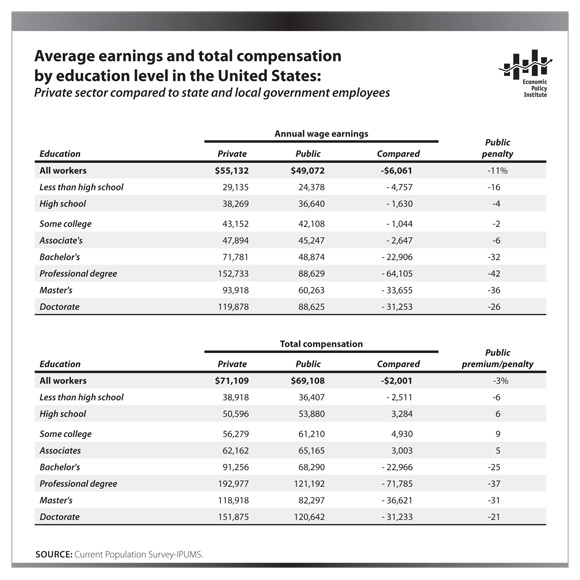
Last year, EPI published a paper by Rutgers University professor Jeffrey Keefe, which supplied overwhelming evidence that public-sector workers, on the whole, earn less than those in the private sector.

Keefe offered some suggestions for why these public employees are often perceived to be overcompensated. For starters, public sector workers are, as a group, more highly educated, work in more highly paid occupations and they tend to work moderately fewer hours than those in the private sector. In addition, it is frequently noted that public employees earn more in benefits such as health care and pensions: therefore, a simple wage comparison will not accurately capture difference in total compensation. Nonetheless, after controlling for multiple factors including level of education, hours worked and non-cash compensation, Keefe found that, on average, full-time state and local employees are undercompensated compared to “otherwise similar private-sector workers.”

Keefe’s 2010 paper, Debunking the Myth of the Overcompensated Public Employee, is highly relevant today as public workers are increasingly blamed for the budget shortfalls of so many state and local governments. A recent series of New York Times stories have focused on this trend, noting that more and more political leaders are demanding concessions from their public workforces, and attempting to pass legislation that would weaken the labor unions that represent much of the public workforce.

Keefe found that private sector workers earned average annual wages of $55,132, $6,061 greater than the $49,072 earned by public sector workers. When looking at total compensation including employer-provided benefits, this gap narrowed but the private sector workers still earned $2,001 more per year than public sector workers ($71,109 in total compensation, versus $69,108). This gap was especially large among more educated workers. College-educated workers on averages earned $22,966 less in total compensation.
Keefe also noted that top political leaders were often the source of this inaccurate information about public worker compensation. Former Massachusetts Governor Mitt Romney, for example, has stated that “average government workers are now making $30,000 a year more than the average private-sector worker.” Keefe’s response: “After an extensive search, we were unable to locate any evidence showing that average government workers earn $30,000 a year more than average private-sector workers.”

Some of his other findings include:

--State and local employees are substantially more educated than their private-sector counterparts. About 54% of state and local full-time employees hold a bachelor’s degree compared to 35% in the private sector.

--Public sector employees receive more of their compensation in the form of benefits than private-sector workers.

--Comparatively high rates of unionization in the public sector have helped to establish a floor on earnings for some lesser skilled workers, while the earnings floor for these workers has collapsed in the private sector.

However, attempting to remove any wage floor would be a misguided policy. EPI research has consistently tracked a failure of wages to keep pace with
productivity gains, which has made it difficult for some fulltime workers to cover their families’ expenses. Leveling downward by cutting public employee compensation and weakening labor unions will only reinforce the three decades of worsening job quality and earnings opportunities for America’s workers and continue the growth of inequality that has weakened the middle class in our nation.

Keefe has also looked into public employee compensation in the state of New Jersey, which has one of the highest rates of union membership in the country.

His 2010 paper, Are New Jersey Public Employees Overpaid? found that full-time state and local employees there are under-compensated by 5.9%, in comparison to private-sector workers, when adjusted for level of education, hours worked and other factors.

The Rest of Kentucky's Story

Life has tossed me several curveballs during the last three months. As a result, I have not been as attentive to my KSN&C musings. My new year’s resolution is to remedy that by writing more.

So blog readers, I wish you a Happy New Year and hopefully I can provide you some thought-provoking commentary.

The “Rest of the Story”

By Penney Sanders

I was always fascinated by the late Paul Harvey’s legendary radio program which provided the story behind the story to news headlines.

As a result, I have looked for what is happening behind the scenes in education to determine what may happen next-reading the tea leaves, so to speak. The tea leaves have been most interesting recently.

It will come as no surprise that I am a fan of Michelle Rhee, the recently deposed chancellor of the DC school system. The headline story was that she resigned prior to a new mayor being elected in Washington. The focus was on how controversial she was in her efforts to reform one of the lowest performing urban school districts in the country.

Rhee showed extraordinary vision and courage in her effort to advocate for the many poorly served students in DC. She exemplified the “no sacred cows” approach to changing schools. It was to be expected that she would run afoul of the educational establishment when she made administrative changes and sought to modify teacher contracts so that poor performing teachers could be more easily dismissed.

She was amazingly determined with a spine of steel. Her efforts produced positive change for children but it certainly irritated a lot of people.

Therefore, her leaving came as no surprise. But where did she go. Ah, that is the rest of the story.

Dr. Rhee has started her own foundation/advocacy group called “Students First”. In that role she intends to continue her work to change poor performing schools with a focus on student outcomes. Additionally, she has joined Florida’s governor-elect Rick Scott as a member of his transition team. In that role, she will help him develop education policy.

Florida’s two previous governors were committed to education transformation: Jeb Bush and Charlie Crist. It is good to see that Rick Scott will continue that strong commitment to educational improvement. Certainly, including Rhee on his transition team indicates he will continue a reform agenda, if not expand it.

This story would be interesting just by itself. However, buried in the education news was the announcement of a new group called “Chiefs for Change.” Five state chiefs: Tony Bennett/ Indiana, Debra Gist/ Rhode Island, Paul Pastorek /Louisiana, Gerard Robinson/Virginia and Eric Smith/Florida.

In the press release, the five indicated they will still work with the education establishment Chief State School Officers Organization(CCSO) on important policy issues, but will “push a subset of policies through the separate group”(Ed Week 12/8/10).

What does this “Gang of 5” bring to the education discussion? Each of these chiefs has exhibited the kind of thinking and leadership that Rhee demonstrated in DC. They are not establishment types. Their focus is on improving student achievement not on maintaining the status quo.

Pastorek is particularly notable because of his work in New Orleans after Hurricane Katrina. As spokesperson for the group, he stated that Chiefs for Change seeks to “set ourselves apart and pursue a more aggressive path toward success…at the top of their agenda: value added evaluations for teachers and principals, more rigorous accountability systems based not on inputs but results; raising academic standards, and expanding school choice.”(Ed Week12/8/10).

Chiefs for Change will be based in the Foundation for Excellence in Education, a group headed by former Florida Governor Jeb Bush.

Do you see a convergence here??? No screaming headlines, just several scattered news stories about an exciting and energized effort around school reform.

These players are poised to dramatically influence public policy on education over the next several years. Each of these six education leaders has battled the “establishment” in their states and now they seek to influence the national agenda.

Overlaying Rhee’s Student First initiative with Chiefs for Change and the announced agenda of Education Secretary Arne Duncan, you can see similar themes which have to do with increased accountability, measureable yearly progress and alternatives for children in failing schools.

As the Kentucky General Assembly begins its deliberations this session, it will be interesting to see how KY’s education policy aligns with the above identified aggressive, student success agenda. What will be the “rest of the KY Education Reform story”?