Last year, EPI published a paper by Rutgers University professor Jeffrey Keefe, which supplied overwhelming evidence that public-sector workers, on the whole, earn less than those in the private sector.
Keefe offered some suggestions for why these public employees are often perceived to be overcompensated. For starters, public sector workers are, as a group, more highly educated, work in more highly paid occupations and they tend to work moderately fewer hours than those in the private sector. In addition, it is frequently noted that public employees earn more in benefits such as health care and pensions: therefore, a simple wage comparison will not accurately capture difference in total compensation. Nonetheless, after controlling for multiple factors including level of education, hours worked and non-cash compensation, Keefe found that, on average, full-time state and local employees are undercompensated compared to “otherwise similar private-sector workers.”
Keefe’s 2010 paper, Debunking the Myth of the Overcompensated Public Employee, is highly relevant today as public workers are increasingly blamed for the budget shortfalls of so many state and local governments. A recent series of New York Times stories have focused on this trend, noting that more and more political leaders are demanding concessions from their public workforces, and attempting to pass legislation that would weaken the labor unions that represent much of the public workforce.
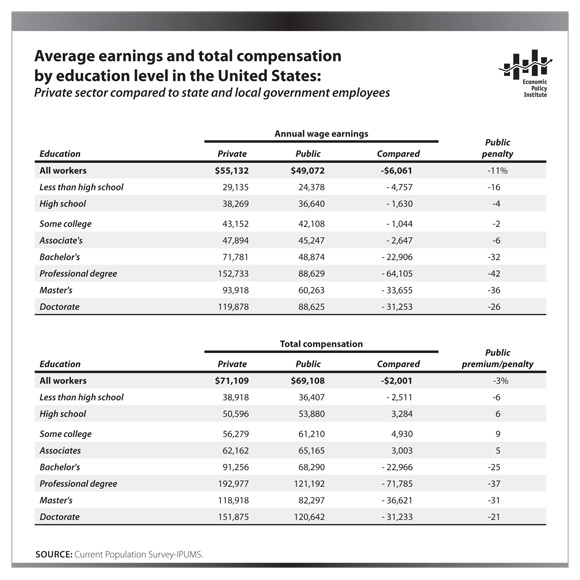
Keefe found that private sector workers earned average annual wages of $55,132, $6,061 greater than the $49,072 earned by public sector workers. When looking at total compensation including employer-provided benefits, this gap narrowed but the private sector workers still earned $2,001 more per year than public sector workers ($71,109 in total compensation, versus $69,108). This gap was especially large among more educated workers. College-educated workers on averages earned $22,966 less in total compensation.

Keefe also noted that top political leaders were often the source of this inaccurate information about public worker compensation. Former Massachusetts Governor Mitt Romney, for example, has stated that “average government workers are now making $30,000 a year more than the average private-sector worker.” Keefe’s response: “After an extensive search, we were unable to locate any evidence showing that average government workers earn $30,000 a year more than average private-sector workers.”Some of his other findings include:
--State and local employees are substantially more educated than their private-sector counterparts. About 54% of state and local full-time employees hold a bachelor’s degree compared to 35% in the private sector.
--Public sector employees receive more of their compensation in the form of benefits than private-sector workers.
--Comparatively high rates of unionization in the public sector have helped to establish a floor on earnings for some lesser skilled workers, while the earnings floor for these workers has collapsed in the private sector.
However, attempting to remove any wage floor would be a misguided policy. EPI research has consistently tracked a failure of wages to keep pace with
productivity gains, which has made it difficult for some fulltime workers to cover their families’ expenses. Leveling downward by cutting public employee compensation and weakening labor unions will only reinforce the three decades of worsening job quality and earnings opportunities for America’s workers and continue the growth of inequality that has weakened the middle class in our nation.Keefe has also looked into public employee compensation in the state of New Jersey, which has one of the highest rates of union membership in the country.
His 2010 paper, Are New Jersey Public Employees Overpaid? found that full-time state and local employees there are under-compensated by 5.9%, in comparison to private-sector workers, when adjusted for level of education, hours worked and other factors.