Showing posts sorted by date for query "school bus". Sort by relevance Show all posts

Thursday, March 09, 2017

Clock running out on neighborhood schools bill


This from the Courier-Journal:
Time is growing very short in the 2017 General Assembly for the controversial bill to allow children to attend the public school closest to their home.
Although Sen. Dan Seum, the champion of the so-called "neighborhood schools bill" in the Kentucky Senate, said earlier this week a new version of the bill would make compromises – primarily that the bill would apply only to grade schools – some key senators said Wednesday they still have concerns.
And the bill is not on the agenda to be considered at Thursday's meeting of the Senate Education Committee.
Sen. Dan Seum
"I think the feeling is that bill is going to languish. I don't think it will move," said Sen. Alice Forgy Kerr, a Lexington Republican who is on the Education Committee. "There's a feeling that we need to be concentrating on the charter schools bill, I know my thinking is that we ought to keep our focus on charter schools."

But Seum said Wednesday he's working to secure votes for the bill in the committee. "I think we still have a very good chance of that happening," he said.

House Bill 151 passed the House on a 59-37 vote two weeks ago. Since then it has been awaiting consideration by the Senate Education Committee. Sen. Mike Wilson, the Bowling Green Republican who chairs that committee, said Wednesday only that the bill is not on his committee's agenda for Thursday, and he referred all other questions about the status of the bill to Seum.
The bill would require school boards across Kentucky to give priority for school assignments to students who live closest to a particular school starting with the 2019-20 term, although it includes exceptions for certain situations and for places like magnet schools. If the nearest school is full, the district would give that child priority for assignment to the next-closest school.

Several senators said they've heard from a huge number of opponents of the bill from Jefferson County who say it could harm black and low-income students, give rise to the return of segregated schools and cause a logistical nightmare.

The Education Committee is comprised of three Democrats and nine Republicans. And it takes seven of the 12 committee members to approve a bill and send it to the Senate floor.

Most Democratic legislators oppose the bill, but support among the committee's Republicans is uncertain. Kerr said she is "probably leaning against the bill." And Sen. Max Wise, a Campbellsville Republican on the committee, said he is opposed.

Six Republican members of the committee said they had not taken a final position on the bill, most of them noting that they had yet to see the substitute bill that Seum described in interviews early this week as restricting the bill to apply to only grade schools.

"I hate to comment on a bill I haven't seen," said Sen. Jimmy Higdon, R-Lebanon. "...If nothing else comes out of this, it has at least started a lot of conversation about the need for change in Jefferson County."

Sen. Stephen West, R-Paris, said, "I see both sides of the issue. We had busing to desegregate – and that was good and helped with the constitutional issues Louisville had at one time. But there's something to be said for a child going to the closest school and not having to sit on a bus for two hours."

Wednesday was the 26th day of a legislative session that can last no more than 30 days. Seum said if the committee does not take up the bill Thursday, he hopes the committee will meet Monday to do so.
"We still have about four or five working days to get this thing on the agenda. It ain't dead yet," he said.

Sunday, March 05, 2017

Study says New Orleans schools spend more on administration and less on teaching after charter transformation

“If you decentralize an entire district, there’s a loss in economies of scale.”

—Christian Buerger, Education Research Alliance


This from the Hechinger Report:
A new report finds that New Orleans schools spend more on administration and less on teaching than than they would have if they had not undergone a transformation to charter schools after Hurricane Katrina.

The research undercuts one argument for charters — that they’re a solution to bloated bureaucracies at parishwide school systems. However, prior research by the same group has concluded that New Orleans’ shift to charters has raised academic performance.
The findings come in a study released in January by the Education Research Alliance for New Orleans. The goal of the study was to assess how school spending patterns have been affected by the city’s shift to charter schools after Hurricane Katrina.

Overall, New Orleans schools — the vast majority of which are charters — spent $1,358 more per pupil on operating expenses, or 13 percent, than a control group in the 2013-14 school year.

Put another way, schools spent that much more than they would have if New Orleans had remained a traditional school district after the storm.

Administrative spending increased $699 per student, or 66 percent, compared to the control group. Meanwhile, instructional spending dropped by $706 per student, or about 10 percent.

Doug Harris, director of the Education Research Alliance and one of the authors of the study, said the shift in spending wasn’t unexpected, but “the size of it was a little bit surprising.”

Christian Buerger, a postdoctoral fellow who worked with Harris on the study, said charter advocates often believe “that traditional school districts spend too much, have too much red tape.”

Their research found the opposite: “We find that charter schools spend even more in that area,” they wrote.

“If you decentralize an entire district, there’s a loss in economies of scale,” Buerger said. That can “lead to an increase in transaction costs.”

For example, parishwide school districts often employ a speech therapist to provide special education for some students. A staffer could have a full schedule by rotating among schools in the district.
A charter management organization, with a smaller enrollment, may not have enough demand for a full-time speech therapist. The charter network could hire a contractor, which often costs more per service hour. But the charter network would still need one of its employees to ensure that students are getting the legally required special education.

As Harris put it, “it’s always cheaper to buy in bulk.”

One New Orleans charter school decided to give up its charter so its students could enjoy the advantages of a larger network. In 2015, the board of McDonogh City Park Academy voted to close it so ReNEW Schools could take it over.

Harris and Buerger found that New Orleans schools spend more on contracted services than the control group.

International School of Louisiana provides an example. In 2014, the school hired a contractor to get its books in order after it had trouble moving to a new payroll vendor. Later, its finance director quit.
At first, the school paid the contractor $14,000 per 10-day period for three workers, though it later cut the cost to $1,000 a week for someone to review the school’s finances weekly.

In addition to lacking economies of scale, Harris and Buerger said charter schools in New Orleans may spend more on administration because they need to provide more training and coaching for their younger workforce.

About half of the increase in administrative costs is due to a rise in in salary expenses. Administrators are being paid more, and there are more of them, Harris and Buerger wrote.

Charter school CEO salaries have long been a topic of discussion in the city. Last spring, NOLA.com/The Times-Picayune reported that the highest paid charter executive earned $262,000 in 2014.

Orleans Parish schools Superintendent Henderson Lewis Jr. earns $180,000 to oversee five traditional public schools and 22 charter schools. He recently announced those five schools will likely become charter schools as well.

However, the additional costs appear to come with academic gains. Harris and Buerger note their findings follow research that shows academics have improved since the charter transformation.
The report notes that even if the reforms are judged positively, it’s not clear that they are financially sustainable.

TEACHERS ARE PAID LESS, HAVE LESS GENEROUS BENEFITS

The drop in instructional expenses — $706 per student — is due mainly to lower salaries and reduced benefits for instructional staff, Harris and Buerger found.

“I don’t think I anticipated that there’d actually be a decline in instructional spending,” Harris said.
After Katrina, with school canceled for the academic year, public school teachers were placed on disaster leave. The Orleans Parish school district couldn’t collect state funding because it didn’t have any students enrolled. So it fired more than 7,000 educators and didn’t renew their collective bargaining agreement.

Now, just a couple schools in the city are unionized.

When schools reopened, many started to hire more teachers through Teach for America and other alternative certification programs. Teach for America members often sign up straight out of college and commit to teaching for two years. The younger workforce has been a point of contention in the city.

The research found that the decline in spending on salaries is due to lower average pay, which in turn “is mainly driven by the 12-year decline in the average experience level” in New Orleans.

Buerger noticed another difference between teachers in New Orleans and elsewhere in the state. “These younger teachers [who] have one or two years experience are getting paid more here than they would in other districts in Louisiana,” he said.

But salaries make up just a third of the instructional spending drop.  Half of it is due to reduced spending on benefits.

Teachers in traditional public schools participate in the Teachers Retirement System of Louisiana, which provides a set pension after they work a certain number of years.

Schools must make a substantial contribution to the pension plan each year; this year, it’s 25.5 percent of the employee’s salary. These contributions have increased in recent years as the state tries to close a funding gap.

The high price deters many charter schools from participating in the teachers’ pension system, so they offer 403(b) plans, which are similar to 401(k) plans. Employees contribute a certain percentage of their pay, and the school may match a portion. Those teachers have no guaranteed pension; their retirement pay is based on the performance of the investments they choose.

In 2013, a single-site charter estimated it would save $250,000 by pulling out of the state pension system and switching to a 403(b) plan.

TRANSPORTATION COSTS UP BY A THIRD

Buerger and Harris also found that transportation costs have risen 33 percent more than they would have if the school hadn’t become predominantly charters. They said they expected that, given new requirements for busing and a school choice model that did away with neighborhood-based schools.
“You can organize transportation in a centralized way, and when you decentralize, it you lose all economies of scale,” Buerger said.

That finding corroborates The Lens’ reporting. In 2013, The Lens surveyed all charter organizations in the city and found that spending and the time students spent on buses had risen with the proliferation of school choice in New Orleans.

Harris said when he talks to charter leaders, they say they like to control their academic calendar and school schedule. This leads them to seek individual bus contracts because it’s hard to coordinate with a charter network that has a different calendar.

“It’s more expensive that way, but they seem to think that’s an important part of allowing them to be distinctive schools,” he said.

That observation also corresponds with our 2013 transportation series. Crocker College Prep’s contract with Hammond’s Transportation cost $1,050 per student. Encore Academy, located in the same building, used Apple Bus Company and paid $785 per student.

Encore’s busing was provided through FirstLine Schools. That year, the Recovery School District also partnered with FirstLine under the Apple contract.

Buerger says there is more research to be done. This study didn’t break out spending differences between charter networks, but he plans to look at that in the future.

“For me as a researcher,” he said, “it’s really exciting to go to the next step and see what kind of variation we have between [charter management organizations] and … single-site schools.”

Thursday, February 16, 2017

Bevin flings hyperbole at JCPS

The strange and temporary alliance of former Senator Ted Kennedy and former President George W. Bush (along with their corporate allies) that led to No Child Left Behind and its romance with test data has also provided fodder for all kinds of claims about the public schools.

Critics and candidates for public office tend to scour the data for weaknesses that might be exploited for their own political gains. School reformers look to the data to argue for more adequate and equitable support for the schools and their vital mission in support of our citizens and our economy. Still others look at the school data and marvel at the public's general lack of understanding about just how far American schools have come.

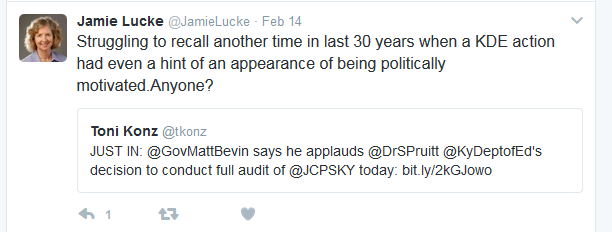
Following a JCPS Board of Education resolution in support of their immigrant students (consistent with the 1982 Supreme Court decision in Plyler v Doe) Kentucky Governor Matt Bevin chose the critic's route and flung hyperbole at the district calling JCPS an unmitigated disaster. The timing is also contemporaneous with Education Commissioner Stephen Pruitt's order to audit the management of the district, which has put Superintendent Donna Hargens under the microscope. It's a hot time in The Ville.

In Plyler v. Doe, (457 U.S. 202 (1982)), SCOTUS ruled that any resources which might be saved from excluding undocumented children from public schools were far outweighed by the harms imposed on society at large from denying them an education.

As a candidate, comments like Bevin's would be expected. But as a governor, not so much.

This from Joe Gerth at the Courier-Journal:

Matt Bevin is courting 'disaster'


It’s a damn good thing business leaders around the country don’t have the internet.

‘Cause if they did, they’d probably read that the Jefferson County’s public education system is a “disaster” and an “absolute unmitigated mess.”

They’d know that if they opened shop in Louisville, they’d find the students here wouldn’t be prepared to go to work for them and don’t have the skills necessary, because the education they got here is a “disaster.”

These aren’t the words of unscrupulous business recruiters from Cincinnati or Indianapolis, or Birmingham or Chattanooga.


The Governor.

Of Kentucky.

There are issues in the Jefferson County Public Schools. We know that.

Far too many of the district’s schools are underperforming. In fact, 18 of them are considered persistently low-achieving schools based on annual tests, according to the state Department of Education website. There are only nine other such schools in the rest of the state.

But there’s no district in the state that’s anywhere near as large as Jefferson County — and that poses problems all its own. Students in Jefferson County schools speak 136 different languages and 7 percent of them have limited ability to speak English.

And more than 60 percent of students are on free or reduced-price lunches, meaning that they live in homes with low incomes — a key indicator that puts them at risk of failing in school.

The state Department of Education announced Tuesday that it was undertaking a full-blown management audit to see if it needs to step in and handle the district’s finances, administration, operations and other responsibilities.

Students have been physically abused at the hands of teachers and administrators, and the district hasn’t done an adequate job of tracking and recording instances in which school personnel have had to restrain students.

But an “absolute, unmitigated mess?” A “disaster?”

Nope.

The district, overall, meets the proficiency standard.

DuPont Manual High School has 44 national merit semifinalists this year. It is one of four Jefferson County schools that have gold or silver status in U.S. News & World Reports' national rankings. Those four schools — Atherton, Brown School and Male are the other three — rank in the top 12 of all Kentucky High Schools.

Doss High School, which is one of the under-performing schools, recently posted the seventh-largest gain in overall achievement of any high school in Kentucky.
Western High School students — also on the list of under-performing schools — saw students complete 1,606 dual-credit hours last year. More than half of the 2016 graduating class received college credit and 10 students this year are on pace to graduate with not just a diploma, but an associate’s degree as well.

And this:

Gov. Matt Bevin calls JCPS an 'unmitigated disaster'


Gov. Matt Bevin called Jefferson County Public Schools an "unmitigated disaster" Wednesday and blasted the state's largest school district for poor educational results in some of its schools.

Bevin, in a morning interview with conservative talk show host Leland Conway, said that "JCPS is a disaster in terms of the educational results. They have more failing schools than the entire rest of the state combined. It is an absolute, unmitigated disaster …"

He also took the JCPS board to task for passing a resolution Tuesday that calls JCPS a safe haven for immigrant students and their families. Bevin said the resolution was illegal and "a smokescreen … a distraction from the fact the system is broken."

Bevin did say JCPS has some schools that "are gems, some of the finest schools – arguably the finest schools in the state." He said the district needs to focus on why some schools are so good, yet others have "failed generation after generation."

"These are the things that JCPS needs to focus on, not trying to skirt the law to win kudos from their liberal friends," Bevin said.

JCPS Superintendent Donna Hargens responded to Bevin's comments, saying that "JCPS has many of the top schools in the state and it also has the challenges of educating students who come to school with a variety of social and emotional needs." She said the district is proud of its inclusive and diverse learning environments.

"The doors of our schools are always open, and JCPS welcomes a collaborative and constructive conversation with Gov. Bevin about how we can continue boosting student achievement, not only in this district, but throughout our commonwealth," Hargens said in a statement.

A JCPS spokeswoman said that Bevin has not visited any JCPS school since becoming governor. Bevin’s children were enrolled in Portland Christian School when he was elected governor in 2015.

Rob Mattheu, parent of a freshman at duPont Manual High and a frequent attendee at JCPS board meetings, said he was disgusted when he saw news reports of Bevin's comments Wednesday.

"We all agree (JCPS) could be better," Mattheu said. "But the way of fixing that is not just saying it's a disaster. ... You have to be a fair critic of what's going on and understand the challenges they face."
Mattheu said he is tired of politicians and others "attacking JCPS with no real knowledge of the system." He noted that JCPS has to educate every child that comes to it, regardless of their background. Mattheu invited Bevin to talk to parents and teachers in Jefferson County to get a clearer understanding of the challenges the district faces.

Gay Adelmann, co-founder of the community group Dear JCPS, said there "absolutely" are problems with JCPS and that "district leaders most definitely need to be held more accountable."

But, she said, "we don't need state leaders who don't understand the complexities of our district coming in and constantly dismantling things that are working, making change for the sake of change."

Bevin's comments about schools in JCPS that have failed "generation after generation" echoes sentiments made by former Kentucky Education Commissioner Terry Holliday in 2013 when he derided the lack of progress at some JCPS schools as "academic genocide." (Holliday in later months applauded gains made at some of those schools.)


Brent McKim, president of the county's teachers union, said that JCPS faces "more challenges than any other Kentucky county," but that JCPS has been improving "faster than the state in many ways." He said JCPS parents and students need more support and resources from Bevin, "not criticism of the schools where educators are working their hearts out to help all their students succeed."

He added that "the governor fully funding the (Kentucky) Teacher Retirement System helps us attract and retain good teachers."

Sadiqa Reynolds, president and chief executive of the Louisville Urban League, said that people should stop "political grandstanding" and instead work together to focus resources on how to help children.

"The governor should be encouraging the school boards to get behind their leaders and execute a plan with equity and closing the achievement gap in mind," Reynolds said in a statement.

She also said that "children benefit from being exposed to people who are different from them. Failing at this, we risk growing them into myopic tyrants who lead in ways that endanger us all."
She said "we should be ashamed" that declaring schools to be safe havens is even a question.
The school board on Tuesday evening approved the safe haven resolution in a divided vote, with three of its seven members abstaining and four in support. The resolution says that JCPS will resist requests from federal immigration officials to share data or resources — unless compelled by a valid court order — that could help identify students or families who are potentially undocumented.

It states that JCPS employees, contractors, volunteers and others cannot disclose information about a student or family's immigration status to Immigration and Customs Enforcement without a valid court order or permission from a parent or guardian. And, among other things, it says immigration enforcement personnel can't be given access to JCPS campuses without the superintendent's review and approval.

The resolution lays out what has already been district policy and practice. Board member Lisa Willner on Tuesday stressed that the board is "not advocating for disobeying federal law, state law, local law."

Board Chairman Chris Brady, who proposed the safe haven resolution, said it is meant to reassure students and families that JCPS is doing everything it can to provide a safe, welcoming environment that is conducive to learning.

Brady said Wednesday that he did not hear Bevin's interview on the radio but said that "anyone can review the resolution and note that it adheres to the rule of law."

Indeed, K-12 student information is already protected by federal and state privacy laws. In addition, public schools in the U.S. may not ask about the immigration or citizenship status of students to establish local residency, thanks largely to a 1982 U.S. Supreme Court case that ruled that children are entitled to a free public education regardless of immigration status.

Board member Steph Horne abstained from the vote on the resolution Tuesday, saying that she had concerns that passing such language could cause unnecessary problems and draw ire from state and national leaders.

"Setting up our board of education as an antagonist against our governor and president is a fight that is not in the greater interest of our students," Horne said. She added that one of the board's duties is to not take actions that could "put JCPS or students at risk of a cutoff of state (or) federal funds."

Also in Wednesday's radio interview, Bevin asked why JCPS was still busing children.

"Are we really helping these children by taking them from one community, putting them on a bus … to another community where arguably they should be getting a better education but frankly they may or may not be, and then pulling them out of there before they can participate in any kind of extracurricular activities …" Bevin said.

Bevin said such students "don’t actually belong to any community anywhere." He called them "educational nomads that are moving around on JCPS buses."

He called busing "an antiquated approach that frankly needs to be re-examined."

Brady said that, as a parent of JCPS students, he's thankful the district has an assignment plan that gives him a choice of where to send his children.

"All of our students in JCPS and those in public schools across the state need the governor's support, not attacks," Brady said. "We welcome the opportunity to have a constructive conversation and (find) common ground from which we can work to benefit all students."
 And this:

#NotADisaster: JCPS teachers respond to Bevin

In response to Gov. Matt Bevin labeling Jefferson County Public Schools an "unmitigated disaster," teachers and administrators on Thursday started a social media campaign refuting the remark and inviting the governor to visit.

Hundreds of JCPS teachers, principals and parents posted photos of classrooms and students accompanied by the hashtag #NotADisaster. Some also added the hashtag #wearejcps.

A JCPS spokeswoman said Wednesday that Bevin has not visited any JCPS school since becoming governor. Bevin’s children were enrolled in Portland Christian School when he was elected governor in 2015.

Robin "MeMe" Ratliff, co-founder of teacher-led connection group JCPSForward, said she isn't sure who first started the hashtag but, "by this morning it was going pretty hard." JCPS educators began spreading word of the movement to each other via direct message, email and text message.

"It was an extension of the anger lots of folks are feeling with the state of the government in general, not just in Kentucky but across the nation," Ratliff said of the hashtag. "I think you're seeing teachers use social media not just for the Kardashians but as an advocacy resource — standing up for your profession, standing up for what you believe in and for public education."

Kelly Armstrong, a special education teacher at Semple Elementary, was one of the teachers who joined the campaign to firmly challenge Bevin's perception.

"I'm a 16 year special education teacher and my classroom is NOT an unmitigated disaster. Come visit. #notadisaster," she wrote on Twitter.

Bryan Quillen, a 10th grade English teacher at Fairdale High School, tweeted, "Hey @GovMattBevin. Maybe you should stop by Fairdale HS. I would LOVE to see you eat your words. Room 218. #notadisaster #wearejcps."

Southern High School teacher Alison Moore posted photos of her AP U.S. History students working and "discussing Social Darwinisim and laissez-faire capitalism" along with the hashtag.

Hite Elementary School computer teacher Beth Kolodey tweeted a photo of her third-grade students building geodesic structures along with the hashtag.

Kolodey is a JCPS graduate, as are her husband and their two children. She was an accountant before switching into the teaching profession in the early 2000's, a change she said was inspired by the need to make a difference.

"I think it's one of the most important things we can do for our future generations, to protect our children by educating them," Kolodey said.

Ratliff said the quickness with which the #NotADisaster spread "goes to show the passion and collective pride that JCPS educators have" and demonstrates the ferocity with which they reacted to Bevin's comments.

Bevin, in a morning interview with conservative talk show host Leland Conway, said that "JCPS is a disaster in terms of the educational results. They have more failing schools than the entire rest of the state combined. It is an absolute, unmitigated disaster …"

Bevin also slammed the JCPS board for passing a resolution Tuesday that calls JCPS a safe haven for immigrant students and their families. Bevin said the resolution was illegal and "a smokescreen … a distraction from the fact the system is broken."

Bevin's statements "invalidated and degraded the work of 6,700 educators in our district," Ratliff said.

Terry Brooks, the executive director of Kentucky Youth Advocates, said Thursday he agrees that there is a lot of great work happening on JCPS campuses, saying five of his grandchildren go to the district’s schools. And he said those successes should be noted and rewarded. But he said just looking at the “individual heroes” does not give a big enough look at how well the district is performing as a system.

“Folks rightfully say we have great teachers and principals,” Brooks said. “At the individual classroom and school level, there are a myriad of school successes. But they’re in spite of the district’s leadership, not because of the district’s leadership.”

Brooks also pointed to a recent district survey that found that only half of school-based certified staff think that JCPS Superintendent Donna Hargens and other central office administrators are providing effective leadership in support of schools.

Hargens responded to Bevin's comments Wednesday, saying that "JCPS has many of the top schools in the state and it also has the challenges of educating students who come to school with a variety of social and emotional needs." She said the district is proud of its inclusive and diverse learning environments.

"The doors of our schools are always open, and JCPS welcomes a collaborative and constructive conversation with Gov. Bevin about how we can continue boosting student achievement, not only in this district, but throughout our commonwealth," Hargens said in a statement.

Ratliff said she is going to Frankfort later this week to invite Bevin to attend a JCPS professional learning event Feb. 24-25 in Louisville.

"I don't need the governor to do a whole school tour," she said. "I'd be happy if he just came to one school and actually talked to educators and students."

Kolodey said she thinks Bevin visiting a school would be a great start.

"It's easy to condemn," she said, "but it's harder to be part of a solution."

Wednesday, March 23, 2016

How do the schools really stack up?

Over at School Finance 101 Bruce Baker is doing his year end review of education data on the New Jersey schools. But his review contains some news that applies to Kentucky and all other states as well. I have added a few bits to highlight Kentucky's performance.

This from School Finance 101:
On many occasions I’ve pointed out better and worse uses of national and international assessment data – of Mis-NAEPery and PISA-Palooza… wherein the media and punditocracy go wild with gross misrepresentations and misinterpretations of relatively limited albeit not entirely useless assessment data.

In New Jersey, we’ve been told in recent years that while our average scores remain high, we must not rest on our laurels, because our gains pale by comparison to reformy standout states like Tennessee. We’ve been told that while our average performance is high, our gaps in achievement are among the largest in the nation and certainly not improving at any reasonable rate. We’ve also been told that these findings provide strong proof that all the money New Jersey has thrown at schools in response to years of litigation over school funding has not only been unhelpful, but that the additional funding to high poverty settings has actually caused harm. As such, the way to repair that harm is to reduce funding to high need settings and redistribute those harmful resources across other, less needy districts likely to use it more wisely (yeah… really… they did say that… and they’ve followed through on that redistribution plan!) And that will help fix the achievement gap!

But what really is the state of student outcomes in New Jersey, if we apply a few basic principles to the analysis of NAEP data – guidelines I have addressed in numerous previous posts:
  • First, average state contexts differ and those differences strongly influence average NAEP scores at all grade levels. In short, poverty matters! As such, performance levels should be adjusted for poverty.
  • Second, NAEP gains over time (which are cohort gains), are strongly influenced by initial NAEP performance. That is, those who started lower and had more to gain, gained more. As such, changes over time should be adjusted for initial scale scores.
  • Third, achievement gaps between low income and non-low -income, or among races are substantially influenced by the income gaps between these groups. As such, achievement gaps should be adjusted for differences in income between groups.

Average Performance Level Adjusted for Poverty

This first figure shows us the scatterplot of state average poverty rate and average 8th grade NAEP scale scores. Those states falling above the line have greater than expected scale scores and below the line have lower than expected scale scores. Notably, the correlations are quite strong. New Jersey beats the odds on both 8th grade reading and math. That is, NJ scores are higher than would be expected even given New Jersey’s low poverty rate?

Figure 1


If we rank states by their average difference from expectations, New Jersey comes in fifth (averaging the math and reading differentials). [Kentucky comes in 7th!]

Figure 2
Slide2

But that’s only because the whole U.S. stinks, right?

Of course, some might argue that its really nothing to cheer about – doing better than other U.S. states, because of course, we all know that the U.S. performs miserably compared to other nations. But as I’ve pointed out previously, when conducting similar poverty adjusted comparisons across countries, the U.S. doesn’t look so bad. (see here for more explanation/discussion)

Figure 3
Slide11

Ah… but you say… outcomes of even high performing – non-low income kids in the U.S. still stink compared to those in other countries. Again, I respond by pointing out that most such comparisons are deeply conceptually flawed. Perhaps most importantly, as I’ve explained on numerous previous posts, the U.S. average is only as low as it is in international comparisons because of the large number of low performing (relatively high poverty) states that have largely thrown their education systems under the bus for the past several decades...

Here are a few more pictures...


Thursday, March 10, 2016

Ex-principal suing Fayette County schools claims retaliation

Former Cardinal Valley principal complained about treatment of Hispanic students

Lawsuit: She was told, ‘No one cares about those Mexican kids with a bunch of illegal parents’

Fayette County school district seeks ruling to avoid jury trial

KSN&C Backstory:

This from the Herald-Leader:
Ivonne Beegle, the former principal of Cardinal Valley Elementary School who said she was asked in 2012 to resign or be fired, alleges in a court document that she was retaliated against because she complained about unequal treatment of her and Hispanic students.

Beegle tells her side of the story in a document filed Feb. 29 in her lawsuit against Fayette County Public Schools officials in response to the school district’s request for a summary judgment. Fayette Circuit Judge Tom Clark is scheduled to consider the district’s request Friday. A summary judgment would cancel a mid-April jury trial.

Beegle, who became principal in the 2007-2008 school year, said that at one point, she was told by a supervisor, “Do not complain. No one cares about those Mexican kids with a bunch of illegal parents.”

The document cites a 2014 deposition that then-Fayette Superintendent Tom Shelton gave in which he was quoted as saying that it was shocking to him that the district didn’t have an adequate focus on “what I consider equity for students such as those that made up the majority of the student population at Cardinal Valley.”

Beegle, who is a native of Nicaragua, said she made numerous complaints of illegality, mismanagement and discrimination while she was at Cardinal Valley.
After her resignation, Beegle filed a lawsuit in 2013 asking for lost wages and benefits, emotional distress damages, and attorney fees and costs.

In the court document, Beegle said that district officials knew she had nothing to do with her administrative dean placing a tape recorder in a flower pot and taping teachers as they talked to district officials. The district officials were investigating a grievance that Beegle had harassed a teacher. The taping incident led to Beegle’s suspension, and district officials told her she could resign or be fired.

Beegle contends in the court document that as a manager, she demanded accountability from employees, and her management style angered a few employees.

In 2012, an attorney for the school district told Beegle in a letter that her conduct fell below the conduct required of a Fayette County school employee because she was aware of the secret recording of private employee interviews during a civil rights investigation conducted by a district staffer. The letter said Beegle shared the recordings with Cardinal Valley employees, failed to report the recording with district leadership and retaliated against certain employees who were interviewed during the civil rights investigation.

Beegle said in her court document that “knowing that she did not do these things, but desperate and confused, (she) resigned her employment in lieu of termination.”

In a Jan. 19 court document asking for a judgment that would avoid a jury trial, school district attorney Bob Chenoweth said Beegle has failed to state a claim on several fronts.

The district’s motion said Beegle can’t show that her employer took action or threatened to take action against her.

On Tuesday, Chenoweth declined to comment beyond the court documents.

Beegle’s attorney, Chris Miller, also declined to comment..

In the court document signed by Miller, Beegle said that Cardinal Valley was regularly treated differently than other schools.

During her tenure as principal, Beegle said, she had complained about black mold in the school buildings, overcrowded classrooms, a teacher getting into a fist fight with a student, and the district’s misappropriation of federal funding by allowing a teacher to attend leadership meetings instead of working with underprivileged children as required. She voiced concerns about buses dropping off students at the school before staff had arrived and about a school bus monitor who had leered at students and kicked students off the bus for speaking Spanish.

Beegle contends that despite high numbers of low-income children, and children who were learning the English language, she was able to show double-digit gains in test scores in both math and reading. Before being suspended, she received outstanding evaluations and awards, the court document said.