Wednesday, March 08, 2017

SB 153: Scrap the bill, keep the metrics

“We can talk about performance-based funding and all the
 different goals that are set out in the bill … 
but the simple fact of the matter is that unless this General Assembly 
is willing to put more money into postsecondary education as we go
forward, the cost of a college degree will only continue 
to increase for tens of thousands of Kentucky students 
who want to better their lives,”

 --Senate Minority Leader Ray Jones, D-Pikeville

The big selling point in favor of Senate Bill 153 is the fact that all university presidents - with varying degrees of enthusiasm - signed off on the proposal. What our legislative leaders fail to point out in testimony before their peers, however, is the other message that was delivered - that failure of the university presidents to agree to a plan would lead to a legislatively imposed funding system that would likely be even worse. I do not mean to suggest that the presidents were threatened. I have no reason to doubt that they were promised. But as UK Trustee David Hawpe observed, "when the Council on Post-secondary Education leadership and the campus presidents knuckled under to the governor’s bullying, the game was over."

The goal of Senate Bill 153 “is to change this funding model, to refocus us on that goal of degree attainment,” said Senate President Pro Tem David Givens, R-Greensburg, who is a primary sponsor of the legislation, along with Sen. Mike Wilson, R-Bowling Green. But degree attainment is already central to every university's mission, and has been under higher ed reform.  


A 2011 study found that Kentucky significantly increased the rate at which bachelor’s degrees were produced in the 12-year period of time following passage of reform legislation in 1997 - at a 36% rate, which is greater than more than half of the other states. 

Staying on pace, in 2016, CPE reported that Kentucky "conferred a record 65,829 degrees and credentials during the 2015-16 year, representing a 2.7 percent increase from the previous year and a 32.5 percent gain over 10 years."

Senate Majority Floor Leader Damon Thayer, R-Georgetown, said university funding has lacked accountability. If that is true, it can only mean that the legislature has not paid attention to the performance data that is already available. What is lacking however, is a formal process of annually vetting accountability data publicly in the manner that we publish K-12 school accountability data. That could happen without legislation.

Aside from that, there's really not much to recommend performance funding. The Century Foundation report, "Why Performance-Based College Funding Doesn’t Work" found that "while pay-for-performance is a compelling concept in theory, it has consistently failed to bear fruit in actual implementation, whether in the higher education context or in other public services. Despite the logic, research shows that tying financial incentives to performance measures rarely results in large or positive outcomes that are sustained over time." While the rationale sounds promising, 12 different studies have failed to establish that performance funding in higher ed has worked anywhere. In Indiana, where performance funding has been in use since 2003, "universities have become more selective and less diverse while also not improving degree production." After a decade of performance-based funding Pennsylvania failed to produce more degrees. Tennessee jacked up their financial incentives, thinking that would do the trick, but graduation and retention rates failed to improve.

It may be easy to count graduates,but producing them is a different matter.

At a time when our state needs a greater percentage of our citizens to be highly-educated in order to satisfy the ever-increasing demands of business and industry, we find that long-term disregard for our state pension systems has left Kentucky ill-equipped to support other critical needs

What Senate Bill 153 does very well is give politicians a performance-based rationale for continuing to under-fund its universities. It is that disinvestment that is driving up tuition costs - the only alternative being a lowering of academic standards, removal of more programs and teachers, or a fundamental change in the very nature of campus life which would likely push Kentucky students toward other states' institutions.

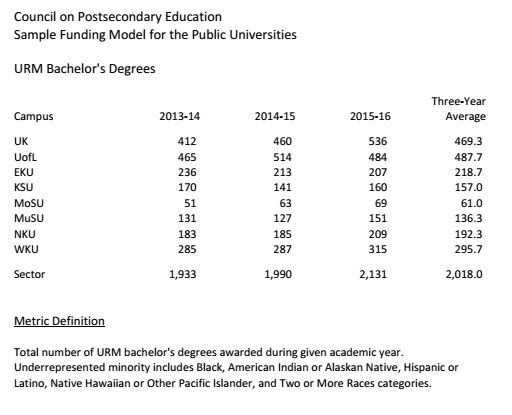
But by all indications SB 153 is set to pass. So to promote better understanding of the metrics involved, KSN&C submitted an open records request to gain “any and all public records related to the most recent institutional data for each university overseen by CPE that could potentially be impacted by Senate Bill 153 including, but not limited to, numbers of degrees conferred, students enrolled, credit hours earned, and all other factors anticipated in the legislation.” The data we received from CPE is meant to provide current metrics for each institution as if SB 153 were in effect today. If deployed, this model would be updated as new data is received from the institutions. Here's the bottom line:


If performance funding were in effect today, UK would effectively capture $1.6M that UofL loses, Morehead would be penalized $2.9M, and I suspect, Kentucky State would close, or come close to it. Of course, K State is being held harmless for the time being, while WKU and NKU received extra support.


 https://drive.google.com/file/d/0B_ChD3Okq_aYT29JREpnYW95V0U/view?usp=sharing


https://drive.google.com/file/d/0B_ChD3Okq_aYbms3MW9aVEIzTTA/view?usp=sharing


 https://drive.google.com/file/d/0B_ChD3Okq_aYbms3MW9aVEIzTTA/view?usp=sharing


https://drive.google.com/file/d/0B_ChD3Okq_aYMEtkY1NBSEJhRDg/view?usp=sharing

https://drive.google.com/file/d/0B_ChD3Okq_aYLWEtSGI4VlFvSzQ/view?usp=sharing

https://drive.google.com/file/d/0B_ChD3Okq_aYZk4xQW1lcTlScHM/view?usp=sharing
https://drive.google.com/file/d/0B_ChD3Okq_aYWENqWXlfN1FwU2s/view?usp=sharing

https://drive.google.com/file/d/0B_ChD3Okq_aYdWxmNjVfakdadjg/view?usp=sharing

https://drive.google.com/file/d/0B_ChD3Okq_aYSG1mMDN6eG9kVzQ/view?usp=sharing

https://drive.google.com/file/d/0B_ChD3Okq_aYa0FvZURDbkhZdXM/view?usp=sharing


https://drive.google.com/file/d/0B_ChD3Okq_aYSndxMDdxS1EzQVk/view?usp=sharing


https://drive.google.com/file/d/0B_ChD3Okq_aYRU5KeEpaOXNSTnc/view?usp=sharing


https://drive.google.com/file/d/0B_ChD3Okq_aYTV9IQWtNYTNaYUE/view?usp=sharing

Monday, March 06, 2017

Betsy DeVos’s Power Over Black Colleges

This from Ivory Toldson in The New York Times:
President Trump meeting with HBCU leader
Betsy DeVos, the education secretary, deserved the hammering she received for her widely reviled comments characterizing historically black colleges and universities (H.B.C.U.s) as early examples of “school choice.” But when it comes to the fate of H.B.C.U.s under the Trump administration, her apparent misunderstanding of their history is a distraction.

The fate of these institutions in the coming years will hinge not on her words, but on her decisions about their funding.

In February, after only a few days on the job, Ms. DeVos made headlines for visiting Howard University, a historically black college founded in 1867. Then, after a meeting with H.B.C.U. leaders Monday, she released a statement calling H.B.C.U.s the “real pioneers when it comes to school choice.” That description was widely criticized as a dishonest attempt to distance these institutions from the segregated past that necessitated them and to awkwardly re-position them as talking points for the school choice movement.

But her misguided remarks have diverted attention away from something more urgent: She now oversees the federal agency that is responsible for roughly three-fourths of the annual federal revenue to H.B.C.U.s. In ways that are much more consequential than any statement she could make, this power will allow her to determine how the schools fare under the Trump administration.

Tuesday, President Trump issued an executive order moving the White House Initiative on HBCUs (WHI-HBCUs) from the Department of Education to the Office of the White House. Some H.B.C.U. advocates supported this move because of their impression that it would strengthen the administrative authority of the initiative and elevate the stature of its executive director. However, moving the WHI-HBCUs from the Department of Education to the White House distances the initiative from the source of essential funding for H.B.C.U.s. That’s because the Education Department is responsible for the distribution of approximately $700 million annually in grants, contracts and appropriations to those schools. But when it comes to annual revenue to H.B.C.U.s, the Office of the President is directly responsible for zero dollars.

This arrangement leaves Ms. DeVos with significant power. H.B.C.U. advocates and defenders like me should focus less on dissecting her talking points and misstatements and more on seeking answers to specific questions about her attitudes toward the funding of historically black colleges in the present day.

First, what are Ms. DeVos’s plans related to Title III, the federal grant program within the Department of Education designed to build the capacity of H.B.C.U.s? President Obama’s budget for the 2017 fiscal year, which never passed, sought to maintain and strengthen these opportunities for H.B.C.U.s to build their capacity. It included a proposal for $85 million in mandatory funding to the schools, as well as $244.7 million in discretionary Title III funding. Will Ms. DeVos maintain or increase these levels of funding?

Second, will Ms. DeVos create new grant programs and contracting opportunities for H.B.C.U.s? President Obama proposed $30 million for a program designed to increase the number of low-income students completing degree programs. Will she work with Congress to include similar programs in the federal budget?

Third, what are Ms. DeVos’s views on college affordability? In his budget proposal to Congress last year, President Obama requested $60.8 billion in mandatory funding over the next decade to help states make two years of community college free, as well as to offer grants to provide free or reduced tuition to students at H.B.C.U.s and minority-serving institutions in their first two years. Will Ms. DeVos be supportive of similar measures?

Finally, will Ms. DeVos protect and expand the Pell Grant program? Approximately 73 percent of all H.B.C.U. students receive Pell Grants to fund their education. Before leaving office, President Obama and his education secretary, John King, issued proposals to ensure that Pell Grants were fully funded. Mr. Obama’s 2017 fiscal-year budget included mandatory protections of Pell Grants. How will Ms. DeVos protect this essential source of funding?

The answers to these questions will have enormous bearing on the futures of colleges and universities that serve students who have been historically disenfranchised. As budget priorities are set for these vulnerable institutions, Ms. DeVos has the potential to be an important influencer of the president and negotiator with Congress. It will be her actions in this area — not her campus visits, meetings or comments — that will determine whether she is ultimately a friend or foe to H.B.C.U.s.
Ivory A. Toldson, a professor at Howard University and the president of Quality Education for Minorities, is the former director of the White House Initiative on Historically Black Colleges and Universities. Toldson is also Editor-in-Chief of The Journal of Negro Education where I have published and participated in peer reviews.

Sunday, March 05, 2017

Study says New Orleans schools spend more on administration and less on teaching after charter transformation

“If you decentralize an entire district, there’s a loss in economies of scale.”

—Christian Buerger, Education Research Alliance


This from the Hechinger Report:
A new report finds that New Orleans schools spend more on administration and less on teaching than than they would have if they had not undergone a transformation to charter schools after Hurricane Katrina.

The research undercuts one argument for charters — that they’re a solution to bloated bureaucracies at parishwide school systems. However, prior research by the same group has concluded that New Orleans’ shift to charters has raised academic performance.
The findings come in a study released in January by the Education Research Alliance for New Orleans. The goal of the study was to assess how school spending patterns have been affected by the city’s shift to charter schools after Hurricane Katrina.

Overall, New Orleans schools — the vast majority of which are charters — spent $1,358 more per pupil on operating expenses, or 13 percent, than a control group in the 2013-14 school year.

Put another way, schools spent that much more than they would have if New Orleans had remained a traditional school district after the storm.

Administrative spending increased $699 per student, or 66 percent, compared to the control group. Meanwhile, instructional spending dropped by $706 per student, or about 10 percent.

Doug Harris, director of the Education Research Alliance and one of the authors of the study, said the shift in spending wasn’t unexpected, but “the size of it was a little bit surprising.”

Christian Buerger, a postdoctoral fellow who worked with Harris on the study, said charter advocates often believe “that traditional school districts spend too much, have too much red tape.”

Their research found the opposite: “We find that charter schools spend even more in that area,” they wrote.

“If you decentralize an entire district, there’s a loss in economies of scale,” Buerger said. That can “lead to an increase in transaction costs.”

For example, parishwide school districts often employ a speech therapist to provide special education for some students. A staffer could have a full schedule by rotating among schools in the district.
A charter management organization, with a smaller enrollment, may not have enough demand for a full-time speech therapist. The charter network could hire a contractor, which often costs more per service hour. But the charter network would still need one of its employees to ensure that students are getting the legally required special education.

As Harris put it, “it’s always cheaper to buy in bulk.”

One New Orleans charter school decided to give up its charter so its students could enjoy the advantages of a larger network. In 2015, the board of McDonogh City Park Academy voted to close it so ReNEW Schools could take it over.

Harris and Buerger found that New Orleans schools spend more on contracted services than the control group.

International School of Louisiana provides an example. In 2014, the school hired a contractor to get its books in order after it had trouble moving to a new payroll vendor. Later, its finance director quit.
At first, the school paid the contractor $14,000 per 10-day period for three workers, though it later cut the cost to $1,000 a week for someone to review the school’s finances weekly.

In addition to lacking economies of scale, Harris and Buerger said charter schools in New Orleans may spend more on administration because they need to provide more training and coaching for their younger workforce.

About half of the increase in administrative costs is due to a rise in in salary expenses. Administrators are being paid more, and there are more of them, Harris and Buerger wrote.

Charter school CEO salaries have long been a topic of discussion in the city. Last spring, NOLA.com/The Times-Picayune reported that the highest paid charter executive earned $262,000 in 2014.

Orleans Parish schools Superintendent Henderson Lewis Jr. earns $180,000 to oversee five traditional public schools and 22 charter schools. He recently announced those five schools will likely become charter schools as well.

However, the additional costs appear to come with academic gains. Harris and Buerger note their findings follow research that shows academics have improved since the charter transformation.
The report notes that even if the reforms are judged positively, it’s not clear that they are financially sustainable.

TEACHERS ARE PAID LESS, HAVE LESS GENEROUS BENEFITS

The drop in instructional expenses — $706 per student — is due mainly to lower salaries and reduced benefits for instructional staff, Harris and Buerger found.

“I don’t think I anticipated that there’d actually be a decline in instructional spending,” Harris said.
After Katrina, with school canceled for the academic year, public school teachers were placed on disaster leave. The Orleans Parish school district couldn’t collect state funding because it didn’t have any students enrolled. So it fired more than 7,000 educators and didn’t renew their collective bargaining agreement.

Now, just a couple schools in the city are unionized.

When schools reopened, many started to hire more teachers through Teach for America and other alternative certification programs. Teach for America members often sign up straight out of college and commit to teaching for two years. The younger workforce has been a point of contention in the city.

The research found that the decline in spending on salaries is due to lower average pay, which in turn “is mainly driven by the 12-year decline in the average experience level” in New Orleans.

Buerger noticed another difference between teachers in New Orleans and elsewhere in the state. “These younger teachers [who] have one or two years experience are getting paid more here than they would in other districts in Louisiana,” he said.

But salaries make up just a third of the instructional spending drop.  Half of it is due to reduced spending on benefits.

Teachers in traditional public schools participate in the Teachers Retirement System of Louisiana, which provides a set pension after they work a certain number of years.

Schools must make a substantial contribution to the pension plan each year; this year, it’s 25.5 percent of the employee’s salary. These contributions have increased in recent years as the state tries to close a funding gap.

The high price deters many charter schools from participating in the teachers’ pension system, so they offer 403(b) plans, which are similar to 401(k) plans. Employees contribute a certain percentage of their pay, and the school may match a portion. Those teachers have no guaranteed pension; their retirement pay is based on the performance of the investments they choose.

In 2013, a single-site charter estimated it would save $250,000 by pulling out of the state pension system and switching to a 403(b) plan.

TRANSPORTATION COSTS UP BY A THIRD

Buerger and Harris also found that transportation costs have risen 33 percent more than they would have if the school hadn’t become predominantly charters. They said they expected that, given new requirements for busing and a school choice model that did away with neighborhood-based schools.
“You can organize transportation in a centralized way, and when you decentralize, it you lose all economies of scale,” Buerger said.

That finding corroborates The Lens’ reporting. In 2013, The Lens surveyed all charter organizations in the city and found that spending and the time students spent on buses had risen with the proliferation of school choice in New Orleans.

Harris said when he talks to charter leaders, they say they like to control their academic calendar and school schedule. This leads them to seek individual bus contracts because it’s hard to coordinate with a charter network that has a different calendar.

“It’s more expensive that way, but they seem to think that’s an important part of allowing them to be distinctive schools,” he said.

That observation also corresponds with our 2013 transportation series. Crocker College Prep’s contract with Hammond’s Transportation cost $1,050 per student. Encore Academy, located in the same building, used Apple Bus Company and paid $785 per student.

Encore’s busing was provided through FirstLine Schools. That year, the Recovery School District also partnered with FirstLine under the Apple contract.

Buerger says there is more research to be done. This study didn’t break out spending differences between charter networks, but he plans to look at that in the future.

“For me as a researcher,” he said, “it’s really exciting to go to the next step and see what kind of variation we have between [charter management organizations] and … single-site schools.”

Saturday, March 04, 2017

Where key Ed bills stand with 7 days to go

This (edited) from the Herald-Leader:
The 2017 General Assembly enters its final phase Monday as Republican leaders prepare for Gov. Matt Bevin a stack of legislation on university funding, religious expression, medical malpractice, workers’ compensation and many other subjects.

The Kentucky House and Senate are scheduled to continue passing bills through Wednesday, then recess until March 14, when they will return for two days of voting on “concurrence” — deciding whether or not to agree with any changes that have been made to their bills by the other chamber.
Next, Bevin, a Republican, will get two weeks to veto legislation if he chooses. Lawmakers return to the Capitol on March 29 and 30 to act on Bevin’s vetoes, if there are any, and conclude their 30-day session.

Here is where some noteworthy [education] bills that have passed at least one chamber stood on Friday:
  • House Bill 128, which would allow school districts to offer elective Bible study classes, awaits a hearing in the Senate Education Committee.
  • House Bill 151 would permit children to attend the school nearest their home, causing concern in Louisville, where a racial desegregation plan involves moving some children outside of their neighborhoods to create greater classroom diversity. It awaits a hearing in the Senate Education Committee.
  • Senate Bill 1, which would establish a new process for intervening in low-performing schools and reviewing classroom academic standards, awaits a hearing in the House Education Committee.
  • Senate Bill 17, which details the right of public students to express religious viewpoints in school, awaits a final vote on the House floor.
  • Senate Bill 107 would grant sweeping powers to the governor to abolish every public educational governing board in Kentucky, including those at state universities, the Kentucky Board of Education and the Council on Postsecondary Education. It awaits a hearing in the House State Government Committee.
  • Senate Bill 153, which would create a new method of funding higher education, funneling $1 billion to state universities based on their graduation rates and other performance measures, awaits a hearing in the House budget committee.
d more here: http://www.kentucky.com/news/politics-government/article136253033.html#storylink=cpy

‘Intolerable’ Inequities

“I think there’s a clear supermajority of legislators that want to 
move away from Brownback economics and the failed tax experiments.” 

--Kansas State Representative Jim Ward 

The debate over school funding in Kansas goes back to the 1960s when the Legislature added an article to the Constitution that read, “the Legislature shall make suitable provision for finance” of public education. A court case decades later that ended with lawmakers agreeing to provide $4,492 in base aid per student, but that goal was never reached, due in some measure to the nationwide financial crisis. By the 2008-9 academic year the figure began a downward slide, which has continued under Kansas Governor Sam Brownback and led to the current lawsuit which claimed that the Legislature was failing to meet its constitutional obligation to adequately fund schools.

The case not only cited Kentucky's Rose v Council for Better Education (1989) decision but  has potential implications for Kentucky schools today.

In February 2016 the Kansas court threatened a court-ordered shutdown of the Kansas schools if the state failed to fix the system.
“The legislature’s unsuccessful attempts to equitably, i.e., fairly, allocate resources among the school districts not only creates uncertainty in planning the 2016-2017 school year but also has the potential to interrupt the operation of Kansas’ public schools,” the court said.
Kansas was already in a deep financial hole following Gov. Brownback’s decision to cut taxes, which he predicted would help bolster the state economy. Revenue has consistently fallen short of projections under that system - a system that many believe serves as a model for Kentucky Governor Matt Bevin. 

This from the New York Times:

Kansas Supreme Court Says State Education Spending Is Too Low

The Kansas Supreme Court ruled on Thursday that the state’s spending on public education was unconstitutionally low, dealing a new blow to Gov. Sam Brownback, who is facing a rebellion from his own Republican Party over his trademark tax-cutting doctrine.

In a unanimous ruling, the court said black, Hispanic and poor students were especially harmed by the lack of funding, pointing to lagging test scores and graduation rates. The justices set a June 30 deadline for lawmakers to pass a new constitutional funding formula, sending them scrambling to find more money to pay for a solution.

This is the second time in about a year that Kansas’ highest court has ruled against the state’s approach to paying for schools, just as Mr. Brownback finds himself wrestling with growing budget deficits and as his relations with fellow Republicans have deteriorated to new lows.

Mr. Brownback, who has made cutting taxes and shrinking government the centerpiece of his administration since taking office in 2011, championed the largest tax cuts in state history, turning Kansas into a national testing ground for his staunchly conservative philosophy. But the state has since struggled with gaping deficits, and patience has run thin, even among some former allies.

Just last month, the Republican-dominated Legislature approved a tax increase that would have raised more than $1 billion to help narrow the budget gap — a bold rejection of Mr. Brownback’s vision. In the end, the governor vetoed the measure, and he barely survived an override attempt. The school funding ruling now adds yet another layer of fiscal trouble for Kansas and political tumult for Mr. Brownback.

Tax cuts by Gov. Sam Brownback have led to huge deficits
“Either the governor will have to bend, or we have to get enough votes in the House and Senate to override him,” Dinah Sykes, a Republican state senator, said, noting that lawmakers will have to get to work immediately to find money in the budget to satisfy the court’s requirements. “I thought that the tax plan that we put on his desk that was vetoed, I thought that was a compromise,” Ms. Sykes said.

She added that lawmakers now had to prepare to find a legislative solution — with or without the governor. “We just have to dig in and figure out how to solve this problem,” she said.
The court did not specify how much more money was needed for the state’s schools, but finding any could prove difficult. Current budget deficits reach into the hundreds of millions.

“I think there’s a clear supermajority of legislators that want to move away from Brownback economics and the failed tax experiments,” said State Representative Jim Ward, the Democratic leader in the Kansas House. “Now the school decision expedites the importance of getting that done sooner rather than later.”

Mr. Brownback, who is barred by term limits from seeking re-election next year, has faced plunging approval ratings and increasingly criticism from the moderate wing of the Republican Party. In a statement, he acknowledged that some students in Kansas had not received a suitable education, calling for a new funding formula to “right this wrong.”

“The Kansas Legislature has the opportunity to engage in transformative educational reform by passing a school funding system that puts students first,” Mr. Brownback said. “Success is not measured in dollars spent, but in higher student performance.”

He made a pitch for schools outside of the public education system, suggesting that parents “should be given the opportunity and resources to set their child up for success through other educational choices.”

School funding consumes about half of Kansas’ budget, and its political salience cuts across party lines. Kansas prides itself on its public schools, and, in many small towns, the high school serves as a community anchor. The right to a suitably funded education is enshrined in the state Constitution.
The current lawsuit was prompted by a slide in education financing that began after the recession under Mr. Brownback’s predecessor as governor, Mark V. Parkinson, a Democrat.

But the school funding mechanism has been litigated in Kansas courts for years, and there are sharp regional distinctions in how the issue is viewed. In the affluent Kansas City suburbs, where test scores are high, many want to preserve special taxes that benefit their local school districts. In rural and urban parts of the state, where incomes are lower and academic performance sometimes lags, plans to provide more per-student funding for minorities and poor students have greater resonance.
"Because of the budget cuts, frozen budgets, we’ve had to eliminate almost all of our extended learning time,” said Alan Cunningham, the superintendent of Dodge City Public Schools, a district where the first language of a majority of students is not English.

“Those kids are not able to get the time they need to learn the things that they need to learn to be successful,” Mr. Cunningham said.

In its ruling, the court detailed statistics that showed African-American and Hispanic students, as well as poor students and those learning the English language, lagging behind their peers academically.
Cynthia Lane, the superintendent of public schools in Kansas City, Kan., where more than 80 percent of students come from low-income households and qualify for free or reduced-price lunches, said lawmakers needed to make special provisions for disadvantaged children in the new funding plan.
“For a decade, we have been cutting support — we have been offering less tutoring, less support, less enrichment,” said Dr. Lane, whose school district was one of the four plaintiffs in the case before the Supreme Court. “So this ruling today gives me great hope that we can start talking about our aspirations, not just worrying about protecting where we are.”

James E. Ryan, the dean of the Harvard Graduate School of Education, said that courts in school finance cases frequently order state legislatures to come up with funding formulas that are fair — and Kansas was no exception.

“What you see in Kansas you see in states across the country,” he said. “Namely, that there is an achievement gap between poorer kids and more well-off kids, and between white students and students of color.”

Mark Tallman, a lobbyist for the Kansas Association of School Boards, said he was pleased with the court’s ruling and hopeful that it would result in more resources in schools. He also said the ruling was an indication that the political winds in Kansas had shifted against Mr. Brownback, particularly with a more moderate Legislature voted into office in November, when Democrats gained 13 seats.
“I do think that this Legislature is much more interested in funding education,” Mr. Tallman said. “I think the election results suggest that voters are seeing problems with our funding system that they want to address.”

For now, Mr. Brownback has shown a willingness to use a veto pen, leaving it uncertain whether lawmakers can agree on a new school funding plan by the June deadline, and whether they can raise enough revenue to support it.

“You have enormous political will in Kansas to make the changes necessary,” Mr. Ward, the Democratic lawmaker, said, “and any politician obstructing that does it at their own peril.”

Thursday, March 02, 2017

University accreditation: Stakes high in political game of chicken

Last week EKU finished a very successful reaffirmation site visit from SACS-COC (Southern Association of Colleges and Schools Commission on Colleges, the SACS name for higher ed accreditation). As a Regent at EKU, that process afforded me the opportunity to discuss university governance issues with the visiting SACS-COC officials.

(Perhaps this is a good time to remind readers that all opinions expressed here are my own and do not necessarily reflect any official position of the institution, the Board of Regents, or any of the university's members.)

Going into that conversation, I was ready for our visitors to dodge any questions related to governance implications at UofL and how EKU might be affected. To my surprise, they didn't dodge anything. Rather, I was reminded that the SACS-COC standards are already in place, and that actions by states that threaten an institution's standing against those standards could be acted upon at any time. Just because UofL was placed on a one-year probation does not mean that SACS-COC will necessarily wait a year to act, if in the view of our academic peers our universities have become subject to undue political influence. UofL's loss of accreditation is mandatory if the university fails, or is unable to address SACS’ concerns.

For his part, Gov. Matt Bevin has said, "We don’t answer to accrediting agencies."

The Morehead News reported that the situation has "left [UofL] twisting in limbo while politicians in Frankfort play a game of chicken with the university’s accrediting agency."

This from the Morehead News reprinted in the Richmond Register:
Lawmakers wrong about colleges
We are disappointed and concerned that the Republican-controlled General Assembly is willing to put Kentucky public higher education at risk by stroking the ego of Gov. Matt Bevin.
Most lawmakers in the Senate and House apparently have drunk the Republican Kool-Aid and believe that the governor’s whims must be written into statute.

Without regional accreditation by the Southern Association of Colleges and Schools (SACS), academic credit earned at any of our public universities and community and technical colleges will be worthless.

The University of Louisville currently is on SACS probation because of the governor’s dissolution of its Board of Trustees and his creation of a new board by executive order.

Accrediting agencies like SACS know that political interference is a threat to academic freedom at universities and colleges and that such conduct must be avoided at all costs.

Senate President Robert Stivers told his colleagues that last week’s bill to give the governor statutory authority to remove college board members would not be a problem with SACS accreditation of UofL.

It is obvious that bill is a direct response to the successful legal challenge by Attorney General Andy Beshear which reversed Bevin’s heavy-handed interference at UofL.

With Republicans controlling the governor’s office and both houses of the legislature, those lawmakers seem determined to bring legitimacy to Bevin’s actions at UofL.

We believe Senate Minority Leader Ray Jones, D-Pikeville, was right when he described the bill as a “power grab” that conveys too much power.

He and five other Democrats, including MSU alumni Robin Webb and Johnny Ray Turner, voted against the bill but it passed 32-6 and moved on to the House where another Republican super majority waits to add its rubber stamp to Bevin’s “my way or the highway” approach to governing this state.

We find it interesting that the 91 Republicans in the legislature apparently are convinced that the governor is smarter than all of them.

Wednesday, March 01, 2017

Resegregation from 30,000 feet

 Consider the following pictures.
Look at the colored circles and notice that sometimes there are so many on top of one another that the white circles turn grey.
Then ask yourself a question.
Do I generally see all of the same colors in each picture?
Or do the different colors tend to cluster together in different pictures?
Now consider that these dots represent FCPS students of different races in different parts of the county (in 2011).
Here's the 30,000 foot view of FCPS students showing racial distribution. What it also shows is a  segregated housing pattern in the county.

House Majority Whip Kevin Bratcher, R-Louisville, has renewed calls for neighborhood school attendance zones with House Bill 151. Similar bills have failed in the past but it's a new day in Frankfort and Bratcher's chances of getting a bill passed are perhaps better than any prior effort.

If Bratcher is successful, and FCPS students are assigned to the schools nearest their home, it is not too hard to see how schools will be re-segregated to a significant degree.

But HB 151 has some real appeal particularly for the parents of elementary school children who value what's best for their own child (over what may best for all children).

In most Kentucky counties HB 151 will make very little or no difference since, here in the 8th whitest state in America, the student demographics are not terribly diverse, and most districts send kids to the closest school already. Only a decade ago 78% of all African American students lived in 8 Kentucky school districts. Today's data can't be very different from that. So for those districts (like Fayette, Jefferson, Paducah, Elizabethtown, Covington, Newport, Bowling Green, as I recall, Bullitt maybe...) the result is going to be significantly different.

Consider too, that student populations naturally shift over time and existing schools may not exist exactly where you'd like them to be in order to implement such a  plan. The circles on this map show a 1 mile radius around the existing schools (in 2011), including a lot of overlapping. This will challenge school officials if they must attempt to meet the letter of the law.


A dear friend and HB 151 supporter scolded me the other day saying, "The issue is that students need parental support in order to be successful. It's all about the success of the individual child. As it stands now, the parents cannot get to the school for conferences and events. YOU, as an "educator," should know this." And, of course, I do know that.

But my problem is that I also remember the legal history of desegregation in American schools and the effects of this legislation would extend well beyond what happens in white neighborhoods.

Of course if there was a good school in every community, this would be less of a problem, but that has never been the case. Or perhaps, with an increasingly conservative SCOTUS, there is the chance that America will be declared post-racial and "the problem" will go away.

But Bratcher and other supporters of HB 151 should at least be aware that one result of the such a law would be a significant re-segregation of student populations in a number of districts.


This from Pure Politics:
House Majority Whip Kevin Bratcher faced a number of skeptics Saturday on his plan that would allow parents to send their children to the nearest school, a significant shift in the state’s largest school district.

Bratcher, R-Louisville, was joined by Sen. Morgan McGarvey, D-Louisville, and Louisville Metro Council members Robin Engel and Stuart Benson at a Café LOUIE meeting at Fern Creek Library.
Much of the discussion at the informal gathering revolved around legislative proposals filed by Bratcher, particularly House Bill 151. That legislation would allow children to attend schools nearest their homes starting in the 2019-20 school year.

HB 151 is aimed at Jefferson County, where students are bused to different schools. That system began in the 1970s under a U.S. Supreme Court order to desegregate the school system and has continued despite that order sunsetting in 2000.

Some at Saturday’s meeting said they were concerned that black students could be negatively affected if HB 151 became law while others, like Rob Mattheu, said they feared that HB 151 would hurt schools’ magnet programs.

“The biggest problem is that the wording of the bill does not protect magnet programs, which are programs inside schools that would be considered neighborhood schools under this bill,” Mattheu told Spectrum News after the event.

“Mr. Bratcher spoke to the fact that if there was room in those schools, they could have a magnet program. The problem with that is that … there’s no way a school can predict year-to-year how many students will be able to attend that magnet program because they don’t know how full the school’s going to be, and some of these programs cost a lot of money.”

Bratcher, who said he experienced busing during his youth in Louisville, said HB 151 exempts magnet schools but is silent on magnet programs.

He said he had language that would have added protections for magnet programs, but that would have imperiled the bill’s original concept “because they could make a magnet school at every school.”

Bratcher said the Supreme Court’s decision to lift the desegregation order in 2000 came after the high court was satisfied with the county schools’ racial compositions.

“Fern Creek doesn’t even have busing,” he said. “Why? Because the neighborhoods are … desegregated enough.”

McGarvey countered that he didn’t think HB 151 would be good for JCPS, adding that true neighborhood schools can’t be achieved given the volume of students and schools’ capacities in the system.

HB 151 represents government overreach in the local school system, he said.

“As you’re seeing right now we can’t clearly identify all of the ways in which House Bill 151 will impact our public schools,” McGarvey said. “… We are taking a school system that is a good school system with an 81 percent market share and we are putting that at risk.”

HB 151, which cleared the House on a 59-37 vote Thursday, might attract some political opposition to Bratcher in the 2018 election cycle. Mattheu said he would support anyone running against the Louisville Republican when he’s up for re-election.

But Bratcher said he was unconcerned with any political fallout he might face because of HB 151, saying for every negative comment he’s received on the legislation, 50 have been supportive. He called HB 151 “the will of the people.”

“I’ve had tough elections before,” he told reporters after the event.

A short refresher course in the adoption of Common Core

Sen. Mike Wilson
With Republicans solidly in control state government, the current legislative session is seen by many as an opportunity to cleanse the state of some of the more foolish ideas put forth by less enlightened politicians of the past. The Kentucky Senate began the process with 2017's version of Senate Bill 1. The bill's sponsor, Republican Sen. Mike Wilson of Bowling Green has said this effectively would "repeal" the Common Core standards for English language arts and math that the state adopted several years ago. Gov. Matt Bevin has repeatedly said he wants to repeal Common Core. But that effort is more rhetorical than it is real.

So who put forward such an unpopular idea in the first place? Turns out it was mostly Republicans. They thought it was a great idea when Eisenhower, Reagan and GHW Bush promoted it. A bad idea when Clinton tried to implement it. A good idea again under GW Bush. And an abomination under Obama. Having railed against the standards for so long, today's politicians seem to have forgotten that our students needs a stable set of curriculum standards - no matter what you call them.

 
A Brief historical timeline of the development of the 
Common Core State Standards

·        Introduction: The elementary and secondary education system was created in the early 1900s to serve a different time when people had different needs. Although the idea of human capital is as old as education itself, the concept of college readiness was hardly a concern when access to college was limited to a relatively few privileged individuals who had the wherewithal to attend. Illiteracy was seen as the state’s educational problem. There was no concern that high school graduation rates were too low at a time when very few jobs required knowledge workers. Most students would grow up to work on the farm, in a factory, or a business and the dominant model of the school was as a sorting machine. If an individual student failed academically he was said to have wasted his opportunity and the consequences were seen as the student’s own fault. But while school failure might relegate a student to a life of manual labor, there were industrial jobs to be had. Indeed, one of the purposes of American high schools from 1920 to the 1940s was an attempt to remove youth from the labor market. (Spring, 2010; Harrison & Klotter, 1997). School reform in the early 20th century was largely focused on the development the American high school (and somewhat separate efforts at vocational education, as with the Smith-Hughes Act of 1917) and were dominated by the prevailing progressive impulse to bring educated elites to the task of improving social conditions in the nation. But by mid-century, nearly every state had compulsory attendance laws, teachers were required to earn a four-year degree, school administration had been removed from patronage-hungry trustees and placed in the hands of professionals, and most young people were earning the coveted high school diploma. (Peterson, 1995) But the rise of the Cold War following World War II, and concurrent scientific advancements, brought a new urgency to the task of raising graduation standards. It began with a beep heard around the world.

·        1957: The Soviet Union launches Sputnik. Despite the fact that the satellite, a 23” silver ball with whiskers, was relatively simple, compared to the satellites that would follow, its beeping radio signal quickly galvanized the nation. Not only had the Soviets beat the United States into space, but it became clear that they possessed the technology to launch nuclear bombs. The nation awoke to the need to improve the schools

·        1958: In response to the Soviet launch of Sputnik, the Eisenhower administration passes the National Defense Education Act which calls for higher academic standards.

President Dwight D. Eisenhower
·        1959: President Dwight D. Eisenhower suggests that national academic standards were needed (Layton, 2014).

·        1965: Elementary and Secondary Education Act passed.

·        1968: In McInnis v. Shapiro, 293 F. Supp. 327 (1968), the first fiscal equalization case to make it all the way to the U S Supreme Court, plaintiffs argued that under the 14th Amendment’s equal protection clause, funds should be distributed based on educational need. But they were unable to help the court devise “discoverable and manageable standards” by which the court could determine when the Constitution is satisfied, and when it is violated. Plaintiffs began looking for a set of judicially manageable standards that could be used to determine whether a state had met its obligation to provide equitable schools for its children. (Day, 2003).

·        1973: The U. S. Supreme Court rejected 14th Amendment arguments altogether in San Antonio Independent School District v Rodriguez, 411 U. S. 1 (1973), creating a new wave of cases based on education clauses in state constitutions (Day, 2003). 

President Ronald Reagan
·        1983: President Ronald Reagan’s National Commission on Education published its catalytic report, “A Nation at Risk: The Imperative for Educational Reform.” The report was a response to the freewheeling reforms of the 1960s and early 1970s (which sought to free the children, challenge authority, and focus on social justice issues) and decried “a rising tide of mediocrity” in American high schools (National Commission on Excellence in Education, 1983). While the report’s statistics were disputed, the nation’s attention was galvanized around the idea that American schools were failing and the era of school accountability was given birth. The Commission made findings in four areas: Content, Expectations, Time, and Teaching. In the area of content, the commission recommended an examination of curriculum standards in light of other advanced countries, and higher college admission standards. While shocking at the time, the vision of school reform as drawn by ANAR was mild compared to the 21st century vision that would develop around President George W. Bush’s No Child Left Behind eighteen years later. ANAR called on states and the nation to craft genuine curriculum standards and strengthen high school graduation standards. “Far from being a revolutionary document, the report was an impassioned plea to make our schools function better in their core mission as academic institutions and to make our education system live up to our nation’s ideals” (Ravitch, 2010).
Ed Prichard
      
      1985: In Kentucky, an equally influential contribution to the policy dialogue had come from the Prichard Committee on Academic Excellence with the publication of The Path to a Larger Life: Creating Kentucky’s Educational Future. The Prichard Committee saw “Education [as] a seamless web running from the earliest years through the highest levels of educational achievement” and called for a more direct connection between secondary and postsecondary education in the form of a set of curriculum standards that anchored a high school diploma to entry-level college standards (Prichard Committee, 1990). Prichard pushed for the publication of school goals, the “identification of the competencies expected of all Kentucky high school graduates,” measurement of “the mastery of these competencies,” and assuring that a diploma is only awarded “when the student demonstrates that he or she has mastered the desired competencies…” (Prichard Committee, 1990). 
      
      1989: The National Center on Education and the Economy (NCEE) published their highly influential report, “America’s Choice: high skills or low wages!” which called for new set of national educational performance standards to be benchmarked to the highest educational standards in the world and met by American students by age 16. Many states began enacting policies recommended by NCEE (National Center on Education and the Economy, 1990). 

      1989: Kentucky drew national attention when its Supreme Court declared the entire system of schools to be unconstitutional in Rose v Council for Better Education, 790 S. W. 2d 186, (1989). The Rose court accepted a standards-based rationale for determining whether the state had met its constitutional obligation, and that launched another wave of school reform litigation based on both equity and adequacy claims as expressed in state constitutions (Day, 2011).  

President George H. W. Bush
·        1989: President George H. W. Bush invites the nation’s governors to an education summit, where influential AFT President Albert Shanker urges them to begin creating a national system of high standards and rigorous assessments with real consequences. Arkansas Governor Bill Clinton took charge of the governors’ effort to draft national goals for the year 2000, a major policy shift away from keeping students in school without any real standards of achievement.

·        1990: In response to the Rose decision, the Kentucky General Assembly passed the nation’s most ambitious statewide school reform package, the Kentucky Education Reform Act of 1990 (Day, 2011;  Guskey & Oldham, 1997). Arguably, KERA’s most powerful feature was the advent of a new kind of high-stakes accountability system based on student achievement outcomes (test scores). The old method of reporting only school-wide means concealed the substandard performance of as much as a third or more of the student population. The new data, disaggregated into subgroup performance, revealed those short-comings and changed the way educators talked about student success. The public reporting of student test score data by subgroups, along with the ranking of schools – a contribution of the news media - proved to be a powerful tool for driving change in this new era of “high-stakes” assessment. The promise of “equality of educational opportunity” that had guided American schools for a century was effectively replaced by a new goal – “equity of student achievement outcomes” (Day &; Ewalt, 2014).

President Bill Clinton
·        1994: President Bill Clinton’s effort to create voluntary national standards fell apart when history standards, which included social justice issues, were attacked by conservative groups as “the epitome of left-wing political correctness” (Ravitch, 2010). Clinton backed away from national standards and provided funding under his Goals 2000 program for states to write their own standards, pick their own tests, and be accountable for achievement (Ravitch, 2010).

      1996: The National Governor’s Association, in concert with corporate leaders, created Achieve, Inc., an independent, bipartisan, nonprofit education reform organization based in Washington D. C. that focused its efforts on helping states raise academic standards and graduation requirements, and strengthen accountability (American Diploma Project, 2011).  

      2001: Achieve sponsors a National Education Summit and joins with the Education Trust, the Thomas B. Fordham Institute, and the National Alliance of Business to launch the American Diploma Project (ADP) to identify the “must-have” knowledge and skills most demanded by higher education and employers.

President George W. Bush
·        2001: When President George W. Bush signed the bipartisan No Child Left Behind Act into law a new definition of school reform became nationalized; one characterized by accountability (Ravitch, 2010). The Act requires states to test every child annually in Grades 3 – 8 in reading and math and report disaggregated test scores. This reauthorization of the Elementary and Secondary Education Act was built upon a standards-based reform whose roots were found in policy responses to A Nation at Risk (Kaestle, 2006). Nationally, there was concern over the “vast differences in educational expectations [that] existed across the states” (Conley, 2014). 

      2004: The American Diploma Project (ADP) writes, “Ready or Not: Creating a High School Diploma that Counts” which described “specific content and skills in English and mathematics graduates must master by the time they leave high school if they expect to succeed in postsecondary education or high-performance, high-growth jobs.” The standards were said to be “considerably more rigorous than [the existing] high school standards” (American Diploma Project, 2007). 
      
Governor Ernie Fletcher
      2004: Kentucky Governor Ernie Fletcher’s (R-Lexington) education agenda featured the idea of getting high schoolers ready for college and the workplace, including year-end assessments and better curriculum alignment across all core content areas. Fletcher’s plan was developed based on research conducted through the state's participation in the American Diploma Project, a joint effort of three Washington-based education reform groups: Achieve Inc., the Education Trust, and the Thomas B. Fordham Foundation – which are not coincidentally, also the groups behind the Common Core State Standards (CCSS). 

          2005: At the National Education Summit on high schools that year, governors from 45 states joined with business leaders and education officials to address a critical problem in American education – that too few students were graduating from high school prepared to meet the demands of college an careers in an increasingly competitive global economy. The result was ADP’s creation of a set of benchmarks that were proposed as anchors for other states’ high school standards-based assessments and graduation requirements. ADP identified “an important convergence around the core knowledge and skills that both colleges and employers – within and beyond ADP states – require.” (American Diploma Project, 2004) The American Diploma Project set five goals and the criteria against which participating states were measured to determine if the goal had been met.
·        Common Standards – The criteria are met “if the standards writing process is guided by the expectations of the state’s postsecondary and business communities, if those communities verify that the resulting standards articulate the knowledge and skills required for success in college and the workplace, and if an external organization verifies the standards’ alignment to college- and career-ready expectations” (American Diploma Project, 2011).
·        Graduation Requirements – “High school graduates…need to complete a challenging course of study in mathematics that includes the content typically taught through an Algebra II course (or its equivalent) and four years of grade-level English aligned with college- and career-ready standards” (American Diploma Project, 2011).
·        Assessments – “[S]tates must have a component of their high school assessment system that measures students’ mastery of college- and career-ready content in English and mathematics. The assessment must have credibility with postsecondary institutions and employers” such that a certain score indicates readiness (American Diploma Project, 2011).
·        P-20 Data Systems – States must have “unique student identifiers to track each student through and beyond the K-12 system” and must have “overcome all barriers to matching” and have “the capacity to match longitudinal student-level records between K-12 and postsecondary, and matches these records at least annually” (American Diploma Project, 2011).
·        Accountability Systems – States must value and reward the number of students who earn a college- and career-ready diploma, score college-ready on high school assessments, and enter college without the need for remediation (American Diploma Project, 2011).
      
      2006: ACT’s report, “Reading between the lines” argues that there are high costs ($16 billion per year in lost productivity and remediation) associated with students not being ready for college level reading and suggest that students are actually “losing momentum” during high school, that poor readers struggle, are frequently blocked from advanced work, that low literacy levels prevent mastery of other subjects, and is commonly cited as a reason for dropping out (ACT, 2006). NAEP reading results from 1971-2004 showed average reading scores for 9-year-olds were the highest on record but scores for 13-year-olds had risen only slightly since 1975. But reading scores for 17-year-olds had actually dropped 5 points between 1992-2004 (Perie, Moran, & Lutkus, 2005). 
 
·        2007: The National Center for Educational Statistics (NCES) issued a report that established the lack of any continuity among the various state accountability systems. Under the provisions of the bipartisan No Child Left Behind Act (NCLB), states were required to report annually the percentages of students achieving proficiency in reading and mathematics for grades 3 through 8.  But the law allowed each state to select the tests and set the proficiency standards by which it determines whether the state has met its adequate yearly progress (AYP) goals. The NCES report revealed that proficiency standards varied so much from state to state that comparisons were impossible. Students in states where cut scores for proficiency had been set low appeared to be achieving at remarkable rates. But when the performance in these states was mapped against the estimate of students achieving a “proficient” rating on the National Assessment of Educational Progress (NAEP) there were substantial difference found. The variations could be explained by differences in both content standards and student academic achievement from state to state, as well as from differences in the stringency of the standards adopted by the states. As a result, there was no way to directly compare state proficiency standards in an environment where different tests and standards were used (National Center for Educational Statistics, 2007).

·        November 2007: CCSSO policy forum discusses the need for one set of shared academic standards

·        2008: Achieve report “Benchmarking for success: Ensuring US Students receive a world-class education” recommends states “upgrade state standards by adopting a common core of internationally benchmarked standards in math and language arts for grades K-12 to ensure that students are equipped with the necessary knowledge and skills to be globally competitive” (National Governors Association, CCSSO, & Achieve Inc., 2008).

·        July 2008:  In “Out of many One: Toward rigorous Common Core Standards from the ground up,” CCSSO Executive Director, Gene Wilhoit, says, “All students should graduate from high school prepared for the demands of postsecondary education, meaningful careers, and effective citizenship. A state-led effort is the fastest, most effective way to ensure that more students graduate from high school ready for college and career, a universally accepted goal…ADP Core has become the common core as a byproduct of the alignment work in each of the states.” 

Gene Wilhoit
·        Summer 2008: CCSSO’s Executive Director Gene Wilhoit and Student Achievement Partners Co-founder David Coleman convince philanthropist Bill Gates to spend more than $200 million advancing Common Core. Over the next two years Gates would fund groups across the political spectrum and by June 2009, CCSS would be adopted by 45 states and the District of Columbia (Layton, 2014).

·        December 2008: NGA and ADP report urges states to create internationally benchmarked standards.   

·        April 2009: NGA & CCSSO Summit in Chicago called for states to support shared standards. 

·        May 2009:  The CCSS Initiative Development begins on the college and career ready standards. (CCSS Initiative, 2014)

·        July 2009: Based on positive responses from the states Common Core State Standards Writing Panels begin work.

·        July 24, 2009:  Race to the Top competitive grants are announced. To be eligible, states had to adopt "internationally benchmarked standards and assessments that prepare students for success in college and the work place.” 

·        July 2009: President Barack Obama and Education Secretary Arne Duncan announced $4.35 billion in competitive “Race to the Top” (RTTT) grants. To be eligible, states had to adopt "internationally benchmarked standards and assessments that prepare students for success in college and the work place (U. S. Department of Education, 2009). But the support of the Obama administration for this hitherto voluntary national effort would create confusion as to whether CCSS was a national effort or a federal effort. When viewed as a federal effort, CCSS became ripe for politicization.

Sen. Damon Thayer
       August 2009: The Kentucky legislature passed Senate Bill 1 which was sponsored by a host of Republicans including former Senate President David Williams (R-Burkesville) along with Sens. Katie Stine (R-Southgate) and Damon Thayer (R-Georgetown). SB1 directed the Kentucky Department of Education (KDE) and the Council of Postsecondary Education (CPE) to plan and imple­ment a comprehensive process for re­vising the core standards so they are fewer in number, more focused and in-depth, evidenced-based, incorpo­rate international benchmarks where possible, and are common from high school to postsecondary introduc­tory courses. KDE issued detailed time lines for implementing the deadlines imposed by the bill – which was to be fully implemented by 2011. College Readiness Workgroups had already been established to review the common core standards. After reviewing the time lines Stine encouraged Holliday and King saying, “It’s a tall task but it looks like you’re well on your way.
 
·        September 2009: 48 states (not Texas or Alaska) Washington, D. C., the Virgin Islands and Puerto Rico were counted as participating in this effort (National Governors Association, 2009).
·        January, 2010: Responding to fears that Common Core might squeeze social studies out of the curriculum, an alliance of social studies organizations, including a state collaborative working under the CCSSO called the Social Studies Assessment, Curriculum and Instruction (SSACI), the National Council for the Social Studies, and the Campaign for the Civic Mission of Schools (CMS) began an initiative to focus on the four state standards identified in the No Child Left Behind Act: Civics, Economics, Geography and History. The group expands to include 15 organizations and forms the Task Force of Professional Organizations to work with SSACI (Swann & Griffin, 2013).
 
EPSB, KDE and CPE leadership
·        February 11, 2010: Kentucky adopts CCSS, the first state to do so. 
·        March 2010: First draft of CCSS officially released. 
·        June 2, 2010: The standards-development process was completed in approximately one year by Achieve, Inc., (Mathis, 2010). The standards were finalized on June 2, 2010 (Porter et al., 2010). 
·        June 2010: Final draft of CCSS released (English Language Arts and Math).

·        July 2010: Kentucky launches Leadership Networks for teacher, school, and district leaders around the implementation of the common core state standards within the context of highly effective teaching, learning, and assessment practices.

·       Spring 2012: Kentucky assesses CCSS in a new accountability system.

·        September 2. 2012: Education Secretary Arne Duncan awards $360 million to two multi-state consortia to develop standardized tests: The Partnership for Assessment of Readiness for College and Careers (PARCC) and The Smarter Balanced Assessment Consortium (SBAC). (U. S. Department of Education, 2012) 
·        2013: Nationally, with bipartisan support for a conservative proposal, and much evidence-based rationale, CCSS seems to be on track for a relatively easy adoption among the 45 states that remained committed. The thornier issue appeared to be whether a set of national exams based on the CCSS could be agreed to, and would be affordable. But backlash against CCSS was surfacing in state legislatures in Alabama, Indiana, Michigan, Missouri, Pennsylvania Missouri, Georgia, South Dakota, and Kansas (Exit Strategy, 2013). 
Sen. Charles Grassley
·       April 2013: The Republican National Committee surprises many educators when it passed a resolution bashing the standards. In a letter to colleagues on the appropriations subcommittee that handles education funding, Sen. Charles Grassley (R, Iowa) calls CCSS an “inappropriate overreach to standardize and control the education of our children” (Strauss, 2013). Grassley asks Congress to cut off all future funds for CCSS and its assessments, and “restore state decision-making and accountability with respect to state academic content standards.” The letter says in part:” While the Common Core State Standards Initiative was initially billed as a voluntary effort between states, federal incentives have clouded the picture. Current federal law makes clear that the U.S. Department of Education may not be involved in setting specific content standards or determining the content of state assessments. Nevertheless, the selection criteria designed by the U.S. Department of Education for the Race to the Top Program provided that for a state to have any chance to compete for funding, it must commit to adopting a “common set of K-12 standards” matching the description of the Common Core. The U.S. Department of Education also made adoption of “college- and career-ready standards” meeting the description of the Common Core a condition to receive a state waiver under the Elementary and Secondary Education Act. Race to the Top funds were also used to fund two consortiums to develop assessments aligned to the Common Core and the Department is now in the process of evaluating these assessments” (Grassley, 2013). 
    

      2013:  Once a public policy issue becomes politicized, it is difficult to accurately predict its future. But a report from the Center on Education Policy (CEP) found that while concern over funding for CCSS implementation is high, state education leaders say that the effort will go forward. In their report, “Year 3 of Implementing the Common Core State Standards: State Education Agencies Views on the Federal Role” CEP found that the majority of the 40 states responding to the survey, said that it is unlikely that their state will reverse, limit, or change its decision to adopt CCSS this year or next. Few state education leaders said that overcoming resistance to CCSS was a major challenge in their state (Renter, 2013). 
Sen. Katie Stine

·        April 2014: Damon Thayer and Katie Stine follow the national party lead and abandon common core. In an Op-Ed in the Herald-Leader Stine claimed that CCSS would fail to meet the needs of all students including those most advanced, and that somehow, CCSS hampers a student’s ability to “take those upper-level high school courses that are essential prerequisites to college studies in science, technology, engineering and mathematics (STEM).

     June 2014:  By this time 43 States, the Department of Defense and several U. S. territories had adopted CCSS in ELA/literacy and Math (CCSS Initiative, 2014).


References
American Diploma Project. (2004). Ready or not: creating a high school diploma that counts. Washington: Achieve, Inc. (Retrieved from http://www.achieve.org/ReadyorNot)
American Diploma Project.  (2007) Aligned expectations?: A closer look at college admissions and placement tests. Washington: Achieve, Inc. Retrieved from http://www.achieve.org/AlignedExpectations
American Diploma Project. (2011). Closing the expectations gap 2011: sixth annual 50-state progress report on the alignment of high school policies with the demands on college and careers. Washington: Achieve, Inc.  Retrieved from http://www.achieve.org/ClosingtheExpectationsGap2011
CCSS Initiative (2014). Complete timeline. Retrieved from http://www.corestandards.org/about-the-standards/development-process/
Conley, D. T. (2014). Common core state standards: Insight into their development and purpose.” Council of Chief State School Officers. Retrieved from http://www.ccsso.org/Resources/Publications/The_Common_Core_State_Standards_Insight_into_Their_Development_and_Purpose.html
Day, R. E. (2003).  Each child, every child: the story of the council for better education, equity and adequacy in Kentucky’s schools (Doctoral dissertation). Council for Better Education. Retrieved from http://works.bepress.com/richard_day/doctype.html#popular_press
Day, R. E. (2011).  Bert Combs and the council for better education: catalysts for school reform" The Register of the Kentucky Historical Society 109,(1), 27-62.
(Available at:
http://works.bepress.com/richard_day/4) Accessed July 29, 2013.
Day, Richard E. and Jo Ann G. Ewalt. (2013) “Education Reform in Kentucky: Just What the Court Ordered,” in James C. Clinger and Michael W. Hail, Kentucky Government, Politics, and Policy. Lexington: University Press of Kentucky.
“Exit Strategy: State Lawmakers Consider Dropping Common Core.” (March 14, 2013) Education Week.
Grassley, C. (2013). Letter to Sen. Tom Harkin and Sen. Jerry Moran, United States Senate, Senate Appropriations Committee. Retrieved from http://www.scribd.com/doc/136967446/Senator-Grassley-Letter-to-Defund-Common-Core 
Guskey, T. R. & Oldham, B. R. (1997). Despite the best intentions: inconsistencies among components in Kentucky’s systemic reform. Educational Policy 11:4, 426-442.
Harrison, L. H. & Klotter, J. C. (1997). A new history of Kentucky. Lexington, KY: The University Press of Kentucky.
Kaestle, C. (2006). Forward. Politics, Ideology, and Education: Federal Policy During the Clinton and Bush Administrations. New York, NY: Teachers College Press.
Layton, L.  (2014). Common standards for nation’s schools a longtime goal. The Washington Post. Retrieved from http://www.washingtonpost.com/local/education/common-standards-for-nations-schools-a-longtime-goal/2014/06/09/cbe7e9ec-edb1-11e3-92b8-52344c12e8a1_story.html
Layton, L. (2014). How Bill Gates pulled off the swift common core revolution. The Washington Post. Retrieved from http://www.washingtonpost.com/politics/how-bill-gates-pulled-off-the-swift-common-core-revolution/2014/06/07/a830e32e-ec34-11e3-9f5c-9075d5508f0a_story.html
Mathis, W.J. (2010). The “common core” standards initiative: an effective reform tool? Great Lakes Center for Education Research and Practice. Retrieved from http://www.manateelearn.com/pluginfile.php/2204/mod_resource/content/1/PB-NatStans-Mathis.pdf
McInnus v. Sharpiro, 293 F. Supp. 327 (1968).
National Center on Education and Economy. (1990). America’s choice: High skills or low wages. Rochester, NY: National Center on Education and the Economy.
National Center for Educational Statistics. (2007). Mapping 2005 state proficiency standards on the NARP scales: Research and development report. Institute of Educational Services, 482.
National Commission on Excellence in Education. (1983). A nation at risk: The imperative for educational reform. Washington, DC: U.S. Department of Education.
National Governors Association, Council of Chief State School Officers, & Achieve Inc. (2008). Benchmarking for success: Ensuring U.S. students receive a world-class education. Washington, DC: National Governors Association. Retrieved from http://www.edweek.org/media/benchmakring%20for%20success%20dec%202008%20final.pdf
National Governors Association. (2009). Forty-nine states and territories join common core standards initiative.
National Research Council. (2012) A Framework for K-12 Science Education: Practices, Crosscutting Concepts, and Core Ideas. Washington D. C.: The National Academies Press. Retrieved from http://www.nap.edu/openbook.php?record_id=13165&page=R1
NGSS Lead States. (2013) Next Generation Science Standards: For States, By States. Washington, DC: The National Academies Press.
Panel Moves Toward Next Generation Science Standards,” (July 13, 2010) Education Week.
Peterson, P. E. (1995). The new politics of choice: in Ravitch and Vinovskis (eds.) Learning from the Past,: What History Teaches us about School Reform. Baltimore, MD: Johns Hopkins University Press, 226-227.
Porter, A., McMaken, J., Hwang, J. & Yang, R. (2010). Common core standards: The new US intended curriculum. Educational Researcher April 2011 40(3), 103-116. Retrieved from http://edr.sagepub.com/content/40/3/103.short
Prichard Committee for Academic Excellence. (1990). The Path to a Larger Life: Creating Kentucky’s Educational Future, second edition. Lexington: University Press of Kentucky. Retrieved from http://books.google.com/books?id=aEB8RxhktC8C&pg=PR3&source=gbs_selected_pages&cad=3#v=onepage&q&f=false)
Ravitch, D. (2010). The death and life of the great American school system: How testing and choice are undermining education. Basic Books: New York.
Rentner, D. S. (2013). Year 3 of implementing the common core state standards: State education agencies’ views on the federal role.” Washington, D. C.: Center on Education policy. Retrieved from http://www.cep-dc.org/displayDocument.cfm?DocumentID=420
Rose v. Council for Better Education, 790 S. W. 2d 186. (1989).
Spring, J. (2010). American Education. New York, NY: McGraw Hill.
Strauss, V. (2013). Common core standards attacked by republicans. Washington Post, The Answer Sheet blog. Retrieved from http://www.washingtonpost.com/blogs/answer-sheet/wp/2013/04/19/common-core-standards-attacked-by-republicans/
Swan, K. & Griffin, S. (2013). Beating the odds: The college, career, and civic life (C3) framework for social studies state standards. Social Education, 77(6), 317-321.
U. S. Department of Education (2009). Press release: President Obama, U.S. secretary of education Duncan announce national competition to advance school reform. Washington D. C.: U.S. Department of Education. Retieved from http://www.whitehouse.gov/the_press_office/President-Obama-US-Secretary-of-Education-Duncan-announce-National-Competition-to-advance-school-reform
U. S. Department of Education (2010). Press release: U. S. Secretary of Education Duncan Announces Winners of Competition to Improve Student Assessments. Washington D. C.: U. S. Department of Education. Retrieved from http://www.ed.gov/news/press-releases/us-secretary-education-duncan-announces-winners-competition-improve-student-asse