Thursday, May 19, 2016

KCTCS cuts 500 faculty, staff positions

Remaining faculty to teach 5 & 6 classes

This from the Herald-Leader:
Facing a $26 million shortfall caused by declining enrollment and a decade of budget cuts from state government, Kentucky’s community college system has cut 506 positions, including 170 faculty and staff jobs that were occupied.

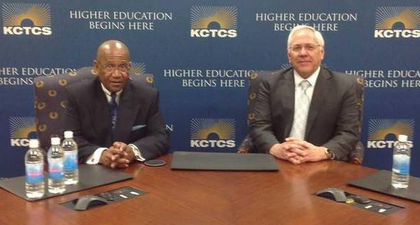
Chair P.G. Peeples and KCTCS President Jay Box

Read more here: http://www.kentucky.com/news/local/education/article78360412.html#storylink=cpy
According to the Kentucky Community and Technical College’s central office, colleges have cut 191 faculty positions and 315 staff posts. Because many of the positions were vacant or were vacated through retirements, only 45 faculty and 125 staff were actually laid off.

KCTCS President Jay Box was not immediately available for comment Wednesday. But earlier this month, he warned of upcoming spending reductions because of a 4.5 percent cut in state support over the next two years. Those cuts come on top of $39 million in budget reductions from the state since 2008.

“As you know, the combination of declining enrollment, loss of tuition and years of state funding decreases have led us to this point,” Box said in a May 4 letter to the 16 KCTCS campuses. “Over the last year, KCTCS has tightened its belt to the point there are no notches left.”

Box said the revenue shortfall required “tough decisions,” including a 6.1 percent tuition increase next year.

“The proposed tuition increase, which must be approved by the KCTCS Board of Regents, is projected to generate $11.7 million dollars in revenue in 2016-17,” Box said. “However, due to fixed cost increases, a 4.5 percent state appropriation cut and no projected growth in enrollment, we are still short by more than $26 million dollars. All of this has led to staff reductions and program suspensions.”

Education officials are still waiting for the results of a court case challenging current-year cuts of 2 percent imposed by Gov. Matt Bevin.

KCTCS officials did not respond to questions about how many of the job cuts were made at the system’s central office in Versailles.

KCTCS’ total enrollment has dropped 28 percent since 2010, when the system hit a high of 58,577 students. Enrollment was 45,770 in fall 2015.

Other public universities in Kentucky are debating how to erase similar revenue shortages. In March, Morehead State University imposed a week-long unpaid furlough for faculty and staff. Eastern Kentucky University instituted a hiring freeze and is studying program cuts, as is Western Kentucky University. All eight public universities are expected to raise tuition when they finalize budgets in June.

At KCTCS, individual community colleges were allowed to make cuts themselves. At Maysville Community and Technical College, for example, 21 full-time staff employees were cut, with other employees taking up those responsibilities, said Pamela McGlone, the marketing and public relations director for the college. No faculty positions were cut.

At Bluegrass Community and Technical College in Lexington, layoffs have been avoided altogether because as many as 40 open positions have not been filled in the past five years, said President Augusta Julian. That erased about $2 million of a $6 million deficit.

“We did everything we could to avoid mass layoffs,” Julian said. “Our folks are terrific — they don’t like it but they understand.”

To cut costs, the school has ended programs, such as a dental lab and collision repair certificate. Another big change is that professors are expected to teach five classes a semester, and next year, they must teach five classes in one semester and six in the next.

Jake Gibbs, a BCTC history professor and Urban County Council member, said the cuts are affecting morale.

“This will make people less available for students, people are exhausted, and probably adjunct professors will be losing their jobs,” he said. “It’s not an ideal situation.”

Gordon Lester taught English at Big Sandy Community and Technical College in Prestonsburg for the past six years. He and three other faculty were told their contracts would not be renewed and they should not come to commencement to see their students graduate.

“In this part of the state, it creates a real economic hardship,” because jobs are so scarce, Lester said.
Robert King, president of the Council on Postsecondary Education, said community college enrollment has always been affected by the economy.

“Some of this is a reflection of an enrollment decline they’ve been experiencing as the economy has recovered, that’s fairly typical,” he said. “But what happened this year is just the most recent in a long line of constant erosion of public support for our institutions.”

Marcia Roth, chairwoman of the KCTCS Board of Regents, said other states have increased spending on higher education “because they understand the students who go to community college are the future economic engine of the state, and they invest in those students.

“And yet Kentucky, in my opinion, made the unfortunate decision to cut higher education.”
Read more here: http://www.kentucky.com/news/local/education/article78360412.html#storylink=cpy

NKU cuts more than 100 faculty, staff

This from the Enquirer:
The Northern Kentucky University Board of Regents approved President Geoff Mearns' plan to cut more than 100 faculty and staff positions to combat a $8 million budget gap at a special meeting Wednesday.

"This is a stark and difficult reality," Mearns said.

The $8 million budget reduction came as a result of the $2.2 million decrease in state funding, increases in fixed costs including retirement contributions and other fixed costs and declining enrollment.

"We are, as a result of this gap, compelled to make some reductions in faculty and staff and that is because our budget is very dependent on personnel costs," Mearns said.

Mearns said since 2008, NKU has looked to extract efficiencies in terms of operating costs, but the univerisity has "already captured the low-hanging fruit" and had to resort to personnel cuts.

The board approved the plan to eliminate 37 faculty positions, which will have a $3.5 million impact.
The majority of those positions are "confirmed and anticipated" vacancies. That includes "pre-existing vacancies," faculty retiring June 30 and faculty who volunteered to take advantage of the phased retirement program that will take place over the next year or two.
Six of those faculty positions are currently filled, but are on the non-tenure/tenure track and will be cut next year. Those employees will still be teaching this academic year, but their contracts will not be renewed.

The cuts will bring the total number of faculty down 6 percent to 550 positions. The positions were drawn from all six colleges and the currently filled positions were selected by chairs, deans and the provost because they can be replaced with "capable and qualified" adjuncts.

The board also approved the president's plan to eliminate 68 staff and management positions.
More than half of those positions are currently filled and the cuts affect virtually every division on campus, from athletics to administration and finance.

It will take $4.5 million out of the budget.

Mearns outlined the process when the university is faced with a reduction in force:
  • Provide for an equitable transition in staffing.
  • Balance the financial needs of the university and minimizes any disruption of services while respecting the dignity of the employees affected.
  • HR/legal services will conduct a review of every position reduction.
  • Consider vacant positions and attrition.
"We recognize that these decisions have a real impact on people, particularly those present employees whose positions will be eliminated," Mearns said.

"The decisions for budget reductions followed certain principles, including NKU's strategic priorities as a guide," he added.

In addition to personnel reductions, graduate and professional student financial aid will drop $209,000. The operating funds will also be slashed $1.1 million.

The action came on the same day that a judge in Frankfort ruled Gov. Matt Bevin can cut the budgets of public colleges and universities without the approval of the state legislature.

Franklin County Circuit Judge Thomas Wingate says two state laws allow Bevin to reduce allotments for public colleges and universities. Wingate said Bevin was not adjusting the colleges’ appropriation, which is something only the state legislature can do. He was just ordering them not to spend all of it.

Making the cuts was "difficult. There's no way around it," regents chairman Nathan Smith said. "These are challenging times for higher education around the country, especially here in Kentucky."
The state continues to cut higher education funding and he said there is no reason to believe Bevin and the General Assembly will reverse the trend anytime soon.

Despite the circumstances, Smith is optimistic about the future of the university.

He said Mearns and his administration haven't avoided making the necessary difficult choices and are taking a strategic, long-term approach to this university's fiscal health.

"Our overall financial position is strong because we have managed our resources prudently and haven't had to borrow against our future," Smith said. "In fact, we continue to invest in our future. The quality of our academic programs has never been stronger. We will continue to innovate and thrive."

Friday, April 29, 2016

EKU students react to tuition increase

This from the Richmond Register:
Eastern Kentucky University's tuition is rising and so are some tempers.
Many EKU students learned Thursday the university's board of regents approved a tuition increase for resident undergraduate students for 2016-17.

Students interviewed by The Register Thursday afternoon expressed their frustration of facing a higher price tag for college than originally expected.

"I don't like it," Ethan Bean, an EKU construction major, said of the tuition increase. "It will probably affect my financial aid and now I will have to figure out how to pay what it can't cover."

Regents approved a tuition increase Wednesday of 5 percent for resident undergraduate students for 2016-17, slightly under the cap of 5.3 percent set by the Kentucky Council on Postsecondary Education. The increase amounts to an additional $418 per student per year.

The board also approved an increase in residence hall costs of 3.8 to 5.4 percent, varying from hall to hall.
"I feel they shouldn't be putting the financial burden of the university on the backs of students," Kele Morgan, an EKU applied engineering major, said. "We won't see any benefit to the projects they have going on now, but we are expected to help pay for them."

Morgan and other students say, while they understand the need for the revitalization efforts on campus, a tuition increase on top of other student fees is getting out-of-hand.

According to one EKU student who will graduate next year, the cost of tuition has risen nearly every year the student has attended the university.

"I'm just trying to get out of here as fast as I can before I end up in so much debt I won't be able to afford a stick of gum when I graduate," said Hollis Gavendry. "It's such a shame too, because I really wanted to enjoy college like my dad did. He was in so many clubs and a fraternity. He has so many great memories, unfortunately, I had to work part-time to cover my books and part of my tuition so I missed out on a lot because I was worried about paying bills."

Morgan said he thinks current students are getting a raw deal.

According to the sophomore, not only are students charged a $150 fee per semester for a proposed student center, freshmen are required to purchase a meal plan, while many freshmen and sophomores are required to stay in campus housing.

"We aren't even going to utilize what we are being charged for," Morgan said. "The construction is also causing a parking nightmare on campus. You can't even park at the rec because it is commuter parking. So I get a ticket if I want to go to the gym. They closed off some of the other parking lots, so we can't use them."
Bean said he pays the university $2,000 a semester to stay in a residence hall, which he is required to do, but has already located an off-campus apartment that will only cost him $5,000 for a full year.

"It's kind of ridiculous isn't it," the sophomore said.

Alex Elliott said she doesn't understand why she has to pay for a parking pass that is almost useless.

"Most of the lots I use are pay lots, because there are no spaces. We have too many people on campus with cars, but I get it, we have to have a car to get around. We aren't getting what we are paying for," the junior creative writing major said.

For students like Morgan and Gavendry who work part-time to supplement their educations, a tuition increase means they are forced to rely on loans to complete their degrees.

"It just means I have to take out more loans," Morgan said. "Hopefully, I can qualify for it on my own."
While the students begrudge the tuition hike, many say they still enjoy their time at the university and the faculty that have taught them.

"It makes sense why they had to do it," Rebecca Baldridge said. "It's unfortunate, but it could be worse. I still love being here and I like the university."

Morgan said despite the recent financial woes, he is glad he chose to pursue an education at Eastern.
"It's a great campus," Morgan said. "It's only going to get better, it is still big enough that you don't know everyone here but small enough that it isn't overwhelming."

Gavendry said he appreciated the quality of the faculty EKU has hired to teach.

"A lot of my professors have been very interesting and highly qualified people in their own right that have done amazing things," the junior said. "Some have become mentors to me and taken a personal interest in my goals. You don't get that everywhere and I think that is what makes EKU special."

Some students wanted to make it clear their frustration does not lie with the board of regents.

"Come on, we all know why this is happening," Elliott said. "The higher-ups in Frankfort don't care about higher education. The university has to do what it can to survive. My fight is not with President (Michael) Benson or the regents, basically we are all getting the short-end-of-stick on this one."

EKU is facing a 4.5 percent ($3.1 million) cut in state appropriations each of the next two years, plus a $2.7 million increase in retirement costs, a $1.5 million increase in fixed and unavoidable costs, and unknown budgetary implications relative to the federal Fair Labor Standards Act.

Given expected enrollment levels, the tuition increase is expected to produce approximately $3.7 million in revenue for the University.

Prichard Committee weighs in on final outcomes of legislative session

Governor and General Assembly Maintain and Strengthen Key Investments in P12 Education

We thank members of the General Assembly and Governor Bevin for crafting a budget for the upcoming biennium that strengthens investments in early childhood and maintains P-12 funding, including the SEEK formula and other key non-SEEK programs such as preschool.

pclogo-300x300We also applaud lawmakers for the vision to increase the income eligibility level of the Child Care Assistance Program (CCAP) to 160% of the current federal poverty level. While disappointing that the Governor vetoed an increase in preschool eligibility to 200% of the federal poverty level, the budget does align the state’s eligibility for preschool and CCAP, as well as establishes a grant pool to incentivize public-private partnerships between public preschool and childcare. These investments safeguard the building blocks of education for Kentucky’s children.

Preserving funding for public preschool, as well as raising the income eligibility level for child care assistance, will allow more of Kentucky’s children access to much needed early learning and development programs. Funds to incentivize public-private partnerships between school districts and private child care providers will maximize public resources and allow for the coordination of full-day, high quality learning experiences that are best for children and their working parents. Blending these resources means children can be served in environments that best suit their needs while also supporting families that rely on services to keep working.

Postsecondary Requires Focus in Future Session

Unfortunately, the pattern of disinvestment in public postsecondary institutions that has persisted since 2008 continues with 4.5% reductions to most campuses. The costs of such disinvestment are ultimately born by students and families, as evidenced by the approval this week of roughly 5% increases in tuition for the 2016-2017 academic year at most campuses. This is of great concern as more Kentucky students are college- and career-ready and value the pursuit of higher education as a means to a better life.

On the other hand, state student financial aid increased over the biennium. While the General Assembly provided an additional $55 million increase in need-based aid through the lottery-funded College Access Program (CAP) and Kentucky Tuition Grant (KTG) – which could have served 30,000 more financially disadvantaged students – the Governor’s veto of parts of House Bill 10 effectively reduces this increase to $15 million.

Two new programs created in the budget to help increase college access and attainment, the Work Ready Kentucky and the Dual Credit scholarship will still receive $30 million over the biennium, although the Governor’s veto of House Bill 626 leaves details of how the programs will work to be determined.

More funding for student financial aid signals progress toward making postsecondary education possible for all Kentuckians and we hope work continues to increase financial assistance to those students who need it most.

As well, the inclusion of a performance-based postsecondary finance model in 2018 is a promising first step in substantially linking public investment to actual outcomes and measures of quality and performance.

The public pension crisis has placed a significant strain on the rest of the state budget, making it more challenging to fund education at all levels. The substantial funding included for the public pension funds will hopefully ease this pressure in future years and not crowd out additional investments in education.

As a whole, in the face of significant fiscal challenges, we appreciate that lawmakers gave every effort to ensure Kentucky maintains support for a seamless web of educational opportunities necessary for success in school, career and life.

Regents approve 5 percent tuition increase for EKU

This from the Richmond Register:
Eastern Kentucky University's Board of Regents approved an increase in the in-state tuition rates for the 2016-2017 school year Wednesday.

Tuition will be increased by five percent, which equates to an extra $209 a semester, or $418 yearly, for all in-state residents. 

The rate increase is slightly below the tuition cap of 5.3 percent that was set Tuesday by Kentucky's Council on Postsecondary Education for 2016-17. 

The board also approved to increasing 2016-2017 residence hall rates by 3.8 to 5.4 percent. EKU Student Government Association President Katie Scott was the only vote against the increase. 

Barry Poynter, vice president for finance and administration, said the rate of residence hall increases is based upon the hall's conditions and amenities.

Tuition for Model Laboratory School will remain the same as approved by the regents. 

During his report to the board, President Michael Benson recommended that several cost-avoidance actions take place in order for the university to remain financially stable. 

Most of the actions, which were recommended by a number of departments and committees, affect employees of the university directly. 

The board approved proposals to: reduce the tuition waiver benefit for current full-time employees from twelve, to nine credit hours; revise the university's cell phone policy which, according to Benson, costs the university nearly $300,000 a year; increase benefit eligibility for part-time employees who work 30 hours up from 24, which will reportedly save the university $115,000; allow full-time staff to only accrue one year of vacation time instead of two years.

The president said while the university's benefits package is a great recruiting tool for potential employees, these changes would put EKU in line with other institutions.  

Benson also recommended, and the board approved the creation of a faculty efficiency task force which will work with faculty members on ways they can rely less on adjuncts and contractual employees.

As the budget discussions move forward, the university president asked the board to consider creating a university-wide budget review committee. 

"We all know, going into this process, time is not our friend," Benson told the regents. "Going forward, we need to look for ways to become more efficient."

The president proposed the group consist of both members from the academic side and staff sides of the university, and that they bring forth ideas about how to handle budget concerns to the board's June meeting. 

Benson also recommended looking into modifying some aspects of the university's healthcare plan while also reviewing the university's contractual services for the state, which returns little, if any, revenue. 

According to the president, the measures would save the university roughly $1.5 million. 

The board unanimously approved a contract extension for Benson during Wednesday's meeting, which would add an additional two years on the president's current obligation. 

Chairman Craig Turner said Benson's extension comes with no increase in salary and has the same conditions for termination as the president's original contract. 

After the board's approval, Benson was treated to a round of applause. 

Regent Janet Craig praised the president for his efforts to address the university's budget issues.
'We as a board, appreciate the job the president is doing. If financial circumstances were better, I would vote for a raise. We know he is the right one to lead us through these times," Craig said during the meeting. 

Turner also complimented Benson's work saying the president was "extremely innovative and responsive" to the changing needs of the university. 

Turner also enlightened the board on the decision of university presidents to agree to Governor Matt Bevin's immediate 4.5 percent cuts and the challenges that await. 

"Unfortunately, we are on a very short time frame with some of the challenges, because of mixed messages from congress," Turner said Wednesday afternoon. 

The Board of Regents chair said while Benson and other university president's "fought a really good fight," the surprise budget cut of 4.5 percent to the current year and the agreement of the governor to reduce the cuts to two percent drove the president's to agree. 

"Under the current situation we feel it was the right thing to do," Turner said. 

Benson later admitted to the board he felt as if he and the other president's backs were against the wall at the time. 

However, Turner warned the board the future performance-based funding criteria will be another challenge the university will face. 

According to Turner, the performance-based funding guidelines are more like additional cuts to the university as all post-secondary schools will be put together in a pool with specific metrics that will lead to a "winner takes all" scenario. Under Bevin's proposed plan, one-third of state funding for universities in the 2017-18 fiscal year would be based on this model. Turner said he is confident EKU will be able to remain at the top of the list of high-performing schools, but warned that changes would have to be made and that details have yet to be defined in the proposed model. 

"The real danger in the future is performance-based cuts," Turner explained. "However, students are going to remain our primary focus. We are not going to compromise our academic standards and our faculty and staff are our greatest assets." 

The chair said Wednesday's discussion, while not a light-hearted topic, was one of progress. 

"As we look at the budget, there may be short-term pain for long-term success. Today we have had unbelievably healthy conversation about what is important to Eastern."

Friday, April 15, 2016

Tax break vetoes first step to reform

Gov. Matt Bevin has a chance to lead the state in a better direction and he's showing interest in actually doing so. While I do not believe cuts to higher education were necessary or wise (especially considering past cuts, and that our universities serve as economic engines for the Commonwealth, and that those cuts were juxtaposed against simply banking $250 million for some future unspecified problem in the face of current students' needs) the governor deserves credit for his action to secure our pensions and tackle tax reform. It is the need for tax reform that underlies the rest of the state's problems.

This from the Herald-Leader:
Bevin right to veto tax exemptions passed by legislators, hold out for tax reform

Kentucky now exempts more taxes than it collects, has antiquated tax system

Stopping exemptions will add urgency to reform efforts

Gov. Matt Bevin did the right thing by vetoing tax exemptions passed by the General Assembly this session.
Gov. Matt Bevin

To paraphrase his veto messages, we just can’t go on this way.

Some tax exemptions are worthy and appropriate but we are way past that point. Kentucky now exempts more in taxes than it collects. This exemption bonanza, combined with an outdated tax code that does not adequately capture revenue from growth in a modern economy, has landed us in deep trouble. Chronic revenue woes have shortchanged education at all levels, infrastructure investment and a host of other legitimate and essential state government services.

Everyone knows this — a report is published each biennium enumerating the exemptions — but, pushed by lobbyists and special interest groups, exemptions just keep coming, and many never end.
The answer, as Bevin said in his veto messages, is comprehensive tax reform, a thorough review of our tax structure that considers exemptions as carefully as spending, creating a code that’s modern, broad-based and fair.

The need for a tax overhaul also is not news, as our pages and a host of tax reform plans can attest. But Bevin has added an important note of urgency by cutting off the exemption spigot. Good for him. The legislature should let the vetoes stand.

Read more here: http://www.kentucky.com/opinion/editorials/article71901212.html#storylink=cpy

Read more here: http://www.kentucky.com/opinion/editorials/article71901212.html#storylink=cpy


This from WEKU:
CPE Head Assessing State Budget Agreement Impact

The head of Kentucky’s Council on Post-secondary Education says the compromise state budget will have an effect on every college and university campus in the state. Leaders from the House and Senate reached a compromise agreement early Thursday morning.
CPE President Bob King

CPE President Bob King says the 4.5 percent funding reduction to higher ed over the next two years is better than having no budget at all. “It’s gonna affect class size, it’s gonna affect the availability of certain courses and programs," King said. "But I’m confident that the presidents and their staffs will do the very best they can to minimize the impact on our students."

King says he respectfully understands the concerns expressed by Governor Bevin about solving pension issues. But, he hopes to see future state budgets include more money for higher education.

The agreed to $21 billion spending plan sets aside $25 million for a free community college tuition program for Kentucky high school graduates who maintain at least a 2.5 GPA. It also includes a performance-based funding structure for Kentucky’s colleges and universities.

Tuesday, April 12, 2016

Hampton should study history

Public support for higher ed was key to U.S. prosperity

This from the Herald-Leader:
In a recent visit to Eastern Kentucky University, Lt. Gov. Jenean Hampton voiced a central tenet of the Tea Party wing of the Republican Party, best summed up as: I’ve got mine; you’re on your own.
Like so many who espouse an anti-government form of rugged individualism, Hampton seems blissfully unaware of how much she has benefited from opportunities provided by others, mainly taxpayers.
Lt. Gov. Jenean Hampton

And now that she’s climbed the ladder of opportunity, she seems to want to pull it up behind her.

In defending Gov. Matt Bevin’s cuts to higher education during an interview with The Eastern Progress, Hampton said: “But if you say college is a right, what you’re saying is somebody must provide that. The taxpayers must provide that. Those of us who go to work must give part of their earnings to put you through college, and I disagree with that. It is not a right, it is a privilege.”

In the same interview, Hampton, without a hint of self irony, recounted how she worked her way through college with help from “grants and scholarships and later the GI Bill.”

Hampton, 57, earned her undergraduate degree at Wayne State University, a public university that voters brought into Michigan’s system of taxpayer-supported higher education in 1959, the year after Hampton was born. She served seven years in the U.S. Air Force — also supported by taxpayers — becoming a computer systems officer and gaining experience that boosted her later career in the corrugated packaging industry. She earned an MBA with help from the taxpayer-supported GI Bill.

Her advice to students’ worried about spiraling tuition: “There are other schools. You know, let’s inject some competition in there. If you guys decided, ‘hey you know what I think the tuition is too high here,’ and if enough people decided tuition was too high and started actually shopping your dollars, what do you think will happen? Tuition comes down.”

The students explained that Kentucky has no four-year colleges with lower costs than Eastern.
Hampton, who ran unsuccessfully for the legislature in 2014, also seems uninformed about Kentucky’s education status, saying “not only are we low on the totem poll in education but when we are ... getting standardized testing on a national level we’re not making par. And so, those scholarships and stuff are out of reach for some students in rural areas, because they are not able to make the grades that they need because of the history of education.”

In fact, Kentucky’s fourth- and eighth-graders outperform their peers nationally in reading and science on the National Assessment of Educational Progress. Kentucky teens are graduating from high school at above the national rate and going on to college at almost the national rate though too many leave before graduating.

A little over a generation ago, Kentucky was at the bottom educationally. But the legislature enacted ambitious reforms and a penny increase in the sales tax that propelled young Kentuckians into the nation’s mainstream — a gain that’s at risk of being lost because Kentucky keeps cutting education.
Hampton advised students to seek a degree in an area where graduates are in demand, saying, “ I would not be studying history.”

If she did study history, she would learn that this country’s middle class and many of the 20th century’s great scientific and technological breakthroughs were built on taxpayer support for higher education.

Read more here: http://www.kentucky.com/opinion/editorials/article71258302.html#storylink=cpy

Friday, April 08, 2016

Bevin’s solo cuts demand challenge

This from the Herald-Leader:
Senate President Robert Stivers and other Republican lawmakers should be as concerned as Democrats about the constitutional implications of Gov. Matt Bevin’s executive order altering appropriations enacted into law by the legislature in the 2014 budget.
Senate President Robert Stivers

A lot more is at stake than just the immediate 4.5 percent cuts Bevin ordered last week in higher education’s current year appropriation — an order that prompted Attorney General Andy Beshear to threaten a lawsuit unless Bevin rescinds it.

If this precedent stands, a governor could drastically remake state government by cutting or even eliminating funding for a particular agency or function after the legislature goes home, over the legislature’s objections. A governor could punish lawmakers by retroactively reducing appropriations to their districts.

Indeed, what’s the point of the legislature enacting a budget if the governor is free to unilaterally cut appropriations when there is no revenue shortfall?

On Wednesday, Stivers said, “I think the governor has the right to do what he has done.” Also, “With all due respect to Attorney General Beshear, I think a lot of people are posturing politically.”
This conflict makes for political drama, no doubt. A Democratic AG and son of a Democratic governor clashes with his father’s Republican successor.

But the larger concern should transcend the politics of the moment. Bevin’s order erodes the legislature’s standing as a branch of government, upsetting the constitutional balance of power. Also, state laws make it clear that a governor lacks authority to make cuts absent a revenue shortfall, as well as shielding higher education from changes in funding allotments.

Governors come and go. The fortunes of political parties wax and wane. Lawmakers of both parties should want to protect the legislature’s authority from this encroachment by the executive. The budget is a law, and executing the laws of the state is the governor’s foremost duty.

All this could become moot if Bevin rescinds the order or depending on what lawmakers mandate in the next biennial budget, which is still up in the air.

Otherwise, Beshear has no choice but to challenge Bevin’s action. The budget is one of the many laws that the governor is not supposed to be above.

No excuse for not enacting a state budget

This from the Herald-Leader:
From where we sit, the impasse over the state budget looks as if it could be easily resolved.
Gov. Matt Bevin could win $500 million for the rainy-day fund and future pension payments. That’s less than what he wanted, but it would be the largest reserve in modern times, according to House budget committee chair Rick Rand.

The House agreed in negotiations to the public pension funding levels Bevin sought in the next biennium.

And Bevin could avoid being blamed for slashing public support for higher education.

What’s not to like about that for a governor wrapping up his first legislative session and hoping his Republican Party can take the House in November?

So, with victory within reach, what does Bevin do?

Throws a bomb by ordering immediate 4.5 percent cuts in higher education with only three months left in the fiscal year, cuts that Bevin announced in January but that neither the Democratic House nor the Republican Senate approved.

This incendiary act could burn Bevin in several ways. Both Attorney General Andy Beshear and House Speaker Greg Stumbo say Bevin is violating a state law that says, unless there’s a revenue shortfall, governors have no authority to cut appropriations made by the legislature. There is no revenue shortfall.

Beshear on Friday called on Bevin to rescind the order within seven days or face a lawsuit.
(Interestingly, Bevin rescinded an executive order signed by former Gov. Steve Beshear making it easier for felons to regain voting rights. Bevin insisted that he supports voting rights for felons but that the prior governor had exceeded his authority. We guess the limits of authority look different depending on your angle.)

Even if Bevin avoids a legal entanglement with the Democratic AG, he seems to be steering toward a budget meltdown. If no budget is enacted, he will find it painful to govern. A court ruling when the legislature failed in the past to enact a budget limits spending to government functions that stem directly from the state constitution, such as public safety and education, and what’s required by federal law. That leaves a lot of what the state does unfunded.

Bevin may think the public will blame House Democrats if there’s no budget, but he and Republican lawmakers will also feel the fallout if he tries to govern without a budget or has to call a special session to enact one.

All Bevin has to do to get a budget is back off his demand for 9 percent cuts in higher education in the next biennium; that’s the House’s line in the sand. Kentucky has been cutting colleges and universities for years, fueling tuition increases. Protecting higher ed from cuts now would not only be politically smart, it’s also the right thing to do for the future.

Bevin insists the cuts are necessary to shore up the dangerously sagging public pension systems. He wants $500 million set aside in a fund to pay into pensions in the future. But both the House and Senate budgets proposed larger contributions to the pension funds in the 2016-18 biennium than Bevin proposed.

One of the pension funds for state employees is so perilously underfunded that it could soon be forced to liquidate its investments to meet monthly obligations. The crisis is real. And Bevin is winning praise from many quarters, deservedly so, for elevating the pension crisis, making it impossible for lawmakers to ignore.

Bevin can still salvage his first session. There’s plenty of time between now and the April 15 deadline to agree on a budget.

The state needs a budget. Legislators have a constitutional duty to enact a budget, and no matter how they calculate the political odds, legislators should enact one. 

And this:
There’s no excuse for this session to end without a budget since lawmakers of both parties have embraced Gov. Matt Bevin’s top priority: shoring up Kentucky’s shaky public pension funds.
Negotiators have resolved some differences on how to allocate money across pension funds. But the biggest stumbling block remains: Is it necessary to cut education to free up money for pensions?
Bevin and the Republican Senate say yes. But the Democratic House put more money into pensions than Bevin proposed during the next biennium without cutting education.

The charts above show funding levels in Bevin’s budget and those approved by the chambers, the starting point for the negotiations that started last week.

The Senate’s emphasis on the Kentucky Employment Retirement System reflects its dire state of crisis. The Kentucky Teachers Retirement System is healthier but still underfunded and at risk of slipping into crisis.

Bevin wants to sock away $500 million (from a surplus in the State Employees Health Plan) in what he calls a “permanent fund” for pensions in future budgets. He also wants a larger rainy day fund, altogether idling more than $1 billion, which he says will start the state on a path to fiscal soundness.
That’s a lot of money to sideline when education still suffers from years of cuts, especially at the risk of a partial government shutdown or special session if lawmakers fail Tuesday to enact a budget.

Thursday, April 07, 2016

Black Student Threatened with Lynching by Lexington Catholic High School Teammate

This from Key News Journal:
Denisha Vinegar asked her son for his Macbook so she could give the serial number to a repairman who was ordering a replacement for his cracked screen. While the laptop computer was unlocked and in her possession, Denisha took the opportunity to peek around her teenage son DaMarco’s laptop and stumbled across a disturbing text exchange in which her sons life was threatened.
Denisha Vinegar and her mother Earlene Neal.

A boy, later determined to be a football teammate, singled DaMarco out in a group message about turning in money.

“I was confused why he’d ask DaMarco for money, so I kept reading to see why. Then I saw things like ‘picking cotton’ and ‘sell crack to get it’ and stuff about me being on Maury because he doesn’t know who his father is’’, said Denisha.

Mid-stream, the name of the text conversation was changed by this teammate and re-titled “Damarco I’m gonna lynch you’’. 

The bully said these things in the group text:
“Damarco lynch means I’m gonna hang you bc you’re black and I just might’’
“your mom is on an episode of Maury bc u don’t know your real dad’’
“I don’t care if you steal it or sell crack just get the f***ing money’’
“damarco I’ll hire you to pick my cotton $1 per week’’
“turn in your welfare check; Food stamps accepted’’
DaMarco doesn’t have a cellphone but can receive text messages through an iMessenger app which delivers them to his computer, where his mother saw them.

There are several names and phone numbers of DaMarco’s Lexington Catholic football teammates on the text list, who sat idly by as this student verbally assaulted and threatened to kill Demarco demanding that he bring in money for a fundraiser.

Denisha says this threat to kill her son was the proverbial straw that broke the camel’s back.

In June 2015, during summer football camp, a Caucasian student came to DaMarco’s room and said to his roommate that all Black people smell like piss.

In October 2015, Denisha was told by her son’s Latin teacher that he is being mean to a girl in class. Denisha asked if it is the same girl who teased Demarco about his complexion and made comments about picking cotton. Denisha asked what the teacher said to that girl or her parents, but the teacher continued to focus on Demarco’s reaction and made excuses for the girl.

DaMarco began to fear more for his safety after they reported the incident. “He said [the bully] told him that he’d spit in his face in front of the coach and nobody would do anything about it. He said he’d noose my son with a chain instead of rope. I asked who was there when he said these things and my son didn’t know the other boy’s names because they were upperclassmen and he was new.’’

A Police report against the bullying student has been filed. Detectives came to Denisha’s home, collected statements and evidence including her son’s laptop. The police report obtained for this story notes that the text messages where received as evidence.

This is being investigated as a hate crime. Lexington Police Detectives are expected to make contact with the accused students parents this week to cite him and give him a court date. Once cited, Lexington Catholic will be informed of the investigation by law enforcement.

lex cath logoTo add insult to injury, Denisha said Lexington Catholic has not released DaMarco’s transcript. She has been saddled with a $4000 bill. She said the bill was because they did not meet fundraising goals that would have reduced his tuition by the time he withdrew and his transcripts are being held until she pays. He has enrolled in a public high school but without this transcript he cannot be placed in the appropriate level courses and will be short graduation credit if not resolved.

Good Impression Turned Bad

Denisha said that she’d never heard anything negative about Lexington Catholic High School and was warmly welcomed when she arranged for a visit after her brother relayed that the football coach was interested in her son.

DaMarco’s uncle Devin Neal said, “I got a call from Mark Perry, the football coach. I didn’t know him, never met him. He called to ask about the boys and when we were going to bring them to the school.’’ Devin knew the coach was referring to his nephew Demarco and his own son who is a year younger. Devin is a known youth football coach for several leagues around town.

Denisha called Lexington Catholic and scheduled a time for a tour but was called back and told that the coach wanted to be there so she took another date. “The lady on the phone sound really excited when she called back. I was really impressed that the coach knew who my son was and he made me feel he was really welcoming him.’’

Devin was excited for the boys to have opportunities that he and his sister did not. He was going to enroll his son there for high school also.

So it came as a total shock when he heard what happened to his nephew. Devin said he couldn’t believe what his sister told him so he asked to see the computer for himself.

Devin said, “When I saw it I made a call to the coach. Coach Perry said he’d pass the information on to the Vice Principal, but I felt he should have been the leader on this. He took sides.’’

The coach put the two boys together and pressured DaMarco into saying that he was friends with the bullying teammate even after Demarco said repeatedly they were NOT friends.

“I know coaches can be intimidating to a young boy, especially behind closed doors,’’ said Devin.
DaMarco was a freshman at Lexington Catholic who played football, and was new to the Catholic school system, coming from Fayette County Public Schools. He excelled and played in a few varsity football games and was conditioning for the track team before the threats caused his mother to withdraw him.

Denisha said no one from the school called her after they reported the threat. She reached out to Father Norman Fischer, the Black priest (of St. Peter Claver Catholic Church) who is listed as school chaplain.

“When I reached him, he said he hadn’t even heard about the incident,’’ said Denisha. However, later he became the mouthpiece for the school and was the only person in touch with her and her brother.
Father Norman described his role as “pastoral healing’’. He knew this was an “unhealthy relationship” between the boys and wanted to mediate and bring some healing for everyone involved.
“It was tense, awkward and unfortunate,’’ said Fr. Norman. “I recognized there was a need for an apology.’’ He described the apology to Demarco from the classmate as “very sincere.’’

Denisha is not satisfied by that. “It wasn’t sincere. This all happened over a period of time. If he was remorseful he’d have come back and apologized on his own. That is not sorry. He’s sorry because it’s been made public and he’s sorry for what is coming.’’

Denisha believes the bully who made the racist statements only received an in-school suspension.
The 2015-15 Lexington Catholic HS student handbook lists, “Written or verbal assault/threat made against any student, faculty, or administrative member of Lexington Catholic High School’’ as an offense that warrants expulsion.

Lexington Catholic officials have refused to give specifics on how the student was disciplined but Vice Principal Jonathan Kincheloe did confirm the offending student was still enrolled. When asked, Kincheloe said “he did not feel comfortable’’ making a statement of zero tolerance for this type of behavior.

Pictures from the accused teens Instagram social media account show the teen aiming a large assault rifle type fire arm and in a separate photo there is a pickup truck with a large confederate flag flying from the back of the flat bed.

Additionally, the football coach may have violated rules by contacting DaMarco’s uncle about him attending the school. In the “Athletic Matters’’ section of the handbook it states “no staff member shall contact a student athlete outside of the feeder system of schools in accordance with KHSAA Bylaw 10.’’

Earlene Neal, DaMarco’s grandmother is appalled by the lack of response. “I’m highly upset. I’ve been with Fayette County Public Schools for 24 years. We would’ve done something.’’

For DaMarco’s great aunt Teresa Gardner Golightly this brought up painful memories. “This is a hate crime as far as I’m concerned,’’ she said. “When we integrated Morton Middle School, we were called niggers, spit on, police called, stuff written on the bathroom walls. It was horrible. When people get up the nerve to say it, they’ll do it. [Denisha] was right to take him out of there. I was afraid for him.’’

University presidents meet with Bevin, won't say much

This from the Daily Independent:
There were no public meetings, but key state lawmakers on Wednesday continued looking for a compromise on a state budget while the governor had a lengthy meeting with university presidents who didn’t want to talk about it afterward.
Gov. Matt Bevin

Lawmakers are divided on a new budget, with the Republican Senate supporting Republican Gov. Matt Bevin’s plan to cut many state agencies, including universities and community colleges, 4.5 percent this year and 9 percent the next two years and use the savings to bolster the state’s troubled pension systems.

House Democrats insist there are sufficient resources to tackle the pension problem without penalizing higher education. That’s the issue over which the two sides broke off negotiations last week.

The university presidents have said Bevin’s proposed cuts will be damaging to their services, hurt students and inevitably lead to higher tuition costs.

But last week, Bevin unilaterally implemented the 4.5 percent cuts for this year without consulting with the legislature. House Speaker Greg Stumbo and Democratic Attorney General Andy Beshear said he exceeded his legal authority, and Beshear said if Bevin doesn’t rescind the cuts by the end of the week, he’ll sue.

Bevin issued a statement last week thanking the presidents for their cooperation and implying they were on board with the cuts because they understood and supported the need for more funding for pensions.

Senate President Robert Stivers, R-Manchester, said much the same thing Wednesday, explaining the presidents understand the need for the state to confront pension issues.

But the presidents can hardly oppose Bevin publicly at this point. He appoints their boards, and unless Beshear is successful in court, Bevin controls their state funding.

However, it was still something of a surprise Wednesday when some of the presidents were spotted leaving the governor’s mansion after what was apparently a three-hour-plus meeting with Bevin.
Those interviewed by CNHI News Service were reluctant to say much.

Dr. James Ramsey, University of Louisville president, deflected a reporter’s questions about the meeting, saying he was on a cell call. Asked if it was a good meeting, Ramsey turned his hands palms up and gave a noncommittal response.

Asked if there was progress or a compromise with the governor, Ramsey simply said, “Not really,” as he drove away.

Dr. Robert King, president of the Council on Postsecondary Education, declined to characterize the tone of the meeting or describe what was discussed. But asked if he thought the meeting produced any progress, he said, “I think so.”

Dr. Wayne Andrews of Morehead State University didn’t return messages seeking comment, nor did Bevin’s news spokeswoman. Murray State University President Robert Davies declined to comment through a spokesman.

Stivers, on the other hand, was upbeat about a potential compromise.

He said there were discussions Wednesday between Republican senators and House Democrats on various budget units, including conversations between him and Stumbo.

“It’s gone very well today, in my opinion,” Stivers said. “Discussions are still good and ideas are being exchanged.”

Stivers went so far as to say he thinks chances “are still good” the two sides can come to some sort of compromise in time for both chambers to vote on a new budget when they convene for the final day of the 2016 General Assembly on Tuesday.

Stivers said Bevin has had budget discussions with some lawmakers and others, but he didn’t know all the people he may have talked to.

But when asked if the Senate was prepared to budge on its insistence that funding for universities be cut, Stivers said, “We’re very much still in that mode.”

Democrats have said they won’t agree to such cuts. But Stumbo had left the Capitol and was unavailable for comment following Stivers’ comments to reporters, according to his news spokesman.

Stivers said the deadline for an agreement that would provide enough time to get a budget before rank and file lawmakers by Tuesday would be sometime Sunday.

Stivers also believes Bevin is within his authority to cut university funding without legislative approval.
 And this from EKU President Michael Benson (via campus email...emphasis in original)

Dear Colleagues:

Late yesterday afternoon, all of the presidents of Kentucky’s universities and colleges were notified of a meeting to be held today, at the request of Matt Bevin, in Frankfort at the Governor’s Mansion.  All nine of the presidents were in attendance, along with members of House and Senate leadership and the Governor’s budget director, John Chilton.

After nearly 3 hours of discussion, debate, and deliberation, I am slightly more hopeful that some type of negotiated agreement might be reached by our elected officials within the next few days.  Included below is a brief summary of the latest budget debate news  from Chris Nolan, one of people with whom we work in Frankfort.  I hope it is helpful in keeping everyone up-to-date with the latest developments.

Budget talks resumed behind closed doors Wednesday as key legislative leaders, the Governor and university presidents met for several hours and renewed their efforts to try to break an impasse in the budget negotiations.  However, there was no apparent breakthrough in the negotiations. 

The key points at issue are the current year 4.5 percent budget cuts to higher education that the Governor issued by executive order last week and any potential vetoes the Governor could issue without the legislature being able to override them.  The two issues are tied together because the House Democrats are questioning why they should strike a budget agreement over any potential cuts to education if the Governor believes he has the ability to cut education at any time through executive order as he did last week. 

The Senate and Governor have proposed cuts to higher education and use the money to put into a fund to pay down the state’s enormous pension liabilities.  The House has said other revenues can be dedicated toward pension payments and there is no need to cut any part of education, especially since the state had a budget surplus and there is no crisis of a shortfall.  Universities, meanwhile, have become the political football in the budget negotiations.

Despite the impasse, Senate President Robert Stivers (R) said afterwards that “chances are good” that legislators will pass a two-year, $21 billion budget for the state before the legislative session adjourns next week.  Stivers added, “ Information is being exchanged, ideas are being discussed and there have been some very good conversations today.”

House Speaker Greg Stumbo (D) has been mum publicly and has made no comments on Wednesday’s negotiations.  Discussions are complicated by the fact that the last offer Senate Republicans put on the table had no higher education cuts in the current year and 4.5% cuts during the new budget biennium.  However, the Governor’s subsequent executive order cutting universities 4.5% in the current year is looked at as a step backwards by Democrats. 

Even if an agreement can be reached on education cuts, House and Senate leaders have yet to discuss other significant differences in the budget such as cutting funding for Planned Parenthood and suspending prevailing wage on state contracts.  Both issues are hyper partisan and have yet surface publically.

The deadline to get a final agreement for an April 12 vote is late Sunday.  House-Senate negotiators are expected to discuss the budget amongst their respective leadership teams tomorrow morning (Thursday) and then have more private meetings.

When lawmakers recessed last Friday — the 59th day of the 60-day session — budget negotiations broke off after House and Senate leaders failed to agree on cuts to higher education and money for public pension payments.  If there is no budget compromise by the current last day of the session on Tuesday, April 12, the Governor would have to call lawmakers back for a special session or preside over a partial government shutdown that would begin July 1.  Only the governor can call a special session and set its agenda.  A special session would cost taxpayers about $70,000 a day and last at least five days.  Under a partial shutdown, the governor could spend money only on statutorily or constitutionally required services and federal mandates.

We will continue to keep you all apprised of any new happenings. 

Until then, #KeepCalmAndCarryOn.

Thanks for your continued service.

Kind regards,

Mike Benson