Wednesday, June 27, 2007

Herald-Leader responds to yesterday's Supreme Court rulings


Not-so-free speech
Rulings favor special interests, not citizens


It's noteworthy that President Bush's Supreme Court is picking and choosing which free speech to protect.

Chief Justice John Roberts and the majority rose to the defense of the kind of speech that's fueled by millions of special-interest dollars. But they slapped down a high school student who was suspended for hoisting a cryptically goofy "Bong Hits 4 Jesus" sign at a non-school event.

A court that truly puts the First Amendment first would have honored precedent and ruled that the Constitution gives students the right to free expression. Instead, the court perceived a dangerous pro-drug message in the parody banner.

The court also abandoned precedent to clear the way for unlimited amounts of special-interest money to pour into the final weeks of political campaigns under the guise of so-called issue ads. Often bankrolled by corporations and unions, these ads clearly malign one candidate without specifically advocating voting for a particular opponent.

Roberts said: "Where the First Amendment is implicated, the tie goes to the speaker, not the censor."

He should have added except when the speaker is an average person with no bankroll to back up his words.
Cartoon by Joel Pett.

Tuesday, June 26, 2007

State's Attorney's issues Press Release in St Charles Open Meetings violation investigation

Text of today's press release:
~
Office of the Kane County State’s Attorney
JOHN A. BARSANTI, State’s Attorney
Kane County Judicial Center
General Offices: (630) 232-3500
37W777 Route 38 Suite 300

Contact:
St. Charles, Illinois 60175
John Barsanti (630) 232-3500

FOR IMMEDIATE RELEASE

ST. CHARLES SCHOOL BOARD VIOLATED OPEN MEETINGS ACT

June 26, 2007

After an investigation, the Kane County State’s Attorney has determined that members of the Board of Education of St. Charles School District 303 violated the Illinois Open Meetings Act when they voted April 11, 2005, in closed session to extend the contract of the superintendent. The closed session was part of the Board’s regularly scheduled meeting.

After careful consideration of the facts, including the Board’s recent ratification in open session of the contract extension, the state’s attorney has determined that the following actions to be taken by the Board would be an appropriate sanction:
· Issue a public apology for the Board’s violation
· Attend training on the Illinois Open Meetings Act
· Agree to release to the public a copy of the recording of the closed session during which the violation occurred

The Board has agreed to these sanctions.

The Board’s action on April 11, 2005, violated not only the provisions of the Act, but also the spirit of the Act, Kane County State’s Attorney John Barsanti said.

The Act requires that any action of a public body must be taken in open session, in public view.

A copy of the portion of the audio tape of the closed session during which the violation occurs is available to members of the media at the Kane County State’s Attorney’s Office at the Kane County Judicial Center, Suite 300, 37W777 Route 38 in St. Charles Township. For a copy, please call Chris Nelson at (630) 444-2998 and be prepared to present in person a valid media credential.

St Charles District 303 expected to release tape detailing open meetings violation

The St. Charles school board has agreed to release to the public and media a tape recording of a 2005 closed session meeting that officials say proves the board willfully broke the law.

Acting on a request from the Kane County state’s attorney, the board also is apologizing to the public and pledging to never violate the Open Meetings Act again. In addition, it must undergo a training workshop this year about the law governing open public meetings.

This from the Daily Herald.

St Charles school board admits it violated open meetings law in Erwin contract amendment

ST.CHARLES – By a six-to-one vote, the St. Charles school board acknowledged it violated the Open Meetings Act when it failed to vote publicly on a contract extension for the district superintendent.

“I think this puts an end to the whole inquiry in this whole area,” board president Kathy Hewell said.

The board took the vote late Monday night, after they discussed it in executive, or closed, session.

Kane County State’s Attorney John Barsanti recommended the board release to the public a recording of the April 11, 2005, executive session. He also directed the board to send a press release about the Open Meetings Act violation. The board also will have to be trained on the Open Meetings Act and the Freedom of Information Act, Hewell said.

Hewell said she did not know when the tapes would be released.“That’s [Barsanti’s] decision,” Hewell said.

On April 11, 2005, board members discussed extending Superintendent Barbara Erwin’s contract in executive session, but they never voted on the extension publicly. Still, Erwin’s contract extension was signed by the school board president, the board secretary and Erwin.The board voted June 8, 2007, to ratify Erwin’s contract amendment.

Hewell said acknowledging a violation of the Open Meetings Act will have no bearing on the contract amendment.“The contract amendment was ratified previously so there’s nothing further to be done in that area,” Hewell said.

How the board voted on a resolution to acknowledge a violation of the Open Meetings Act:
Kathy Hewell - yes
Karla Ray - yes
Scott Nowling - yes
Chris Hansen - yes
Robert Lindahl - yes
Lori Linkimer - yes
Jim Gaffney - no

This from the Kane County Chronicle.

Can you choose wisely?


Bong Hits 4 Jesus: Debriefing

Yesterday, the U S Supreme Court crafted a narrow ruling in the "Bong Hits 4 Jesus" case, Morse v Fredrick, that public schools do not violate the First Amendment rights of students by sanctioning them for speech during a school-sanctioned activity when that speech may promote the use of illegal substances. Today, the lawyers are analyzing what that means with respect to free speech.

Here's what happened:
As the Olympic torch was carried through the streets of Juneau on its way to the 2002 winter games in Salt Lake City, students were allowed to leave the school grounds to watch. The school band and cheerleaders performed. With television cameras focused on the scene, student Joseph Frederick and some friends unfurled a 14-foot-long banner with the inscription: “Bong Hits 4 Jesus.”

But Frederick never reported to school. He said his car was stuck in snow.

He arrived outside the school in time for the torch entourage. He stayed on the sidewalk across the street from Juneau-Douglas High, and with the help of several other students, held up the banner just as the torch passed, in the hope of getting on the local TV news.

Frederick said the banner was a nonsensical message that he first saw on a snowboard. He intended the banner to proclaim his right to say anything at all.

Juneau principal, Deborah Morse, said the phrase was a pro-drug message that had no place at a school-sanctioned event. Frederick denied that he was advocating drug use. But it probably did not help his case with the court, that he later pled guilty to a misdemeanor charge of selling marijuana at Stephen F. Austin State University in Texas.

This from PBS's NewsHour.

Experts Analyze Supreme Court Free Speech Rulings

JUDY WOODRUFF: What signals does the court send with today's decisions? For that, we turn to: Walter Dellinger, former acting solicitor general under President Clinton, and now a law professor at Duke University; and Richard Garnett, associate professor at Notre Dame Law School, where he teaches on First Amendment issues.
Richard Garnett, to you, first, three decisions, three split decisions, 5-4. Is there a common thread here as it relates to the First Amendment? Are we learning something about this court and the First Amendment today?

Richard Garnett: Notre Dame Law School

"...you saw what I regard as relatively narrow, modest opinions, which stayed within the framework of earlier decided cases. So you might say that these three cases are consistent with a theme that some people have seen in the new chief justice's thinking and writing, namely, incrementalism."


RICHARD GARNETT, Notre Dame Law School: You know, one thread that seems to hold these cases together is that, in all three, you had an older decision that the courts have had the option of either rejecting or reversing entirely or trying to live with. And in several of the cases, you saw some of the justices on the conservative side saying, "Look, we should take this farther. The cases you're asking us to work with, they were wrongly decided. Let's scratch them and move on."

But in all of these cases, the court decided not to do that. And instead you saw what I regard as relatively narrow, modest opinions, which stayed within the framework of earlier decided cases. So you might say that these three cases are consistent with a theme that some people have seen in the new chief justice's thinking and writing, namely, incrementalism.

JUDY WOODRUFF: Is that what you're seeing, Walter Dellinger, incrementalism?

Walter Dellinger: Duke University School of Law
"In the "Bong Hits 4 Jesus" case, what was striking was that the opinion is actually quite narrow. It's protective of student speech, because the opinion says that you can only suppress student speech if you're actually advocating illegal drug use."

JUDY WOODRUFF: Well, we hear Professor Garnett saying, though, they're doing this along pretty narrow definitions of the law.

WALTER DELLINGER: Well, that was true at least in one of the cases today, the school case. One of the things we learned about the First Amendment today was that the court -- it's a little more differential [sic] to free speech rights of corporations than it is to public school students in one important respect...

...And yet in the "Bong Hits 4 Jesus" case, what was striking was that the opinion is actually quite narrow. It's protective of student speech, because the opinion says that you can only suppress student speech if you're actually advocating illegal drug use.

But what does the phrase "Bong Hits 4 Jesus" mean? Nobody knows. The kid may have just wanted to get on television.

But in that case, the court went the other way and assumed that this was an advocacy of illegal drug use. I don't think that an earlier court in Tinker would have thought this unprotected speech by the student.

~

This from the Los Angeles Times: Justices let schools ban pro-drug signs.
High court rules, 5-4, that administrators have the right to discipline students for promoting illegal activities.

This from Education Week: Supreme Court Backs Discipline of Student for Drug-Related Banner.

And this: U.S. Supreme Court Limits Student Speech in 'Bong Hits 4 Jesus' Case.

This from BBC News: US student loses free speech case

This from the Christian Science Monitor: Court restricts student expression.
The Supreme Court ruled Monday that school officials retain discretion to censor student speech that they believe may encourage illegal drug use.

This from Breitbart: Top US court rules against 'Bong Hits 4 Jesus.'

This from CNN: 'Bong Hits 4 Jesus' case limits student rights.

This from the Chicago Tribune: Court Limits Student Free-Speech Rights.

This from MSNBC: Supreme Court limits student speech.
In 'Bong Hits 4 Jesus' case, Roberts says advocacy of drug use can be curbed.

High School Student Takes On Fiery Newscaster Over Sex Ed Talk

This Week in Education says: "We've all seen full-grown adults crumble and fluster when faced with hard-charging newscasters who disagree with their points of view, but give credit to this Boulder high school sophomore Jesse Lange who takes on none other than the firebreathing Bill O'Reilly over a controversial sex and drug talk given at a Boulder high school."

I agree. This kid gets points for poise and clarity.

Here's the backstory:

And now, Ladies and Gentlemen, the falafel-loving ... louffah-weilding

Bill O'Reilly!

School Official Apologizes for Removing Photo of Kiss


His high school apologized for blacking him out, but Andre Jackson, a graduating senior whose kissing summoned the censors, remained unsatisfied.

Last week, a picture of Mr. Jackson kissing his boyfriend was deemed “suggestive” by the superintendent of the Newark public schools and redacted, with black marker, from the yearbook of East Side High School. Yesterday, the school district reversed course, and released a statement apologizing to Mr. Jackson and saying the yearbook would be reissued with the picture unmarked.

“Superintendent Marion A. Bolden personally apologizes to Mr. Jackson and regrets any embarrassment and unwanted attention the matter has brought to him,” read the statement, which was issued by the Newark public schools’ general counsel, Perry L. Lattiboudere. “The district takes pride in its diverse student population and supports all our students, regardless of race, gender, ethnic background or sexual orientation.”

Mr. Jackson, 18, said that nobody bothered to call him...

...In the statement, the school district said that unredacted yearbooks would be handed out to any senior on request. That did not go far enough for Mr. Jackson, who said that everyone should get the uncensored page. “It’s not about who wants one,” he said. “It’s about what happened.”

This from the New York Times.
Photo by MANNY FERNANDEZ.

Monday, June 25, 2007

Former teacher marries teen student


WILMINGTON, N.C. -- A 40-year-old high school science teacher and cross country coach has resigned his position and married a 16-year-old student.

Brenton Wuchae coached Windy Hager at South Brunswick High School, where she recently completed her sophomore year as one of the school's top runners. He also lives less than two miles away from the Hagers' home on Oak Island.

Wuchae married Hager in Brunswick County on Monday, according to a marriage license.

Hager's parents, Dennis and Betty Hager, said they did all they could to keep the couple apart after noticing a deeper-than-usual friendship forming between them. The parents said they tried to intervene by talking to the coach, going to school officials, pleading with police and sheriff's office detectives, even other teachers and students at South Brunswick.

But the Hagers say they reluctantly signed a consent form allowing their daughter to marry her coach.

Brunswick County Schools Superintendent Katie McGee said both the school system and the Brunswick County Sheriff's Office investigated Wuchae's case but did not come up with enough evidence that would merit charging or even firing the coach.

This from WCNC (Carolinas).

Read the Principal's letter to the parents from the Wilmington Star.

Black college enrollment in South, rate passes milestone

RALEIGH, N.C. - For the first time, blacks are as well represented on college campuses in the South as they are in the region's population.

Details are being released today by the Southern Regional Education Board.

The nonprofit organization promotes education.The board's member states are Texas, Alabama, Arkansas, Delaware, Florida, Georgia, Kentucky, Louisiana, Maryland, Mississippi, North Carolina, Oklahoma, South Carolina, Tennessee, Virginia and West Virginia.

In the 16 states measured, blacks make up 21 percent of college students and 19 percent of the population.The number represents progress but it also has to be seen in context.A major contributing factor is the South's rapidly growing Hispanic population, which has reduced the proportion of the population that is black. That's made the milestone easier to reach mathematically.

Overall, black enrollment rates for college-age students, while improving, still lag well behind those of whites, as do the graduation rates of black college students.

This from the TuscaloosaNews.com.

2007 SREB Fact Book on Higher Education

The SREB Fact Book on Higher Education is one of the nation's most comprehensive collections of data on higher education. The 50th anniversary edition continues a SREB tradition dating back to 1956 of providing comparative national, regional and state-specific data highlighting trends that affect colleges and universities.
This year's highlights include historic increases in college enrollment, details on population changes that could challenge SREB states' continued education progress, and the growing college affordability gap for lower- and middle-income students.

Happy birthday, Mom

My mother, Eilene Clore Day, nicknamed "Queenie" (I'm not making this up ) served long-term as School Secretary and Treasurer to the Ludlow Board of Education and was a significant player among the men who ran our schools.

No Bong Hits 4 Jesus after all


The US Supreme Court handed down its decision in Morse v. Frederick today where the Court held that public schools do not violate the First Amendment rights of students by sanctioning them for speech during a school-sanctioned activity that may be reasonably interpreted to promote the use of illegal substances.

A high school student was suspended after he displayed a banner with the message "Bong hits 4 Jesus" during a televised parade on a school day.

The student subsequently sued his principal, arguing that the principal unreasonably restricted his right to free speech. The Court reversed the Ninth Circuit's decision and held that the "First Amendment does not require schools to tolerate at school events student expression that contributes" to the danger of illegal drug use.

Read the Court's opinion per Chief Justice Roberts, along with a concurrence from Justice Thomas, a second concurrence from Justice Alito, a partial concurrence and dissent from Justice Breyer, and a dissent from Justice Stevens.

This from Jurist.

And this from the Anchorage Daily News.

WASHINGTON -- The Supreme Court tightened limits on student speech today, ruling against a high school student and his 14-foot-long "Bong Hits 4 Jesus" banner.

Schools may prohibit student expression that can be interpreted as advocating drug use, Chief Justice John Roberts wrote for the court in a 5-4 ruling.
Joseph Frederick unfurled his homemade sign on a winter morning in 2002, as the Olympic torch made its way through Juneau en route to the Winter Olympics in Salt Lake City.

Frederick said the banner was a nonsensical message that he first saw on a snowboard. He intended the banner to proclaim his right to say anything at all.
His principal, Deborah Morse, said the phrase was a pro-drug message that had no place at a school-sanctioned event. Frederick denied that he was advocating for drug use.

"The message on Frederick's banner is cryptic," Roberts said. "But Principal Morse thought the banner would be interpreted by those viewing it as promoting illegal drug use, and that interpretation is plainly a reasonable one."
Morse suspended the student, prompting a federal civil rights lawsuit.
The winning side in the case was quick to assert that the decision was not anti-free speech.

In their concurrence, Justices Samuel Alito and Anthony Kennedy specified that the court's opinion provides no support for any restriction on speech that goes to political or social issues.

It's a narrow ruling that "should not be read more broadly," said Kenneth Starr, whose law firm represented the school principal.

Students in public schools don't have the same rights as adults, but neither do they leave their constitutional protections at the schoolhouse gate, as the court said in a landmark speech-rights ruling from Vietnam era.

The court has limited what students can do in subsequent cases, saying they may not be disruptive or lewd or interfere with a school's basic educational mission.

Frederick, now 23, said he later had to drop out of college after his father lost his job. The elder Frederick, who worked for the company that insures the Juneau schools, was fired in connection with his son's legal fight, the son said. A jury recently awarded Frank Frederick $200,000 in a lawsuit he filed over his firing.

Joseph Frederick, who has been teaching and studying in China, pleaded guilty in 2004 to a misdemeanor charge of selling marijuana at Stephen F. Austin State University in Nacogdoches, Texas, according to court records.

Conservative groups that often are allied with the administration are backing Frederick out of concern that a ruling for Morse would let schools clamp down on religious expression, including speech that might oppose homosexuality or abortion.

The birthplace of the black middle class in Kentucky


When the Civil War ended in the spring of 1865, approximately four million blacks were emancipated to fend for themselves. Seeking to address their ignorance and illiteracy, a group of ministers congregated at Louisville's Fifth Street Baptist Church in August of that same year to form an association of black Baptists in Kentucky, the need to make education available to the masses being prime on the agenda.

All of the 12 messengers gathered there to form the State Convention of Colored Baptists in Kentucky -- among them Henry Adams, Elisha W. Green, and George Dupree -- had been enslaved prior to the Civil War and they deeply felt the urgency to establish a school to help both the formerly enslaved and future generations extricate themselves from generations of illiteracy and ignorance.

...a stance of self-sufficiency, though under white supervision, already had been modeled by Louisville's First Baptist Church (now Walnut Street) in 1828 when the congregation dismissed 18 enslaved blacks and granted them permission to congregate for worship, "under their own vine and fig tree."

...Interestingly, the ministers understood that religion alone would not be the sole salvation of their people. In his autobiographical account of his life and ministry, Life of the Rev. Elisha W. Green, the formerly enslaved pastor explained, "…we agreed to purchase the "Hill property," at Frankfort, for the purpose of erecting thereon a college in order to educate our people and get a competent and well educated ministry. We saw from our own ability, and looking at the condition of our people just from slavery, that our effort to do this was a good one."

The churchmen envisioned future generations of free men and women who would be well equipped to compete on an equal footing with whites. According to Green, "We old brethren just out of slavery, many of us not having had the privilege to learn, thought it a grand thing to build an educational structure upon which, when we were dead, our children would look with pride and call us 'blessed.'"

...The Kentucky Normal Theological Institute in Louisville opened its doors in 1879 at Seventh and Kentucky Streets, with Elijah Marrs at the helm. His tenure would only last one year, however, as an intelligent, educated pastor in Lexington captured the Association's attention.

...William J. Simmons agreed to take on the challenge. Fortunately, Simmons had prior experience with resurrecting a fledgling educational institution. He had brought a struggling Washington D. C. school back to life while a student at Howard University. The pastors of the Association hoped that this gifted young educator/preacher would infuse vigor into the institution that had been their dream for over a decade.

Establishing a black liberal arts college that was supported by blacks was more than an ambitious undertaking, it was an anomaly. Many different kinds of schools for blacks existed after slavery, according to historian James McPherson, in his book Abolitionist Legacy. The best schools were financed by white entrepreneurs and philanthropists, like those who sponsored Booker T. Washington's Tuskegee (now University) Normal and Industrial Institute.

...The post-slavery era marked a time when an entire race was trying to go to school, according to Williams, both young and old. "The young wanted to learn and prepare themselves for the future. Older blacks wanted to learn to read Bible before they died."

...From 1879 to 1930, State (Simmons) University was responsible for the education of a large segment of the black masses in Kentucky. During that period, the school experienced a number of transformations in its effort to educate Kentucky blacks. In 1886, Simmons accepted a $1000 grant from the John Slater Fund for the purpose of funding industrial education, something to which the college president previously had been opposed.

At some point, Simmons experienced a change of heart and philosophy regarding the role of industrial schools. In May 1890, after a decade of service to the university, he resigned his position as president to establish an industrial school in Bullitt County, Kentucky.

...One factor that had helped to ensure the school's stability was the 1904 passage of the Day Law, which prohibited blacks and whites being taught in the same classroom. The law helped to make State University the primary provider of black higher education in Kentucky.

...In 1918, Charles Parrish was finally elected president, having served as president of Eckstein Norton for 21 years. Immediately upon assuming the position, Parrish successfully moved to change the name of the school to honor Simmons.

Parrish differed from his predecessors in a number of ways. The first president to graduate from the college, Parrish was an officer of the powerful National Baptist Convention, was well traveled, and had built credibility with local influential whites. Additionally, he was fortunate enough to be financially stable as he was pastor of Calvary Baptist Church, a leading church in the community, director of two banks, and a leader at two leading insurance agencies

Parrish had to tackle a number of problems at the school, mainly financial. Low teacher salaries made recruitment of educators difficult. Simmons University had a history of securing well trained presidents and faculty. In the 1920s, many of the faculty members held degrees from respected black institutions. In 1924, extension courses were offered there by the University of Louisville. These courses were taught by Simmons faculty and adjunct faculty from the black community.

...Between 1888 and the mid-1940s, the law and medical departments had trained many of the black attorneys and physicians.

...By the time World War I was in full effect, Louisville's black community had a number of well-trained professionals in the fields of religion, law, and medicine.

Simmons University had emerged as the college of choice for Kentucky's black middle class as Frankfort's Kentucky State Normal and Industrial Institute was primarily an industrial institute.

...By the fall of 1922, student enrollment had swelled to over 500 students and all available space had reached capacity. A building fund campaign was launch for the purpose of erecting a boys' dormitory, an assembly hall, and a hospital addition. But by 1925, the school's tentative financial standing had become cause for true concern.

...Simmons University was caught in rippling financial crisis that caused the demise of several black banks and businesses in the area. In 1930, the University of Louisville purchased the property at Seventh and Kentucky streets, having appropriated $100,000 for black education five years earlier.

...the close of Simmons as a liberal arts university signaled the close of an era in black self help schools in Kentucky and ushered in the start of a new strategy of using the ballot to achieve black higher education.

This from the Courier-Journal.

New group takes aim at racism against kids

Racism -- sometimes unintended -- is why African-American children in Fayette County are sent to foster care, jailed and suspended from school at far higher rates than white children, according to child welfare leaders who gathered at a summit at the University of Kentucky.

For years, the disparity has prompted studies and task forces in Lexington. But newly released statistics have put the problem into focus and led to the creation of the Fayette County Race Community and Child Welfare Initiative:

...Members of the new group, who met Wednesday at UK, promise action instead of talk. The new initiative calls on everyone from neighbors and business owners, physicians and school principals, social workers and judges to consider themselves part of the child welfare system and to think about their perceptions of African-American families before they bring a child to the attention of authorities.

"For the first time that I know of," said Catherine Warner, one of the leaders of the initiative, "we are talking about racism, not calling it diversity or multiculturalism."

This from the Herald-Leader.

Fayette County program would target racial learning gap

FAYETTE BOARD TO VOTE ON PILOT PLAN NEXT MONTH

African-American males nationwide are three times as likely as white males to be in a special needs class, but only half as likely to be placed in a class for gifted, high-achieving students, according to national trends.

This racial disparity has long plagued Fayette County schools and is the driving force behind the district's plans to start a pilot program that would address the issue.

The initiative, the first of its kind in a public school statewide, is expected to place 20 African-American boys, based on a preschool test, in a special kindergarten class with a rigorous curriculum that will focus on critical-thinking and problem-solving skills. The students would remain together through the second grade, when they would be tested for placement in the district's gifted and talented program. The class could be taught all three years by a teacher from the gifted and talented program who would work with an assistant instructor and a speech pathologist.

...Kati Haycock, president of Education Trust, a national organization that focuses on issues related to the achievement gap, said more and more districts are mounting programs to address students with untapped potential. She said the plan to separate the boys could be a way for districts nationwide to address the issue.

"It's not like we're doing so well by these kids in any other settings," she said.

This from the Herald-Leader.

Sunday, June 24, 2007

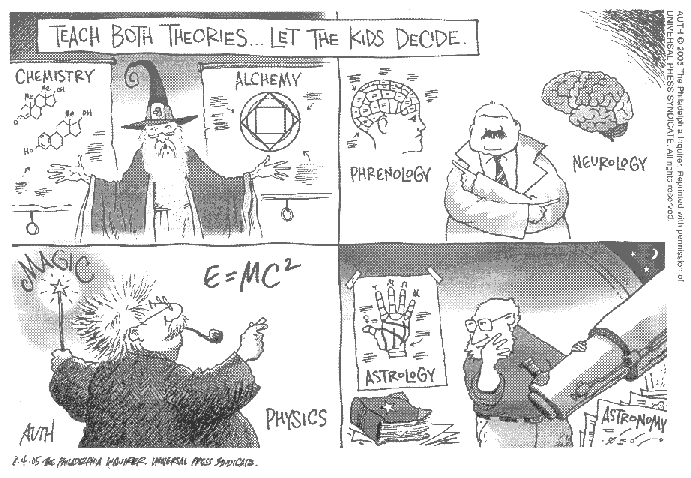
Teach both theories and let the kids decide?

Classical Scholarship lives: The Story of the Archimedes Manuscript


When the Romans advanced to Sicily in the Second Punic War and finally captured the proud city of Syracuse, one of their soldiers met an old man who, surrounded by the din of battle, was calmly drawing geometric figures in the sand. "Do not disturb my circles," the eccentric old man called out. The legionnaire killed him with his sword.

That, at least, is the legend.

The truth is a different story altogether. Placed in charge of King Hieron II's artillery equipment, Archimedes later played an important military role during the siege of Syracuse. He invented powerful catapults to defend his homeland, using cranes to hurl heavy boulders from the walls of the fortress at enemy ships. Mirrors were also used, it is said, to direct burning rays of sunlight at the Roman armada, setting the ships on fire. The Sicilians resisted the onslaught of the ambitious Roman republic for more than two years.

In short, had the legionnaire really speared the eccentric old man with his sword, he would have done the Romans a great service. In addition to being an oddball scholar, Archimedes was a skilled inventor of weapons.

...The fuss revolves around a manuscript that caused an uproar once before, in October 1998, when a fragile, handwritten manuscript with mold spots and blackened edges was offered for sale in an auction at Christie's in New York. After a contentious bidding war, the auctioneer's hammer fell at a price of $2.2 million.
~
Photos from SpiegelOnline.
~
An anonymous "billionaire from the computer industry" had apparently purchased the rare work. But who was it? Neither the auction house nor the new owner was willing to answer that question. Insiders are now certain that it was Jeffrey Bezos, the founder and CEO of online book retailer Amazon...

...The wealthy US buyer was accommodating enough to lend the manuscript to the Walters Art Museum in Baltimore for analysis.

...Part of the problem lies in the fact that the parchment is a palimpsest (from the Greek: scrape clean again). The texts, formulas and drawings by Archimedes, executed in brown ink, were erased in the Middle Ages and overwritten with a religious text. Specialists at the museum irradiated the pages, made of goat leather, with UV light.

Then they were bombarded with X-rays in the particle accelerator at Stanford University to bring out the traces of iron in the Byzantine ink. NASA experts were also involved in analyzing the work...in an effort to determine what was under the text and iconography that was applied overtop of the writings of Achimedes...


...The US researchers certainly discovered a few exciting details. For example, they managed to correctly interpret the "Stomachion," a document that until now existed only in the form of a fragment in Arabic. The title of this treatise on numbers is the name of a children's game Archimedes invented, but it can also signify the beginning of combinatorics.

The researchers were also able to determine the source of the handwriting. A scribe at the court of the emperor of Byzantium apparently wrote the parchment manuscript around 950 A.D. He used various older mathematics books by Archimedes and selected seven important treatises, which he copied.

But science eventually took a turn for the worse in the Byzantine Empire. In 1229, a monk picked up the primer on mathematics, not to study it but to recycle its valuable pages made of animal hide. Using a sponge and lemon juice, he rubbed off the ink. Then he cut the cleaned pages in half, rotated them by 90 degrees and bound them together to make a new book, which he proceeded to fill with prayers and liturgies.

This from SpeigelOnline:International. Photos owned by the owner of the Archimedes Palimpsest.

What kind of Dominatrix is Barbara Erwin?


I used to be a faithful Today Show watcher. That changed several years ago when, following a ratings dip, the show was changed; becoming less about hard news and more about fashion, celebrities and diet.

My wife, who previously would have skipped the Today Show is now a working woman who gets dressed while faithfully listening/watching. That's how I almost got "into trouble" this morning.

She was in the bathroom, hairdryer on full blast, but was still able to catch me changing the channel on the bedroom TV. I started channel surfing because Today was interviewing this week's pop-psychology author. Now, caught by my wife, I reluctantly (or should I say dutifully) returned the channel to NBC.

That's how I "met" Lisa Robyn and learned about her book, The Corporate Dominatrix.

The publisher says, "Using the psychological and theatrical tools of the professional dominatrix, Lisa Robyn shows women how to role-play their way to success.

For a dominatrix in everyday life, the key to effectiveness lies in being switchable–knowing when to be firm and direct and when to be flexible and accommodating.

A Corporate Dominatrix dominates without being domineering and is submissive to authority (when necessary) without being subservient. She stands up for her rights in an open and straightforward way, and she is confident enough to intuit what her clients or colleagues want and she responds accordingly.

The book promises an examination of office behavior as a sociopolitical, neurotic phenomenon, and provides business-minded women with a set of rules to roleplay by.

I always thought a dominatrix was a dominatrix. Mai non. Little did I know, there are different styles of domination; some rather submissive. She stoops to conquer.

Six roles to play to get your way at work


Robyn presents "a compelling strategy for women to get their way at work by choosing the appropriate role to fit the particular situation, while always behaving in a professional manner that earns respect," and encourages women to "become the mistress of your domain" by employing the tactics of the six mistress archetypes of The Corporate Dominatrix: Goddess, Queen, Amazon, Governess, Nurse, and Schoolgirl.

You can even take a quiz to help identify your own particular neurosis, oops, I mean you own particular archetype. Girls only. No boys allowed.

For the rest of you...

You have been bad. Now, prepare to get your butt kicked.


While listening to Robyn's explanation, I couldn't help thinking of our own favorite dominatrix, Barbara Erwin. All the news stories, and comments on this blog from folks who know her, convinced me that she must be a dominatrix. She certainly has our school board licking shoe leather.

But what kind of dominatrix is Barbara Erwin?

Check out the archetypes. Take the quiz if you want. But share your opinion in a comment. We'll see which type "wins."

Saturday, June 23, 2007

Dad Faults Teacher for Showing Pirated Film


He doesn't want to be an ogre about it, but the father of a fifth-grader thinks teachers are wasting time when they show movies in class—and if the film is a bootleg, he says, "That's a really terrible lesson."

Tim Trewhella, 46, said his 10-year-old daughter reported that her class watched the animated movie "Shrek the Third" on Tuesday and recognized it as the fairy-tale hit still showing in theaters.

"A friend hooked me up with it," teacher Lovell Quiroz said, according to the girl.

Peekskill schools Superintendent Judith Johnson issued a statement saying administrative approval is required before a video is shown in elementary school and "if a pirated video was shown it is in violation of district policy." An investigation was under way, the statement said.

This from Teacher Magazine.

In rare turnabout, student accuses teacher of plagiarism

Mary Swenson struggled to finish her doctorate at Capella University. So when she found Sharon Bender, it seemed a saving grace.

A Capella business professor, Bender took an interest in Swenson's management research, even suggesting they team up on a book, Swenson said.

Instead, she charges, her mentor began lifting her work. Swenson said she discovered "thinly veiled" versions of her own writing on Bender's Web site and said that, when confronted, her mentor claimed she deserved some credit herself.

Bender said Swenson's claims are not true - and said it was Swenson who co-opted her ideas.

Passing off someone's work as your own is a cardinal sin in college research. Students can be expelled. Professional reputations can be wrecked. While student plagiarism grabs headlines, allegations against teachers happen more than people realize, experts say. Because students rarely fight back, most accusations fade in the grumbling over beers after class.

This time, though, the student is suing.

This from TwinCities.com.