Thursday, March 24, 2016

The History, Uses and Abuses of Title IX

This from the AAUP:
 
The following summarizes a draft report released for comment by the AAUP. The drafting committee will review all comments received and issue a final version of the report and of this executive summary later this spring. Download the report (.pdf).

Executive Summary:

This report, an evaluation of the history and current uses of Title IX, is a joint effort authored by a subcommittee comprised of members of the AAUP’s Committee on Academic Freedom and Tenure (“Committee A”) and the Committee on Women in the Profession (“Committee W”).  The report identifies tensions between current interpretations of Title IX and the academic freedom essential for campus life to thrive.  This report finds that questions of free speech and academic freedom have been ignored in recent positions taken by the Office of Civil Rights (OCR) of the Department of Education (DOE), which is charged with implementing Title IX, and by university administrators who are expected to oversee compliance measures.

The report concludes with recommendations—based on AAUP policy—for how best to address the problem of campus sexual assault and harassment while also protecting academic freedom, free speech, and due process.

While successful resolutions of Title IX suits are often represented as unqualified victories in name of gender equality, this report finds that the current interpretation, implementation, and enforcement of Title IX has compromised the realization of meaningful educational goals that lead to sexually safe campuses.  Since 2011, deployment of Title IX has also imperiled due process rights and shared governance.  This report thus emphasizes that compliance with the letter of the law is no guarantee of justice, gendered or otherwise.

Specifically, this report identifies the following areas as threats to the academic freedom essential to teaching and research, extramural speech, and robust faculty governance:
  • The failure to make meaningful distinctions between conduct and speech or otherwise distinguish between hostile environment sexual harassment and sexual assault.
  • The use of overly broad definitions of hostile environment to take punitive employment measures against faculty for protected speech in teaching, research, and extramural speech.   
  • The tendency to treat academic discussion of sex and sexuality as contributing to a hostile environment.
  • The adoption of lower evidentiary standards in sexual harassment hearings, i.e. the “preponderance of evidence” instead of the “clear and convincing” standard.
  • The increasing corporatization of the university, which has framed and influenced universities’ implementation of Title IX.
  • The failure to address gender inequality within a broader assessment of its relationship to race, class, sexuality, disability, and other dimensions of social inequalities. 
The contemporary interpretation, implementation, and enforcement of Title IX threatens academic freedom and shared governance in ways that frustrate the statute’s stated goals.  This occurs in part because the current interpretative scope of Title IX has narrowed to focus primarily on sexual harassment and assault on campus.  This narrow fixation strays far afield from the original intent of the legislation and belies the full range of educational opportunities for women originally envisioned by Congress as protected by Title IX legislation, including access to higher education, athletics, career training and education, education for pregnant and parenting students, employment, the learning environment, math and science education, standardized testing and technology.

Critically, the current focus of Title IX on sexual violations has also been accompanied by regulation that conflates sexual misconduct (including sexual assault) with sexual harassment based on speech. This has resulted in violations of academic freedom through the punishment of protected speech by faculty in their teaching, research, and extra-mural speech.  Recent interpretations of Title IX are characterized by an overly expansive definition of what amounts and kinds of speech create a “hostile environment” in violation of Title IX.

These problems of interpretation and implementation demand close attention to the scope of actionable Title IX claims and as well as concentrated efforts to ensure that the procedural rights of the accused are respected.  Sexual harassment’s definitional imprecision has been accompanied by an OCR-mandated change in evidentiary standard that conflicts with due process protections of faculty and students.  The OCR has prohibited the use of the standard calling for “clear and convincing” evidence (highly probable or reasonably certain), and replaced it with a lower standard: that there need be no more than a “preponderance of evidence” (more likely than not) to assess sexual violence claims and by extension, all sexual harassment claims.

The effects of such practices are compounded by the increasingly bureaucratic and service-oriented structure of the entrepreneurial (or “corporate”) university, characterized by a client-service relationship between universities and their students.  This client-service model can run counter to universities’ educational mission when, as in the case of Title IX, universities may take actions that avoid OCR investigations and private lawsuits but that do not significantly improve gender equity.  This client-service model in turn has serious implications for academic freedom, as universities create administrative offices that make and enforce Title IX policies outside of the shared governance process.

Finally, this report reveals that the current interpretation, implementation, and enforcement of Title IX can actually exacerbate gender and other inequities on campus.  Recent student activism protesting institutionalized racial biases in universities reveals the need to ensure that Title IX enforcement initiatives do not, even unwittingly, perpetuate race-based biases in the criminal justice system, which disproportionately affect men who are racial minorities.  The report also cautions against the extraction of gender equity from more comprehensive assessments of bases of inequality—including race, class, sexuality, disability, and other dimensions of social difference—both on and off campus.

Recommended Best Practices

The report recommends the following:

For the Office of Civil Rights (OCR) and the Department of Education
  • The OCR should interpret Title IX as protecting students from sex discrimination, while also protecting academic freedom and free speech in public and private educational institutions.
  • The OCR should increase its attention to protecting due process in all stages of Title IX investigations and proceedings.
  • The OCR should refine its compliance process to develop the potential to work with universities to create policies and procedures for receiving and addressing Title IX complaints in ways that address problems of sexual discrimination while also protecting academic freedom and free speech and providing due process for all parties.
For University Administrators
  • Universities must strengthen policies to protect academic freedom against incursions from overly broad harassment policies and other regulatory university protocols.
  • University policies against sexual harassment should distinguish speech that fits the definition of hostile environment from speech that individuals may find hurtful or offensive but is protected by academic freedom.
  • Through shared governance processes, faculty must be included in all stages of development, implementation and enforcement of sex harassment policy.
  • Universities must clarify their relationship to the criminal justice system and work in coordination with it.
  • Universities should consider adopting restorative justice practices for some forms of misconduct.
  • To further secure the rights of the complainants and the accused, campus initiatives to secure sex equality must be conscious of potential bias on the basis of race, gender identity, class, and sexual orientation in sex discrimination claims and enforcement processes.
  • To meaningfully address inequality, universities should encourage and improve the conditions of interdisciplinary learning on campus by funding gender, feminist, and sexuality studies, as well as allied disciplines.
For Faculty
  • Faculty should participate in shared governance to develop university policies and practices that address problems of sex discrimination, while also protecting academic freedom, free speech, and due process.
  • Faculty should act in solidarity with student attempts to alleviate campus inequalities.

KERA-like accountability scheme arrives in Higher Ed

Colleges and universities will have 25 percent of funding
based on performance in Senate budget, Sen. Givens says


I was under the impression that conservatives, in general, weren't all that keen on the Kentucky Education Reform Act (1990), but I guess things change. Wednesday the Republican leadership introduced a KERA-like performance-based funding system for its universities. College presidents have every reason to be concerned. The good news is that the governor's proposed 100% has now been trimmed to 25% of the state allocation. Approaching reasonable...

This from cn/2's Pure Politics:
Public colleges and universities could see a quarter of their baseline funding based on multiple performance indicators in the second year of the Senate’s biennial budget proposal.

Senate President Pro Tem David Givens, R-Greensburg, presented the upper chamber’s performance-based funding model to the Senate Appropriations and Revenue Committee on Tuesday.

It calls for schools to be grouped into three separate sectors: the universities of Kentucky and Louisville in one, all 16 Kentucky Community and Technical College System institutions into another and the remaining schools except Kentucky State University in a third category.

KSU was exempt from the Senate’s plan because of significant challenges faced by the state’s only public historically black institution, Givens said.

Schools would be graded based on degrees or certificates conferred, retention rates, student progression, graduation rates, shrinking achievement gaps and sector-specific metrics, he said, noting that 32 states have implemented some type of outcomes-based financing model and another five soon will be joining them.
Institutions would then be ranked in their respective categories, with the top achievers taking 100 percent of their performance-based dollars and others earning less accordingly.

Degrees in areas of science, technology, engineering, mathematics and health would be valued more than those earned in other studies, Givens said.

“Whoever’s shown the best performance for the budget period we’ve described would get 100 percent of their allocation,” Givens said. “The other members in that sector would get a percentage relative to that 100 percent.”
Some on the Senate’s budget panel complained that the proposal could harm sections of the state’s non-traditional student body as schools look to earn as many performance-based dollars as possible.

“I do fear that the non-conventional workforce that we try to send is going to maybe fall and be a detriment to some of these institutions and the enrollment policies will continue to be prohibitive for them, so that is my fear,” said Sen. Robin Webb, D-Grayson.
Givens said the Senate’s budget language would allow Gov. Matt Bevin to fully fund an institution based on recommendations by CPE.

Bevin’s original budget called for a third of public higher education dollars to be issued based on performance, envisioning a transition to 100 percent outcomes-based funding over three years starting in fiscal year 2018.

Givens told reporters that Senate Republicans had not discussed moving postsecondary financing entirely to a performance-based model.

“The governor’s had that conversation,” he said. “We’ve never discussed going beyond 25 percent.”
He said he did not envision a scenario in which schools fall behind because they hit their goals but do not receive 100 percent of their outcomes-based funding because they’re not the top-performing institutions in their respective sectors.

Turning to KSU, Givens said there was some debate about keeping the Frankfort university in the mix for performance-based funding because its gains could outpace other competitors schools.

“I truly think of any institution that could excel and move against their baseline the fastest, KSU could be that institution,” Givens told reporters after the meeting.

“So if you had a perpetually poor performer, I could argue that that institution should have more latitude to move quicker than anybody else simply because the bar is so low for them. It is truly a self-refining sort of process. As you set the bar higher, then you’ve got to set it higher each time.”
He declined to say whether KSU would be spared from higher education cuts in the Senate’s version of the two-year spending plan. Bevin called for 4.5 percent spending reductions in the current fiscal year and 9 percent over the biennium for postsecondary education. Those cuts were restored in the House’s version of the two-year spending proposal.

“The beauty of this model is it will overlay any funding amount we decide to do,” Givens said. “I think you’ll get answers to those questions tomorrow.”

House Speaker Greg Stumbo, D-Prestonsburg, said he had not been briefed on the Senate’s performance-based funding proposal, but he noted that the House’s budget included language to study outcomes-based financing for the state’s higher education programs.

“I believe it has merit and I think others believe it has merit, so we’ll take a look at the Senate plan,” Stumbo told reporters Tuesday. “It sounds like they’ve done some research and gotten some information about what other states have done. This is happening in a lot of states across the nation, so it’s not like we’re reinventing the wheel.”

When asked about the Senate’s call for 25 percent performance-based funding for higher education, Stumbo said that proposal “doesn’t seem to me at first blush to be unreasonable,” but he and House Democratic leaders will review the proposal once the Senate completes its version of the budget.

The Senate budget committee has scheduled a special meeting for noon Wednesday ahead of a likely floor vote on the biennial spending plan that day.

Givens’ presentation was part of a broader discussion on the House’s proposed budget in House Bill 303.
John Chilton, Bevin’s state budget director, reviewed a number of the administration’s concerns with the House’s version of HB 303, such as cutting $12 million for heroin addiction efforts, lowering inmate estimates while providing direction on moving prisoners to private facilities if the prison population increases, a $4 million unfunded mandate to design jails in Oldham, Rowan, Laurel and Knox counties, and a $4 million unfunded mandate to transition Operation Unite from coal-severance dollars to the Justice and Public Safety Cabinet’s budget.

While the House’s budget includes less debt than originally proposed, it also lifts limitations on universities looking to bond projects, Chilton said.

“Currently universities are required to get legislative authorization for projects exceeding ($600,000),” he said. “I heard discussion early on in the budget process about raising that limit from ($600,000) to $1 million or maybe $2 million, but the House’s version releases all restrictions on university debt for the next two years.”

Senate sides with Bevin, revives budget cuts

This from the Courier-Journal:
The Kentucky Senate sided with Gov. Matt Bevin on Wednesday in passing a state budget that imposes deep funding cuts to education and many other areas of government to find money for huge new outlays for Kentucky's ailing pension plans.
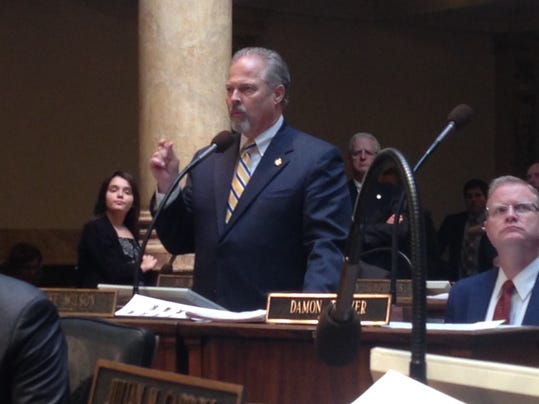
Sen. Chris McDaniel

The Republican-controlled chamber passed its revised version of the 2016-18 budget on a vote of 27-2, with nine Democrats voting "pass."

As it leaves the Senate, the budget bill includes the 9-percent funding cuts that Bevin originally proposed for state universities, support programs for public schools and many other state agencies. The Democrat-controlled House restored funding for those cuts in the budget bill it passed last week.
"It's not something we particularly wanted to do.  It's something that we had to do," Sen. Chris McDaniel, the chairman of the Senate budget committee, said of the cuts to education. "We have got to make our primary investment in getting these pension plans solvent. The problem only gets worse and worse and worse every year."

All three versions of the budget - Bevin's, the House's and Senate's - make big new direct appropriations to address the crisis in state pension funds, which together have unfunded liabilities of more than $31 billion.

McDaniel, R-Taylor Mill, said the Senate budget appropriates more overall to pensions than the House budget did - particularly for the Kentucky Employees Retirement Systems.

And the pension watchdog group Kentucky Government Retirees released a statement later Wednesday commending the Senate's approach.

McDaniel, R-Taylor Mill, said his committee's budget is a sound one that leaves $371.5 million in the state's "rainy day" fund to protect against revenue shortages and $250 million in a new reserve fund called the "permanent fund," which is to be used to make future additional payments to pension funds. Bevin had wanted more in both funds.

But the House had left the rainy day fund at $283 million and spent all of the $500 million Bevin wanted in the permanent fund to pay for restoring the funding Bevin proposed be cut to education and other areas.

Among scores of changes it made to the budget, the Senate budget would:
» Delete all funding for the House priority of scholarships that would make community college tuition-free for high school graduates who enroll in the state's community colleges.
» Begin basing 25 percent of university funding in 2017-18 on its complex model for grading university performance.
 » Delete $450,000 per year that the House added for Louisville Waterfront Development Corp.
» Delete $550,000 per year that the House added for the Home of the Innocents in Louisville.
 » Delete a $65 million bond issue for renovation of the Lexington Convention Center that both Bevin and the House had included in their budgets.
 » Delete funding both Bevin and the House had provided to add 44 additional attorneys for the Department of Public Advocacy.
 » Restore $32 million in appropriations to the Justice Cabinet to fight the heroin abuse problem. The House had reduced this to $20 million.
 » Restore two provisions Bevin had included: one that would ban any public funds going to Planned Parenthood, and one that would repeal Kentucky's law requiring prevailing wage be paid to workers on public construction projects.
 » Apply the same cuts Bevin proposed for programs that support public schools like preschool, textbooks and safe schools. However, McDaniel said his committee provided more money than Bevin did for one program: Family Resource and Youth Service Centers.
The two senators who voted no were Reginald Thomas, D-Lexington, and Brandon Smith, R-Hazard. Thomas objected to the education cuts and the scrapping of the bond issue for Lexington's convention center. Smith protested changes made to the House budget that will reduce the amount of coal severance tax revenues that are returned to coal counties.

The budget bill, House Bill 303, is a plan for spending about $22 billion in state tax revenues (plus additional federal and other funds) for the two-year period beginning July 1.

It now goes back to the House, which is certain to reject the Senate’s changes. That means leaders of each chamber will attempt to resolve the differences in a conference committee.

The conference committee has only a few days to accomplish that task. Wednesday was the 54th meeting day for the legislative session. Under the Kentucky Constitution, lawmakers can meet no more than 60 days in this session.

For now, legislative leaders are planning to pass a final budget bill by Tuesday. But the constitution gives them until April 15, when this session must adjourn.

Wednesday, March 23, 2016

How do the schools really stack up?

Over at School Finance 101 Bruce Baker is doing his year end review of education data on the New Jersey schools. But his review contains some news that applies to Kentucky and all other states as well. I have added a few bits to highlight Kentucky's performance.

This from School Finance 101:
On many occasions I’ve pointed out better and worse uses of national and international assessment data – of Mis-NAEPery and PISA-Palooza… wherein the media and punditocracy go wild with gross misrepresentations and misinterpretations of relatively limited albeit not entirely useless assessment data.

In New Jersey, we’ve been told in recent years that while our average scores remain high, we must not rest on our laurels, because our gains pale by comparison to reformy standout states like Tennessee. We’ve been told that while our average performance is high, our gaps in achievement are among the largest in the nation and certainly not improving at any reasonable rate. We’ve also been told that these findings provide strong proof that all the money New Jersey has thrown at schools in response to years of litigation over school funding has not only been unhelpful, but that the additional funding to high poverty settings has actually caused harm. As such, the way to repair that harm is to reduce funding to high need settings and redistribute those harmful resources across other, less needy districts likely to use it more wisely (yeah… really… they did say that… and they’ve followed through on that redistribution plan!) And that will help fix the achievement gap!

But what really is the state of student outcomes in New Jersey, if we apply a few basic principles to the analysis of NAEP data – guidelines I have addressed in numerous previous posts:
  • First, average state contexts differ and those differences strongly influence average NAEP scores at all grade levels. In short, poverty matters! As such, performance levels should be adjusted for poverty.
  • Second, NAEP gains over time (which are cohort gains), are strongly influenced by initial NAEP performance. That is, those who started lower and had more to gain, gained more. As such, changes over time should be adjusted for initial scale scores.
  • Third, achievement gaps between low income and non-low -income, or among races are substantially influenced by the income gaps between these groups. As such, achievement gaps should be adjusted for differences in income between groups.

Average Performance Level Adjusted for Poverty

This first figure shows us the scatterplot of state average poverty rate and average 8th grade NAEP scale scores. Those states falling above the line have greater than expected scale scores and below the line have lower than expected scale scores. Notably, the correlations are quite strong. New Jersey beats the odds on both 8th grade reading and math. That is, NJ scores are higher than would be expected even given New Jersey’s low poverty rate?

Figure 1


If we rank states by their average difference from expectations, New Jersey comes in fifth (averaging the math and reading differentials). [Kentucky comes in 7th!]

Figure 2
Slide2

But that’s only because the whole U.S. stinks, right?

Of course, some might argue that its really nothing to cheer about – doing better than other U.S. states, because of course, we all know that the U.S. performs miserably compared to other nations. But as I’ve pointed out previously, when conducting similar poverty adjusted comparisons across countries, the U.S. doesn’t look so bad. (see here for more explanation/discussion)

Figure 3
Slide11

Ah… but you say… outcomes of even high performing – non-low income kids in the U.S. still stink compared to those in other countries. Again, I respond by pointing out that most such comparisons are deeply conceptually flawed. Perhaps most importantly, as I’ve explained on numerous previous posts, the U.S. average is only as low as it is in international comparisons because of the large number of low performing (relatively high poverty) states that have largely thrown their education systems under the bus for the past several decades...

Here are a few more pictures...


Friday, March 11, 2016

Madison County students competing, learning to be business leaders

This from the Richmond Register:
Despite Thursday’s clouds, many Kentucky high school students, including those from Berea High School, Madison County ATC and Madison Southern High School, gathered on Eastern Kentucky University’s campus to compete in the Future Business Leader’s of America (FBLA) Region Six Leadership Conference.

The conference's theme was “Let the Magic Begin,” and it took a year to plan.

“It is really neat to study business in our classes, and then get to come to an event like this to apply the concepts,” said Jamie Orr, a Madison County ATC student.

According to Region Six FBLA Chair Paula Short, the conference hosts 33 schools, 35 advisors and 742 high school students.

During the single-day event, students competed in 72 event categories through business classes, Short added. Some categories included business ethics, client services, impromptu speaking, job interviews, social media campaigns, help desk and cyber security.

As with any competition, stress was high, but friendly faces, both old and new, made the day fun and exciting.

“Everyone has been really nice,” said Berea Community high school student Elvia Rojas, who competed in the social media campaign. “My classmates and I have even made friends outside of the Berea (competitors).”

Isaiah Owsley from Madison County ATC also agreed.

“It has been awesome,” he said. “We have gotten to meet so many new people and make new friends.”

For students such as Berea Community FBLA president Greg Schloemer, the event was a test not only of his business skills, but also in multitasking.

“I had to compete in my own competition (network design), while also ensuring that all of the other BCHS members made it to where they were supposed to be,” said Schloemer.

Jamey VanDyke saw the conference as a grand finale of sorts. As a Madison Southern high school senior, this will be one of her last FBLA conferences.

“It is kind of sad,” said VanDyke. “But I know I can do well. I got first place in my category last year.”

VanDyke, who competed in insurance and risk management, said that her category was required to take an online test, which they were given an hour to complete.

“I can’t say enough about the opportunities (events such as this one) provide,” said Kentucky FBLA State Advisor Connie Witt. “My own two kids have gone though the program and I just feel there are so many positives. Students learn commitment, professionalism, communication, leadership, even how to dress and speak professionally.”

Witt added that FBLA students are often provided scholarship opportunities and can even win money if they place in nationals.

However, if Madison ATC student Charles Simpson Jr. is correct, self-satisfaction just might be the biggest reward.

“I’ve learned more about myself than I ever have during this competition,” Simpson said.

Currently there are six FBLA regions in Kentucky, of which Madison County is in the sixth. At the conference, 21 students represented Madison County ATC, 20 for Madison Southern and 67 for Berea Community.

The top three contestants in each category will go on to compete at the State Leadership Conference in Louisville on April 18-20.

Morehead State announces 5-day unpaid furlough for faculty, staff

Unpaid work week will be during spring break, March 21 to 25

Move attributed to declining enrollment, proposed budget cuts

Total cuts need to reach $4.5 million by June 30

Higher education is the solution, not the problem. 
Kentucky students, families, and taxpayers 
deserve more — much more — not less.
-- Morehead State University President Wayne Andrews

This from the Herald-Leader:
Morehead State University will furlough without pay all of its faculty and staff during the school’s spring break, March 21 to 25, because of current and expected economic woes, Morehead President Wayne Andrews announced Thursday.
Wayne Andrews

In a campuswide email, Andrews said Morehead must cut costs by $4.5 million to erase a $2.6 million tuition shortfall and comply with Gov. Matt Bevin’s proposal to cut $1.95 million, or 4.5 percent of the state’s appropriation to the school, during the fiscal year that ends June 30.

“We have carefully examined all current-year expenditure budgets and have identified reductions to address the $2.6 million tuition revenue shortfall,” Andrews wrote. “However, addressing the $1.95 million cut in current-year state appropriation is a more significant challenge given that the cut was announced late in this fiscal year, when most of our discretionary budget resources have been spent or committed.”

Some crucial staffers will have to work during spring break and will have to schedule their furlough later, he said.

The governor’s proposed budget, which also calls for a 9 percent cut to universities over the next two years, will go through numerous changes in the House and Senate.
This week, House Speaker Greg Stumbo said the House’s version of the budget would lessen or reverse Bevin’s proposed cuts to higher education. The House is expected to release its version of the budget early next week. The final document must be completed by April 15, a deadline set by the state Constitution.

No matter what happens with the state budget, Andrews said, declining enrollment and other concerns will require additional belt-tightening and reprioritizing in the coming year.
In a phone interview Thursday, Andrews called the furlough “proactive.”

“We were faced with the unknown,” he said. He and his executive team decided that the option that would affect students the least was a furlough. “It’s preferable to doing layoffs or salary reductions.”
In the past two years, enrollment has declined about 4 percent, Andrews said, mostly because of families dealing with job losses caused by the depressed coal market in Eastern Kentucky.

That left a $2.6 million hole in expected tuition revenue. The university, which has seen its state appropriation decline $6.8 million since 2008, also faces increased fixed costs. For example, Andrews recently received a letter from the Kentucky Employees Retirement System, to which Morehead and several other regional universities belong, saying it must increase its contribution to the system by $1 million next year.

“I’m very mindful that the House is working hard to restore cuts, but I’m also mindful of the fact that the Senate will do what they do,” Andrews said. “I believe there will be cuts; what I don’t know is how much. I thought it was prudent to take advantage of this opportunity” of spring break, when not many people are on campus.

Morehead will hold a series of open forums about its budget for the upcoming fiscal year during the first week of April. An operating budget will go to the board of regents on May 13.

The proposed 9 percent cut would reduce Morehead’s budget by about $3.9 million.

“This may not be the end for us,” he said of the furlough. “Everything may be on the table: programs, staffing. My highest priority has always been to preserve and protect our most valuable asset: our people.”

Other Kentucky universities also face difficult choices. Kentucky State University President Raymond Burse initially said the proposed cuts might force that school to close, although he softened those remarks later.

“These cuts, and the additional cuts proposed, strain our ability to provide affordable access to quality academic programs, to educate students for careers and jobs so important to the advancement of our great state, and to take care of our community,” Andrews said. “Higher education is the solution, not the problem. Kentucky students, families and taxpayers deserve more — much more — not less.”

Thursday, March 10, 2016

Ex-principal suing Fayette County schools claims retaliation

Former Cardinal Valley principal complained about treatment of Hispanic students

Lawsuit: She was told, ‘No one cares about those Mexican kids with a bunch of illegal parents’

Fayette County school district seeks ruling to avoid jury trial

KSN&C Backstory:

This from the Herald-Leader:
Ivonne Beegle, the former principal of Cardinal Valley Elementary School who said she was asked in 2012 to resign or be fired, alleges in a court document that she was retaliated against because she complained about unequal treatment of her and Hispanic students.

Beegle tells her side of the story in a document filed Feb. 29 in her lawsuit against Fayette County Public Schools officials in response to the school district’s request for a summary judgment. Fayette Circuit Judge Tom Clark is scheduled to consider the district’s request Friday. A summary judgment would cancel a mid-April jury trial.

Beegle, who became principal in the 2007-2008 school year, said that at one point, she was told by a supervisor, “Do not complain. No one cares about those Mexican kids with a bunch of illegal parents.”

The document cites a 2014 deposition that then-Fayette Superintendent Tom Shelton gave in which he was quoted as saying that it was shocking to him that the district didn’t have an adequate focus on “what I consider equity for students such as those that made up the majority of the student population at Cardinal Valley.”

Beegle, who is a native of Nicaragua, said she made numerous complaints of illegality, mismanagement and discrimination while she was at Cardinal Valley.
After her resignation, Beegle filed a lawsuit in 2013 asking for lost wages and benefits, emotional distress damages, and attorney fees and costs.

In the court document, Beegle said that district officials knew she had nothing to do with her administrative dean placing a tape recorder in a flower pot and taping teachers as they talked to district officials. The district officials were investigating a grievance that Beegle had harassed a teacher. The taping incident led to Beegle’s suspension, and district officials told her she could resign or be fired.

Beegle contends in the court document that as a manager, she demanded accountability from employees, and her management style angered a few employees.

In 2012, an attorney for the school district told Beegle in a letter that her conduct fell below the conduct required of a Fayette County school employee because she was aware of the secret recording of private employee interviews during a civil rights investigation conducted by a district staffer. The letter said Beegle shared the recordings with Cardinal Valley employees, failed to report the recording with district leadership and retaliated against certain employees who were interviewed during the civil rights investigation.

Beegle said in her court document that “knowing that she did not do these things, but desperate and confused, (she) resigned her employment in lieu of termination.”

In a Jan. 19 court document asking for a judgment that would avoid a jury trial, school district attorney Bob Chenoweth said Beegle has failed to state a claim on several fronts.

The district’s motion said Beegle can’t show that her employer took action or threatened to take action against her.

On Tuesday, Chenoweth declined to comment beyond the court documents.

Beegle’s attorney, Chris Miller, also declined to comment..

In the court document signed by Miller, Beegle said that Cardinal Valley was regularly treated differently than other schools.

During her tenure as principal, Beegle said, she had complained about black mold in the school buildings, overcrowded classrooms, a teacher getting into a fist fight with a student, and the district’s misappropriation of federal funding by allowing a teacher to attend leadership meetings instead of working with underprivileged children as required. She voiced concerns about buses dropping off students at the school before staff had arrived and about a school bus monitor who had leered at students and kicked students off the bus for speaking Spanish.

Beegle contends that despite high numbers of low-income children, and children who were learning the English language, she was able to show double-digit gains in test scores in both math and reading. Before being suspended, she received outstanding evaluations and awards, the court document said.

Wednesday, March 09, 2016

Not time to abandon education

This from the Courier-Journal:
House Speaker Greg Stumbo indicated Tuesday that House Democrats will dip into big reserve funds that Gov. Matt Bevin wants to set aside to deal with the pension crisis to find money to restore some money Bevin has proposed to cut from university and other education programs.
House Speaker Greg Stumbo

"I think the consensus of our members is that it's not a time to abandon our commitment to education in Kentucky," Stumbo, D-Prestonsburg, told reporters when asked about the major changes that the House majority Democrats are about to make to Bevin's proposed 2016-18 state budget.

Stumbo said House Democrats are not quite finished with the budget, and could not say whether the House plans to restore all, or how much of, the 9 percent cuts Bevin has proposed to universities and many important support programs for public schools other than base school funding which Bevin does not propose to cut.

"Our goal is to restore and make whole our educational community as best we can..." Stumbo said. "I don't think it's a time that we should make the draconian cuts that (University of Kentucky President) Dr. (Eli) Capilouto spoke of...The time is to invest. Our economy is growing."

Stumbo said the House will likely leave much of Bevin's budget intact.

"We didn't take any money from his retirement initiatives - the ones that were funded, that were earmarked, that were dedicated," he said.

But Bevin's proposed budget also calls for building up Kentucky's "Rainy Day" fund to guard against future revenue shortages to more than $500 million, and to transfer $500 million in surplus funds of the public employees health insurance fund to a new "Permanent Fund" the governor says will be used to help fund the pension problem in the future.

Stumbo said House Democrats are looking to those reserve funds "and some other places" to find money to reduce Bevin's proposed cuts.

Bevin's office released a statement later Tuesday that said in part, "The number one financial threat to Kentucky's future is our pension crisis." The statement also said, "We are still waiting for details from Speaker Stumbo, but Gov. Bevin has been clear that he will not sign a budget that robs from our pension fund or adds to our debt."

The House budget committee actually approved the Bevin budget bill - House Bill 303 - on Tuesday, but only to get it moving through the legislative process with the understanding that the bill will be sent back to the committee for it to make the changes worked out by the Democratic majority.

Stumbo said the full House will vote on it "probably some time the first of next week." Despite criticism of Bevin and other Republicans that the House is taking too long to amend the budget and send it to the Senate, Stumbo said this is "about on time."

However, a check of the legislative record shows that if the House votes on the budget bill March 14, the date would be a little later than the most recent comparable years. March 14 will be the 47th day of this 60-day session.

Most recent comparable years are 2004 and 2008 - budget sessions after the election of a newly-elected governor when the law gives the governor five additional days to present a budget to lawmakers. In both 2004 and 2008, records reflect the House voted on the budget bills on the 44th legislative day.

And the House's consideration of the budget bill could be significantly complicated if Republicans win all four special elections being held Tuesday to fill vacant seats in the chamber. If that happens, Republicans and Democrats would each hold 50 seats and be required to cooperate in order to move a budget bill down to the Senate.

Tuesday, March 08, 2016

Bevin Pulls a Political Stunt

stalks House chamber claiming no one working

Democrats claim Bevin either misleading or ignorant of the process

This from cn/2's Pure Politics:
Kentucky Governor Matt Bevin is taking an unconventional approach to negotiating with House Democrats on a two-year spending plan.

Bevin released a video Monday morning on his social media sites claiming lawmakers aren’t showing up for work on the budget.

In the video posted below, Bevin goes straight to his supporters with what he claims is inaction on the state’s $21.8 billion biennial spending plan which the House received on Jan. 26.

Since the House got the budget their committees have been holding hearings and vetting the spending proposals which call for 4.5 percent cuts in the current fiscal year and a 9 percent reduction in fiscal years 2017 and 2018.

Bevin’s budget pumps more dollars into struggling state pension systems, and it carves out $100 million bond pool for workforce development projects and $64 million from the Kentucky Lottery to expand dual-credit programs in the state’s high schools with assistance from the state’s postsecondary institutions.

The video features the first year Republican governor speaking direct to camera in the state Capitol. Bevin leads viewers to the empty House chambers claiming Democrats have been dragging their feet and not working.

“It is 11 o’clock on a Monday there is nobody in here, this House, we have less than 19 days left now for this House to be in session together in the Senate and there is nothing being done,” Bevin said. “There is not a soul in here except for me. What are people doing?”

#Get2Work #PassTheBudget
Imagine my surprise when I went to see how the budget debate was going...and found this...#Get2Work #PassTheBudget
Posted by Governor Matt Bevin on Monday, March 7, 2016

Bevin’s video and commentary misses the fact that lawmakers work from the Capitol Annex next door to the Capitol in committee meetings and behind the scenes working groups, and not gavelling into session in the chambers in both the Republican led Senate and the Democratic led House until 4pm on Monday.

Bevin’s budget has gone through numerous House and Senate committees in the 27 working days since the House received the $21.8 billion biennial spending plan and complicating the matter is vagueness within the plan, House Speaker Greg Stumbo said.

“Our budget subcommittees have been meeting every day,” Stumbo said. “The governor, if he’d been here Friday, would have known that we don’t go in until 4pm on (Monday) because we have so many members that we don’t have the benefit of the state airplane like he does.

“If he cared to walk across here, maybe someone would be happy to send a trooper to give him a tour, this is where the work goes on as it has today,” Stumbo said, speaking of the annex where legislative offices and meeting rooms are located.

One of the problems, Stumbo said House budget subcommittees are running into is a lack of information from cabinet secretaries on specific issues, he said pointing to the bond issuance of $100 million for the Education and Workforce Development Cabinet in Bevin’s plan.


The Kentucky Democratic Party also took offense to Bevin’s video, in a statement KDP Chair Sannie Overly questioned the video as either ignorance or purposefully misleading.

“Either Gov. Matt Bevin doesn’t know how the process works, or he was trying to distort the truth and mislead people with his video today on social media,” said Rep. Sannie Overly, chair of the Kentucky Democratic Party. “While Gov. Bevin was trying to be the star of his own phony reality show at the wrong place, House lawmakers were heading to work in the Capitol Annex, where committee meetings happen every day during session.”

Friday, March 04, 2016

UofL's James Ramsey escapes no-confidence vote

This from the Courier-Journal:
Citing self-dealing, thefts, conflicts of interests and other embarrassments and scandals, dissident members of the University of Louisville’s Board of Trustees called for a vote of no-confidence Tuesday in embattled President James Ramsey.

“When we ask questions we get temper tantrums,” Trustee Emily Bingham said. “I regretfully express my loss of confidence in the president.”

But in a contentious meeting marked by personal attacks, Ramsey’s supporters blocked the motion on procedural grounds.

Defending U of L’s 17th president, Dr. Bob Hughes said, "This is not a broken administration, it is a broken board."

He called on every board member to resign and let Gov. Matt Bevin appoint replacements.

Ramsey's fate is still in doubt. The board will reconsider the no-confidence motion at its next regular meeting April 20, and proponents say they have enough votes to pass it.

They include Chairman Larry Benz, who said after the meeting that he supports the measure because of his questions about Ramsey’s leadership and the university’s performance.

Ramsey didn’t speak during the meeting but said afterward that he has no intentions of resigning.
The no-confidence motion was made and supported by trustees who hadn’t previously challenged Ramsey publicly.


Calling for the vote, Dr. Jody Prather cited a “near complete collapse of a meaningful working relationship" between the board and Ramsey as well as instances that have "harmed and embarrassed the university irrevocably."

Trustee Larry Hayes complained that Ramsey has excluded the board from important decisions, including the one to impose a ban on postseason play by the men’s basketball team.

“That was not good governance or shared governance," Hayes said.
Bingham cited “a drumbeat of crises” that prompted 78 full professors to sign a letter saying they were “ashamed to be associated with the university.”  She also said Ramsey had failed to forcefully condemn the sexual misconduct allegations currently facing the basketball program, "already embarrassed by the sexual misconduct of its coach."

“We cannot move forward with leaders whose moral compass on these questions is not clear,” she said.

But Hughes and others who support the president, including Marie Abrams, said the no-confidence vote was out of order because it had not been on the agenda for the special meeting, and general counsel Leslie Strohm, who was hired last year by Ramsey, said that is required by state law.
Lashing out at the dissidents, Hughes and Trustee Ron Butt suggested that they want Ramsey ousted so that he can be replaced with one of their family members.

In an unusual confrontation, Hughes challenged Trustee Craig Greenberg to name their president of choice, saying “you know who his is.” Greenberg replied that he didn't know whom — or what Hughes was talking about.


After the meeting, Hughes said that Ramsey’s opponents are elitists who didn’t go to U of L “and wouldn’t send their children there.”  Without mentioning the mystery candidate by name, he suggested it might be Matthew Barzun, the Louisville businessman and Obama fundraiser who is ambassador to England.

In a battle of impromptu press conferences, Greenberg told reporters "this isn’t about the next president, It is about embezzlement, scandals and indictments. It is time for a change.”


While a no-confidence vote wouldn’t immediately cause Ramsey’s ouster, it could prompt him to resign. He is under contract until 2020, which may explain why the dissidents aren't seeking an outright vote to fire him.

There are currently 19 members on the board, but Bevin is expected to appoint a 20th before the April 20 meeting. The makeup of the board also could change with the resolution of a suit in which the Justice Resource Center has challenged the board's racial composition.

Tuesday's dispute was on the heels of a lawsuit in which a veteran former compliance officer accuses Ramsey and his top lieutenants of trying to squelch enforcement of conflict of interest rules and Ramsey himself of public misconduct. A university spokesman declined to comment on the suit.


Hired in 2002, Ramsey has been credited with helping dramatically increase the university's academic standards for incoming freshmen and its graduation rate. He also led fundraising drives that have transformed the campus and its athletic facilities.

But over the past two years, his leadership came under attack as the university dealt with embezzlement scandals and other embarrassments, including an FBI investigation of its top health care executive and an NCAA investigation of allegations that men's basketball players and recruits were provided dancers and prostitutes.

The university also has been criticized for offering buyouts to top officials in exchange for their silence, and Ramsey's compensation has been questioned.

Last year The Courier-Journal reported that Ramsey, provost Shirley Willihnganz and chief of staff Kathleen Smith had been paid $2.4 million, $1.8 million and $1.3 million, respectively, in deferred compensation. The CJ also reported that Ramsey in 2014 was paid 2.5 times more than the average of the Atlantic Coast Conference's other 14 presidents and chancellors — all of whose universities are ranked far higher academically than U of L.

No-confidence votes are common in academia but usually are made by faculty rather than university governing boards. Some such votes have made headlines and brought about administrative change, according to Insidehighered.com, which says a faculty vote of no confidence in Harvard President Lawrence Summers contributed to the university board's decision to oust him.

But the publication says votes of no confidence typically indicate that faculty feel a leader is no longer fit to serve in his or her position but rarely lead to a resignation or firing.

Thursday, March 03, 2016

Shameless self-promotion

My thanks to EKU Historian Emeritus Bill Ellis for the shout out in the latest Kentucky Monthly.

After two years leading the EKU Faculty Senate (and putting scholarship on the back burner) I am now ready to resume my work on this book project. Just this week I began the process of gathering and reviewing over 300 articles on Bob Sexton and the Prichard Committee for starters. Then there are the Sexton papers at UK to review, and many interviews to conduct.... 


Charter school, voucher bills filed

Sen. Mike Wilson
In addition, Rep. Addia Wuchner, R-Burlington, has filed a bill that would create a school voucher-like program allowing special needs students to redirect per-pupil public school funding to pay for private schools or private tutoring.

Efforts to bring vouchers and charter schools to the Bluegrass State have been going on for years, but with a new Republican governor that has championed charter schools and vouchers and a House that could be moving closer to Republican control, the chances seem greater compared to recent years that such legislation could pass.

Tuesday was the last day for House members to file bills this session, and Thursday is the last day for Senate members to do so.

The charter school bill filed Tuesday by Sen. Mike Wilson, R-Bowling Green, is similar to those he's filed in previous years.

The bill, SB 253, would essentially create a five-year pilot charter school program in Jefferson and Fayette counties, with a maximum of two charter schools allowed to open per year in each county. It would create a "Kentucky Public Charter School Commission," which would have members appointed by the governor and could approve charter applications and provide oversight.
The bill would have charter schools target low-income students for priority acceptance, with extra spots opened up to other students on a lottery basis.

Wilson on Wednesday said he doesn't know if his charter school bill will pass this year, but said that "any year that we have kids that are in a failing school with an achievement gap as much as 40 percent, it's really unconscionable. This is another tool that could be provided to help those kids."
The House charter school bill, HB 589, filed Tuesday by Rep. Brad Montell, R-Shelbyville, is similar to the Senate version.

Wuchner said her bill, HB 620, would not create a voucher program, but said the bill would create individual educational accounts so the families of students with disabilities could  take some of the money that is designated for their education to use for participating private schools or programs.
"This is a way ... to allow parents to use those taxpayer dollars to meet the needs of a very specific group of students," Wuchner said. "It's a newer concept for Kentucky but it's time we start to explore how we can meet the needs of this particular group of students."

Other education bills that were filed right before the House deadline include:
» A bill that would prohibit the state from implementing Common Core and Next Generation Science standards. HB 553 would require the state board of education to recommend new content standards after public input and consultation with the Council on Postsecondary Education, and it would prohibit the state from withholding funds from school districts for adopting different academic content standards;
» A bill (HB 555) that would allow Kentucky residents who are attending high schools in other states that border Kentucky to still earn Kentucky Educational Excellence Scholarship (KEES) money;
» A bill (HB 567) that would move the Education Professional Standards Board under the auspices of the Kentucky Department of Education. The EPSB, which is currently a separate organization, issues and renews teacher certificates, among other roles.

Wednesday, March 02, 2016

Think first. Act second. Create something lasting...

According to Senate Education Chair Mike Wilson, teachers are saying this is not the time to halt the adoption of Senate Bill 1. But what they are really saying is that this is not the time to halt the progress Kentucky schools have made. SB 1 and educational progress are not necessarily the same thing. But it's hard to tell from Wilson's twisted rhetoric.
  
Wilson complains that the original Republican-sponsored Senate Bill 1 in 2009 opened the door to political posturing, artificial accountability, and bureaucratic burdens. Of course, he doesn't mention the part about Senate Bill 1 being a Republican bill. One assumes that is because he wants us to believe the Republicans are here to save us from a school system that - well, actually, a system that has shown great improvements over the past 25 years.

He argues that his new and improved SB 1would reduce political influences that have stifled educators’ voices. But what he does not say is that SB 1 would place state curriculum under the control of politically-selected, and no doubt, politically-motivated appointees thus opening the door for Kentucky to become more like Texas, where historical facts in the classroom are subordinate to the present-day ideologies of the majority. While Republicans sit on the verge of taking over both houses of state government, his assurances that the process would not become politicized fails to pass the smell test.

Wilson laments Kentucky's pursuit of federal Race to the Top (RTTT) money, which called for the adoption of internationally-bench marked standards (which coincidentally matched Common Core, another Republican idea from 2007 [and a good one]). But he fails to mention that Republican leadership at the time touted the state's effort to capture the funds - partly because RTTT also incentivized states to adopt charter schools, and partly because the legislature did not fund SB 1. Neither does Wilson mention that Republican and Democratic education policy was pretty closely aligned in 2009, and that the major planks of American Diploma Project (also an initiative of Governor Ernie Fletcher which led to Kentucky becoming an early adopter) were largely mirrored in RTTT.

Senate Bill 1 also creates a class system with regard to accountability. It reminds me of Kentucky's high school football classifications where small schools face weaker competition and thus have lower expectations than others. It makes sense in football (where a AAAA school may have a thousand players to choose from, but a single A team might have 75 potential players) but I am not sure it makes sense here, unless the goal is really to take pressure off the schools.

By the way, any suggestion that Senate Bill 1 will eliminate achievement gaps is a fairy tale.

But Wilson is not all wrong. He correctly identifies the frustrations of many teachers who have been subjected to the arcane rigors of high-stakes accountability, too much testing coupled with burdensome and often inappropriate teacher evaluations. And he correctly identifies the frustrations of overworked principals drowning in the depths of Kentucky's evaluation process.

Wilson is also correct to complain about federal overreach into state education policy in general. That has been increasingly going on since ESEA was first passed in the 1960s, and brought to new heights under Presidents George W. Bush and Barack Obama. But for today's Republicans to abandon their own best ideas - the ones they praised under Bush 43 - but now reject them simply because President Obama signed on, leaves me doubting that the majority party has a carefully considered education policy at all.

The 2009 version of SB 1, like every other policy, is not perfect. But it was a sturdy framework that has contributed in some measure to the state's impressive growth. There are certainly branches of that tree that need pruning. But Kentucky does not need to dig up a relatively healthy tree in favor of an ill-considered sapling that will do more to reintroduce politics into state education policy than anything we've seen since 1990.  

There is a brand new federal education law passed by Congress in December. The regulations for the new law are still being written. This is the time for Kentucky to study its education policies. Think first. Act second. Create something lasting. And quit jerking Kentucky teachers around.


This hogwash from Sen. Mike Wilson in the Herald-Leader: 


Senate Bill 1 gives more control to the state, schools, teachers


Based on consistent messages from Kentucky public school educators, this is not a time to halt or apply the brakes on adopting Senate Bill 1, but a time to step on the accelerator. Since 2009, political posturing, artificial accountability, and bureaucratic burdens have “halted” practitioners long enough.
Sen. Mike Wilson

First, SB 1 attempts to reduce political influences that have stifled educators’ voices for determining state academic standards and tests. Pursuit of federal Race to the Top money influenced our state to adopt standards without preliminary practitioner input and to hastily choose tests that inadequately aligned with those standards.

Most teachers have had to pull double duty teaching extra lessons for the state test in addition to their regular curriculum. Just ask any Kentucky educator. The good news is that SB 1 will not only allow the public and Kentucky teachers to recommend standards but also trust them to simultaneously ensure alignment of state tests with those standards.

In addition, to reinforce transparency, a committee composed of Governor appointees, representatives, and senators will join the Commissioner of Education to prevent the political end-run influence of vendors or executive orders from nullifying public and educator recommendations. This committee will NOT change the recommendations made by the review groups, but will ensure all voices have been heard before forwarding them to the Kentucky Board of Education.

Second, in response to educators’ outcries from across the state, our bill’s accountability guidelines will allow practitioners to refocus on student growth, staff productivity, and credentialed graduates sought by industry, rather than on compliant activity and a chasing after points. Despite state assistance and sanctions, accountability measures have not effectively impacted student achievement growth, especially for our economically disadvantaged students, whose percentage of novice scores nearly doubles those of their counterparts. Just ask any Kentucky educator.

To hold both higher- and lower-scoring schools accountable to move 100 percent of their students to proficient performance, SB 1 requires one additional measure that compares each school’s average growth with other schools with similar demographics. In addition, to accelerate school improvement, SB 1 aligns with the federal Every Student Succeeds Act (ESSA) to allow local districts the decision-making authority to pursue cutting-edge, turnaround strategies from experts not available from the Department of Education.

Postsecondary readiness will be measured by increases in the percentage of graduates with higher college admissions test scores, college credit hours, and genuine credentials demanded by industry rather than an assortment of additional tests.

Third, although a statewide professional growth and effectiveness system was recently established for Kentucky educators, federal influence reversed the course and stunted the growth of practitioners. The quality new standards and evaluation framework was neutralized by forcing teachers to spend a disproportionate amount of time responding to incessant and overreaching state requirements to submit unnecessary documentation, tallying of processes, and tediously entering contrived student growth on a $36 million web-based system that seldom worked.

A principal remarked that he was no longer a leader of an innovative staff, but a manager of compliance. Just ask any Kentucky educator. SB 1 preserves the state’s authority to establish a quality statewide evaluation framework but designates to the local district the logistics of developing and implementing an evaluation system that must align with that common framework.

This is not a time to stop and study. It is a time to dramatically grow. The best time to plant a tree was seven years ago. SB 1 of 2009 was that tree. However, federal and state influence and overreach has halted growth and significantly diminished the harvest of fruit we envisioned. Just ask any Kentucky educator.

The second best time to plant a tree is now, and we can do that with SB 1 of 2016.

Sen. Mike Wilson, R-Bowling Green, represents the 32nd District in Warren County and is chair of the Education Committee and the Education Assessment and Accountability Review Subcommittee.