Friday, January 07, 2011

K-12 Funding, Policy on Radar for New Congress

This from Politics K-12:
President Obama has a long list of K-12 items on the policy agenda for his next two years in office, but it remains to be seen how his priorities will jibe with those of the new, more conservative Congress that took office last week with many members intent on shrinking the federal government and squeezing spending.

Although renewal of the Elementary and Secondary Education Act—whose current version is the No Child Left Behind Act of 2002—is being touted as one area of potential common ground, the task is politically tricky for reasons that go beyond partisan divisions: There are deep disagreements within both parties over the best direction to take K-12 policy...

Mr. Obama’s push for a one-year extension of that program and of the Investing in Innovation program, also a stimulus initiative, could face tough sledding in a Congress...

‘Neighborhood schools’ sound good but are not panacea

This from Carol Brandon Timmons at the Louisville BizBlog:

A bill that addresses several education-related topics, including charter schools and so-called “neighborhood schools” is expected to make its way through the Kentucky General Assembly during the short session that convened this week.

One part of Senate Bill 3 sets forth rules that would enable Kentucky students to attend a “neighborhood school” — defined as one nearest their home.

The concept of “neighborhood schools” sounds good. But is it really in the best interest of students?

The term “neighborhood school” gets used these days as if it is some cure-all for what plagues public education.

And why would anyone oppose “neighborhood schools”?

That would be akin to speaking against apple pie and motherhood, wouldn’t it?

I mean, can’t you see Beaver Cleaver strolling down the sidewalk of his neighborhood on his way home from school. It’s the American way, right?

Well, in my book, the “neighborhood school” concept is about as relevant today as black-and-white TV with June Cleaver wearing a dress, heels and pearls as she fixed dinner.

While I do not think there is anything wrong with going to a school in one’s neighborhood, I think it has nothing to do with assuring children a good education.

But riding a bus for an hour in the morning and an hour in the afternoon has got to be detrimental to a child’s development, you say?

Well, both of my kids did it through elementary school, and they turned out quite well. In fact, odd as it may sound, their school bus pals provided a good source of socialization.

Back in the day, we chose to have our children attend Lincoln Elementary, located on East Main Street downtown.

Our daughter started there in 1992 — the first year of Project Renaissance, in which parents could choose a school from a “cluster” of about six schools.

She had passed the test to be in the Advance Program, which still was available for first graders then.

Lincoln, as it turned out, was the only school in our cluster that offered the Advance Program for first graders. So we decided to give it a shot.

I admit that, at first, the long bus trip was disconcerting. And I admit that on the first day of school, I followed the bus that picked her up in our neighborhood to the place where she had to get onto another bus and then followed that bus to school.

Lincoln turned out to be a terrific school with dedicated, engaged teachers back then. It was evident that they believed they were on an important mission when it came to educating children.

And the school was only a mile away from my office, which made it convenient to visit the school for lunch and programs.

In that same era, friends of ours had their three children attending their East End “neighborhood school” that was just down the block from their house.

The mother, who picked her kids up at school every day, told me with chagrin that their eldest daughter’s teacher would, without fail, tell her how many days until the next holiday or day off or end of the school year every time she saw the teacher.

That’s just one illustration of how disgusted she was with this burned-out teacher’s lackluster effort.

Since they didn’t want their two younger children to encounter that teacher, our friends pulled their three children out of the public school and enrolled them in what is now Whitefield Academy — located on Fegenbush Lane, a good 30 minutes from their house. So much for that “neighborhood school” experience.

Granted, the school situations I’ve related date to the 1990s. But I think they indicate that just going to the school closest to your home is not a panacea.

So, I hope our legislators will think through the reasons why this part of Senate Bill 3 is essential.

And the legislators, most of whom do not live in a large, urban area, need to understand the implications the law would have on the Jefferson County Public Schools system, which is an enormous, complex organization that has operated under the rulings of federal court orders related to desegregation orders for much of the past 35 years.

I hope that legislators who are proponents of this bill can articulate the reasons why they believe the “neighborhood school” law is a necessity. Because I don’t get
it.

Sure, the new student assignment plan introduced by JCPS this year has flaws that need to be addressed.

But mandating the “neighborhood schools” concept is not the answer.

Senate Passes Charter, “Neighborhood” Schools Bill amid Passionate Debate

Measure Moves to House
When Session Resumes in February

This from KSBA:

At the end of a rare Friday afternoon debate, the Kentucky Senate narrowly voted 21-17 to pass Senate Bill 3, the charter school, “neighborhood” schools legislation championed by President David Williams (R-Burkesville).

An often passionate 80-minute debate between Democrat and Republican senators dwelled little on the issues of creating charter schools, but rather on how districts set school attendance boundaries – the “neighborhood schools” language. As in Thursday’s Senate Education Committee hearing, the focus was on the controversial Jefferson County Schools’ student assignment plan and the bill’s proponents desire to give parents greater say in having their children attend schools closest to their homes.

Both sides in Friday’s exchanges made local decision making by school boards as a primary focus of their support and opposition to both the charter schools and school attendance boundary subjects...

Support for charter schools had been building to some degree as a new advocacy group formed in Lexington. As Jim Warren reported in the Herald-Leader, interest in charter schools in Lexington has grown in recent months with the creation of Asteroids, a group of parents, educators and clergy who have been discussing charter schools since about September. To be sure, there is no groundswell of charter school support yet. And no one has indicated any intention of starting a charter school in Lexington if the General Assembly approves enabling legislation.

"I guarantee you there is lot of frustration among parents with the public school system in Lexington," said Brandi Carey, a mother of four who says a charter school could provide Lexington students with more choices in language immersion programs.

Talk about charter schools previously has been limited mainly to Louisville, where
some parents are calling for charters as alternatives for students in persistently low-achieving public schools.

Rev. Willis Polk, pastor of Lexington's Imani Baptist Church, told H-L that too many students are falling through the cracks and charters could be a valuable addition, if enabling legislation is properly crafted.

"Many of our children graduate from high school, go to college, and arrive there with great deficiencies. Something must be done. Some people are looking at [charters] and hoping and praying that some kind of alternative is made possible for our kids."

Polk's church serves members from the Booker T Washington, Leestown, Bryan Station, and other areas.

SB 3, which is being called “the voluntary charter school bill,” would allow local school boards to create public charter schools free from many existing state and local rules for operating schools to improve educational opportunities for children attending the charters.

Unsuccessful charter applicants could appeal denials or restrictions required by the local school board to the Kentucky Board of Education, which could overturn them. Charter schools would be given three to five years to demonstrate their impact before facing possible loss of their operating authority.

In committee, Senate President David Williams, the bill’s chief sponsor, argued that charter schools are just another tool for “intervention” in low-performing schools, similar to the transformation options schools now use.

Sen. Gerald Neal, D-Louisville, said that while he’s not opposed to charter schools, he is concerned about how they would be structured and their accountability as outlined in the bill.

Senate Bill 3 sailed out of the Senate Education Committee on Thursday, with all five Democrats on the committee voting against it.

But the bill is not only about charter schools. It also contains provisions that under some circumstances, would allow students to attend the school closest to their home - a measure with questionable consequences. Williams argued,

“The only thing this bill does is to give individual parents some authority to negotiate and say ‘I want my child to attend the school closest to our residence within the school attendance boundary,’ rather than have some bureaucrat decide whether that child goes to that school or somewhere else. This bill does not take local control away, it just guarantees parent control.”

So the whole thing turned into an argument over local control - only this time it was Republicans supporting the state imposition of attendance boundary solutions on local school boards.

KSBA reported,

Sen. Gerald Neal (D-Louisville) urged defeat of SB 3, saying it would indeed negatively impact local decision making, as was argued Thurday by three members of the Jefferson County Board of Education.

“These complex issues will not be resolved by actions taken by the state as opposed by those policy makers who are on the ground. An election was just held (in Jefferson County) and all of those (school board members) were re-elected. That’s a public expression of democracy in action. This body, particularly the (Republican) majority has consistently spoken that decision making should take place on the local level. This is a break from that,” Neal said.

Neal unsuccessfully sought to amend the bill’s mandates with a study of the measure’s impact.

“It’s very important that we identify the districts in the state that are likely to be affected. We don’t know that,” he said. “The potential increase in costs of facilities, student transportation and other operations. We don’t know that. Identification of potential impact on diversity and access to special programs. We don’t know that. This study would be central considering what we don’t know, but what we should know when we take a step like this,” said Neal.

The fun-filled 2011 General Assembly resumes on Feb. 1. The issue now goes to the House of Representatives where Speaker Greg Stumbo harbors doubt over its likely success.

Thursday, January 06, 2011

SEEK Appropriation Shortfall Announced

GROWTH IN NUMBER OF STUDENTS
CITED AS CAUSE

$134.9 million in EduJobs monies will offset

Limits Districts' ability to use EduJobs
to Implement SB 1 Requirements

The Support Education Excellence in Kentucky (SEEK) fund, which is the primary source of monies provided to the state’s 174 public school districts, has less money than needed for the per-pupil funding authorized in the enacted budget for the current fiscal year. This will require reductions in funding allocations for all school districts.

Total SEEK funding for Fiscal Year 2011 (FY 11) is about $2.5 billion, which is approximately $49.3 million less than what is actually needed. The shortfall amounts to approximately two percent.

“This is not unusual and has happened twice before, with the last time in FY 2006,” said Kentucky Education Commissioner Terry Holliday. “The good news is that Kentucky received $134.9 million in federal EduJobs dollars to cover shortfalls such as these, and this funding has already been distributed to the school districts. With these additional funds, the per-pupil funding amounts for each district will be met.”

A major reason for the shortfall is that many school districts have shown unanticipated student growth over the past fiscal year. Average daily attendance (ADA) figures for the end of FY 10 showed about 10,000 students more than anticipated. This is due to the enrollment of approximately 3,000 new students statewide, improved student attendance and a change in the way attendance is calculated.

Prior-year ADA figures are used to determine each school district’s per-pupil funding amount through the SEEK formula.

In 1990, the General Assembly passed KRS 157.430, which specifies what must be done in such a situation. As required by that law and state regulation 702 KAR 3:270, the Kentucky Department of Education (KDE) will perform statutorily mandated calculations for final SEEK amounts and make pro rata percentage reductions for all districts to account for this shortfall.
KDE will calculate revised SEEK amounts for each district and share that information by the end of this week. Reductions to districts’ SEEK allocations will occur beginning in April.

The Support Education Excellence in Kentucky (SEEK) funding formula was implemented in 1990, in response to the mandates of the Kentucky Education Reform Act (KERA). The Kentucky legislature allocates funding for the formula, and school districts receive funding based on their average daily attendance figures. The formula also takes into account a number of variables, such as local financial support, transportation costs and more.
SOURCE: KDE Press release

Wednesday, January 05, 2011

The Good, the Bad, and the Ugly

Senate President David Williams, R-Burkesville, told the Courier-Journal on Monday, that he thought several bills would pass the Senate this week - a week usually reserved for organizational matters. The Courier reported that "significant action on several major bills would be unprecedented during the first week of a short regular legislative session..."

Williams released the GOP agenda which included (the good) creating a commission to recommend changes in the state tax code and allowing local school districts to establish charter schools, (the bad) moving new state workers into a 401(k)-type pension plan, and (the ugly) adopting an Arizona-style immigration law.

There were complaints from the Governor and Democratic legislators, who told C-J they had not seen drafts of any of the bills. Williams assured C-J that "the majority Senate Republicans strongly backs all of the bills." Apparently, Senate GOP bill drafts were made available to the media, but only to some members of state Senate.

But, Democrats control the House and Speaker Greg Stumbo, D-Prestonsburg, told CNHI's Ronnie Ellis he doesn’t expect the House to conform to Williams’ accelerated schedule, instead using the first four days for organization. He seemed lukewarm about most of the provisions Williams is pushing and suggested Williams might be motivated by politics. Stumbo doubts Tax Modernization will go anywhere, but a proposed study passed a Senate committee today. The panel also passed Senate Bill 13 which would expand on a privately funded program called Advance Kentucky that already gives cash incentives to math and science teachers in 44 participating schools across the state.

Williams, a declared candidate for governor is on the fast track. But he did find time to squelch dissent on education issues by throwing Louisville's Tim Shannessy off the Education Committee.

First up for education? SB 3: Charter Schools and "Neighborhood Schools" bills.

But a hearing that was supposed to take place today on SB3 was moved back to Thursday. Committee Chairman Sen. Ken Winters (R-Murray) apologized for the delay saying, "We have some of the sponsors who are involved in a meeting out of town and they will not get back before we adjourn.”

This from KSBA:

The Senate Education Committee has now set an 11 a.m. ET Thursday, Jan. 6 hearing on SB 3.

SB 3 would allow local school boards to create public charter schools free from many existing state and local rules for operating schools in an effort to improve educational opportunities for students attending those schools; allow unsuccessful charter applicants to appeal denials or restrictions required by the local school board to the Kentucky Board of Education, which could overturn them; and would require charter schools be given three to five years to demonstrate their impact before facing possible loss of their operating authority.

SB 3 also would create a new set of student enrollment rules relating to the distance between their homes and the public schools in which they enroll. Although the controversy over the Jefferson County Public Schools’ student assignment system has been tied to the bill by both sponsors Seum and Williams, the language of the bill would apply statewide.

The Senate Education Committee did approve Senate Bill 12, which would have principal vacancies filled by the superintendent, after consultation with the school’s site-based decision making council.

So far, 35 Bills have been filed that may impact education.


African-American male student achievement, study of - HCR 15
Attendance
areas, establishment by local boards - SB 3
in schools closest to residence - SB 3

Body
mass index, preventative healthcare examination forms - SB 32
mass index, school physical examination forms - HB 89

Charter
school, requirements for - HB 103
schools, application and approval of - HB 103
schools, establishment of - SB 3
schools, renewal or revocation of charter - HB 103

Compulsory attendance, age limit, raising of - HB 75

Digital citizenship, inclusion in discipline code and professional
development - HB 30

Early
childhood assessment and intervention, district-wide
implementation of - HB 17
education assessment and intervention, implementation of - HB 86

Evaluation, certified personnel - HB 120

Foster children, dual credit and dual enrollment courses,
tuition waiver - HB 13
Great Schools Tax Credit Program, establish - HB 98

Juvenile status offense actions, requirements for - HB 123

Laptop computers, middle school students, study - HCR 7

Mandates on public schools, financial support for - SB 35; HB 39

Persistently low-achieving schools, development of charter
schools in lieu of - SB 3

Physical
activity of children, assessment of and data use - HB 16
activity of children, increasing - HB 88

Principal selection, appointment by the superintendent after
consultation with the school council - SB 12

Programs, career and technical education - SB 36
Scholarship eligible high school student, definition of - HB 112

School
attendance - SB 21
buses, commercial advertising on - HB 62, 67
calendar, starting date - SB 31
meal program, clarification of access to - HB 81

Scientific theories, critical analysis, teaching of - HB 169

Student
assignment plans, funds for implementation of - SB 28
religious expression, support of - HR 25

Students with disabilities, alternative high school diploma for - HB 171
Suicide prevention, Rachael's Law - HB 134

Teachers of advanced science and mathematics, monetary awards for - SB 13
Photo By David Perry at H-L; Hat tip to KSBA

Monday, January 03, 2011

From the Nation's Cartoonists

This from Joel Pett in Slate:
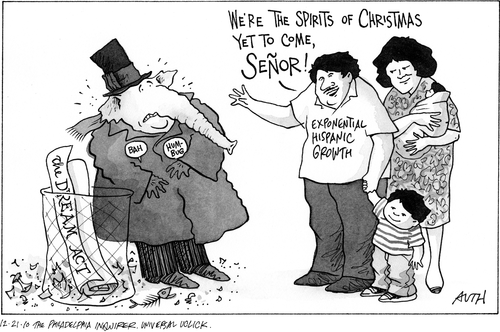
This from Mike Luckovich:This from Gary Varvel:This from Clay Bennett:This from Lisa Benson:This from Clay Jones:This from Don Wright:This from Chuck Asay:This from Clay Bennett: This from Signe Wilkinson:This from Signe Wilkinson:This from Walt Handlesman:This from Chan Lowe:This from Tony Auth:This from Mike Thompson:This from Steve Benson:This from Gable:This from Tony Auth:

Sunday, January 02, 2011

The Amazing Truth about PISA Scores

USA beats Western Europe, ties Asia

An interesting discussion on demography and America's international standing in education...

This from SuperEconomy:
...once we correct (even crudely) for demography in the 2009 PISA scores, American students outperform Western Europe by significant margins and tie with Asian students...
...We all know that Asian students beat Americans students, which "proves" that they must have a better education system. This inference is considered common sense among public intellectuals. Well, [except] for the fact that Asian kids in the American school system actually score slightly better than Asian kids in North-East-Asia!
So maybe it’s not that there is something magical about Asian schools, and has more to do with the extraordinary focus on education in Asian culture, with their self-discipline and with their favorable home environment...

The simplest thing to do in order to get an apples-to-apples comparison is to at least correct for demography and cultural background.
SuperEconomy takes issue with Libertarian claims that the United States public school system (which has more than 90% of all US students) is a disaster. They blame this on government control and on teachers unions. However...top scoring Finland has government schools and strong teacher unions, just like California. He takes shots at on Euro-minded Liberals too.

Sunday, December 26, 2010

The Return of the House Committee on Education and Workforce

This from Politics K-12:

Meet the New GOP Members
of the House Education Committee

The House Education Committee is getting a makeover in the new Congress.

First off, it's changing its name back to House Committee on Education and the Workforce, the title it had from 1995 to 2007, when the GOP controlled the chamber.

Second, Rep. John Kline, R-Minn., the incoming chairman, has named Rep. Duncan Hunter, R-Calif., as the chairman of the subcommittee overseeing K-12 policy. That would give him a spot in the "Big 8" lawmakers that the administration is courting in its push to renew the Elementary and Secondary Education Act.
Hunter, a conservative, replaces former Rep. Mike Castle, a moderate R from Delaware with expertise and a long record of working across the aisle. He was defeated in the primary by teaparty fave Christine O'Donnell, moderately crazy.

New GOP members of the committee include Rep.-elect Lou Barletta of Pennsylvania, who has a national profile on opposing illegal immigration, and doctors Rep.-elect Larry Bucshon, of Indiana; Rep.-elect Scott DesJarlais, of Tennessee; and Rep.-elect Joe Heck, of Nevada.
Other new GOP members include: Rep,-elect Richard Hanna, of New York; Rep.-elect Mike Kelley, of Pennsylvania; Rep.-elect Kristi Noem, of South Dakota; and Rep.-elect Todd Rokita, of Indiana.

At least three GOP moderates are staying on the committee, including Reps. Judy Biggert, of Illinois; Tom Petri, of Wisconsin; and Todd Platts, of Pennsylvania. And former chairman Rep. Howard P. "Buck" McKeon of California, remains on the committee, too.

Other Republicans who have served on the panel in this Congress (or in the past) and will be back, include Reps. Rob Bishop of Utah; Virginia Foxx, of North Carolina, who will oversee the higher education subcommittee; David Roe, of Tennessee; Glenn Thompson, of Pennsylvania; and Tim Walberg, of Michigan.

Friday, December 24, 2010

Montell's New Charter Bill

This from BizLex:

Rep. Brad Montell pre-files charter school
legislation for the 2011 session

Five year pilot program seeks to allow
20 charter schools in Kentucky

Rep. Brad Montell, R-Shelbyville (58th District), today pre-filed legislation for the 2011 session that if passed would allow the establishment of charter schools in Kentucky. If approved Montell's bill would set up a five-year pilot program for charter schools in the Commonwealth, and allow the creation of up to 20 charter schools...

"Because Kentucky doesn't currently allow for charter schools, it cost us two different opportunities to receive Federal funding through the Race to the Top program. Those funds could have been used to prepare our best and brightest students for the challenges of a growing global economy," said Montell. "It is
time that we bring our commonwealth back to educational prominence and permit charter schools in Kentucky."

In addition to allowing the creation of charter schools under a five-year pilot program, Montell's bill proposes other related changes:

• Creation of the Kentucky Public Charter Schools Commission, which would oversee the charter schools program in the commonwealth. While the commission would act independently from the Kentucky Department of Education, its board members would be appointed by the governor.

• Allow public universities and local school districts, if they choose, to establish, manage and oversee their own charter schools.

• Each charter school would have its own board, elected by voters, which would be responsible for overseeing and managing its own particular school.

Currently 40 states allow communities to establish charter schools, including all states that border Kentucky except for West Virginia. Montell says his bill takes into account all the lessons learned by other states in allowing for charter schools, making the proposal one of the most comprehensive in the nation.

"All of us have grown up in public schools. Just because charter schools may look or operate a little differently from what we're used to, it doesn't mean that the educational opportunities are any less valid that those offered by the traditional public schools," Montell added. "What it does mean is that charter schools will allow us to do more innovative things to improve the level of education for our children, and once again establish Kentucky as a model for learning in the United States."

This from the American School Board Journal:

Traditional Schools Serve All Who Come

Woodrow Wilson High School in Camden, N.J...has not wilted in the face of [overwhelming] obstacles. It offers a vast array of services to students and their families, including a health clinic, family counseling, crisis counseling, tutoring programs, daycare for teen parents, and a well-attended Junior ROTC program. Principal Tyrone Richards, a Camden native, is by all accounts a dynamic principal. He has received awards from the district for his strong focus on reducing absenteeism, reforming suspension policies, and improving graduation.

The school also is doing a lot to personalize instruction. It offers a “bridge” program over the summer for rising ninth-graders and has a self-contained Ninth Grade Academy for about 300 freshmen. Two years ago, the academy created the Renaissance Program to honor students who have good attendance and behavior and are attaining a C average or better. Depending on their GPAs, students can earn Blue, Orange, Silver, or Gold cards to enter the program, which has its own club room.

Supports like the Renaissance Program are there for those who reach for them, but it’s clear from the graduation statistics that many do not or are incapable of doing so. But Richards and Camden school board President Susan Dunbar-Bey say the reported 57.5 percent graduation rate for 2009 exaggerates the dropout rate: It doesn’t account for students who move out of the district-- or out of the country to places like Puerto Rico. (About half the students are Hispanic, and nearly half are African American.)

And this:

Who Chooses Charter Schools?

It's not hard to understand why Marlene Gonzalez decided to take her son out of the Camden, N.J., school system. Young Christian was safe enough in his neighborhood elementary school, but his mother kept hearing of low test scores, student bullying, and occasional violence in the city middle and high schools he’d eventually be expected to attend.

Meanwhile, she’d heard talk of a charter school with an eight-hour school day and 200-day school year program that promoted extensive after-school activities, support for families, a safe and orderly school environment, smaller class sizes, and a goal of a 100 percent graduation rate and college placement for all.

It was just the educational setting Gonzalez wanted for her son. So she applied to the LEAP Academy University Charter School. After four years on its waiting list, she got the call for Christian to enroll-- and not a minute too soon, in her mind.

“One of my worries was him going into middle school,” she says. “The schools within Camden are tough.”

Not just tough-- but troubled. With a high unemployment rate and an average household income of less than half of the state average, Camden is a profoundly poor and struggling city-- and its schools pay the price for the social woes that surround its children. Take Camden High, for example, which once was named one of the most “persistently dangerous” schools in New Jersey.

More than 60 percent of its students never graduate, and only 42.6 percent test as proficient on the state’s high school language arts exam, while only 19.4 percent score as well on the math exam.

Ironically, Gonzalez admits, her son was doing well at his local elementary school-- and might have fared well academically at one of the high schools. But she wasn’t going to chance it. Not when a charter school seemed to offer a better choice.

And this:

School Choice: Who Gets Left Behind?

How can we fix low-performing schools?

It’s been the question on educators’ minds for decades, and solutions have been elusive. However, since the passage of No Child Left Behind almost a decade ago, the pressure to improve student achievement has only intensified at the federal level and in the eyes of the public.

One solution touted is charter schools, which receive taxpayer dollars and have greater flexibility in staffing, curriculum, and fundraising while facing the same accountability as traditional public schools. U.S. Secretary of Education Arne Duncan has urged states with caps on charters to raise them, and many have complied in an effort to access the much-desired Race to the Top funds.

The broader debate about charters is playing out in the public sphere. A media blitz that started this fall-- from the documentary “Waiting for Superman,” to NBC’s “Education Nation,” to Oprah Winfrey’s two shows on school reform-- has all but anointed charters as the future (perhaps the only viable future) for public education.

Are charters the answer?

Studies show that most perform no better than regular public schools, and that many do far worse. Some do excel, or at least perform marginally better than the traditional schools, but this very success raises a host of additional questions that school leaders must confront: Do they cull the best performers from the regular public schools, leaving the remaining students worse off than before? And, if so, is this a proper trade-off for giving at least some families more options?

This from the School Administrator:

The Central Office in a Decentralized System

As the charter school movement has come to scale within the United States, it poses new questions about how to govern public education. By next year in New Orleans, an estimated seven in 10 children will attend charter schools. With a significant rural contingent, charter schools are no longer just an urban phenomenon. The rapid growth of charters nationally will likely accelerate in the next few years as several states recently raised or eliminated charter school caps. Their expansion begs the question: What is the role of a school district in a decentralized environment where a majority or even all of its public schools are charter schools?

Partly in response to the growth in charter schools, Paul Hill, director of the Center on Reinventing Public Education, coined the term “portfolio district” to describe a school district that authorizes and manages diverse providers of public schooling —
district-run or externally led traditional schools, alternative schools, small schools within schools, and cyber or charter schools.

In concept, a portfolio district would act like a fund manager overseeing a portfolio of investments. A school district would establish performance expectations and foster differentiation among its schools to serve various segments of its market. And just as a fund manager sells underperforming stocks, a portfolio district will close failing schools, allowing for new ones to take their place...

Hat tip to KSBA

Let the Sun Shine

This from the Daily Independent:

Bill would require budget process to be open to public

Democratic State Rep. Rick Nelson of Middlesboro has a radical idea: He thinks members of the Kentucky General Assembly should hold themselves to the same high standards of open government as members of the governing bodies of cities, counties and school districts are held by laws enacted by legislators.

Nelson has promised to push a proposal in the 2011 General Assembly that would bar legislators from retreating into closed-door meetings to draft the state budget. But, despite the wisdom and fairness of his proposal, don’t expect Nelson’s fellow legislators to approve it.

There is a long history in Frankfort of meeting behind close[d] doors to debate the budget and then waiting until the last possible minute to present the document to the entire General Assembly for a vote. Thus, most legislators are forced to vote on a budget they have not even had a chance to read.Nelson’s proposal plus another one that would require a 48-hour posting of the two-year budget before lawmakers vote on it would go a long way to change a budget process that is so broken that legislators have four times been unable to adopt a budget before the end of the 60-day session...

Study: Value-added data, surveys indicate teacher effectiveness

Despite my moderate acceptance of value-added measures of teacher effectiveness, I'm always skeptical of studies ordered up by an interested party. The results either produce what was ordered, or are buried.

That said, preliminary results of the $45 million Measures of Effective Teaching study -- sponsored by the Bill & Melinda Gates Foundation -- support the use of value-added data to predict future teacher performance.

The study found that student improvement on standardized tests reflected gains in learning and critical-thinking skills, not memorization, as some critics have suggested. Furthermore, the value-added predictions were corroborated by the results of student surveys, which often identified the same teachers as the most effective.

This from the Los Angeles Times:

Teachers' effectiveness can be reliably estimated by gauging their students' progress on standardized tests, according to the preliminary findings of a large-scale study released Friday by leading education researchers.

The study, funded by the Bill and Melinda Gates Foundation, provides some of the strongest evidence to date of the validity of "value-added" analysis, whose accuracy has been hotly contested by teachers unions and some education experts who question the use of test scores to evaluate teachers. The $45-million Measures of Effective Teaching study is a groundbreaking effort to identify reliable gauges of teacher performance through an intensive look at 3,000 teachers in cities throughout the country. Ultimately, it will examine multiple approaches, including using sophisticated observation tools and teachers' assessments of their own performance...

The approach estimates a teacher's effectiveness by comparing his or her students' performance on standardized tests to their performance in previous years. It has been adopted around the country in cities including New York; Washington, D.C.; Houston; and soon, if local officials have their way, Los Angeles.

More on the study at Education Week, The Washington Post, and The New York Times.

Other views of value-added:

L.A. teachers union rejects pay cuts, proposed evaluation system: The Los Angeles teachers union is balking at efforts to cut educators' pay and tie evaluations to students' test scores through a value-added system. The district wants students' scores to account for at least 30% of teachers' evaluation, but United Teachers Los Angeles prefers using data to improve instruction. The contract with the union, which already has seen teachers' pay cut through furloughs, expires in June. A $142 million school system deficit is projected for next year. (Los Angeles Times)

Why test scores can't measure teacher effectiveness: There are many qualities that effective teachers have that cannot be gauged by student test scores or other measures, according to a North Carolina teacher and reading specialist. Cindi Rigsbee writes that effective teachers are committed to their students and to the profession, build relationships with their students and have a passion for learning. Effective teachers also look for ways to improve through professional development and other opportunities, she writes. (Teacher Magazine)

Survey - Teachers need higher pay, but ineffective ones should be fired: More than half of Americans surveyed in a new poll by The Associated Press and Stanford University believe teacher pay is inadequate, but 78% said it should be easier to dismiss poor-performing teachers. About half of respondents said pay should be linked to student test scores and evaluations, while 35% said they believed underperforming teachers are a major problem in U.S. schools. (The Associated Press)

Prich Nets $100 K for Preschool Effort

The PNC Foundation has awarded the PrichardCommittee for Academic Excellence a two-year grant of $100,000 to supportefforts to make quality preschool available to more Kentucky children.

The grant, for 2011 and 2012, will help fund the BusinessLeadership Council for Pre-K, a group of 60 Kentucky business leaders whoseadvocacy for children focuses on giving them access to quality preschool asthe foundation for success in school and life.

PNC has been a national leader in support for pre-k with itsGrow Up Great campaign, a 10-year, $100 million school readiness initiative.Emphasizing the importance of business community investments in earlychildhood, Harry Richart, Regional President and Todd Ziegler, Senior VicePresident, presented a check to the Prichard Committee during a recentmeeting of the statewide education advocacy group.

"We are so pleased to receive this generous support from the PNCFoundation," said Cynthia Heine, interim executive director of the PrichardCommittee. "Research on the positive impact of pre-k makes it clear thatthis is an area with a strong return on investment for individuals andsociety as a whole. The Business Leadership Council is working to raiseawareness of that fact - and to encourage greater state support for pre-k.The grant from the PNC Foundation will greatly help those efforts."

SOURCE: Prichard Committee Press release

This from the Public News Service:

Report: KY Among Few States Cutting Early Ed Programs

State education officials say Kentucky is still committed to giving kids a good head start with state-supported preschool programs, despite a recent budget hit.

A recent report from the Pew Center on the States lists Kentucky as one of only ten cash-strapped states that allocated fewer dollars to pre-kindergarten programs for the 2011 fiscal year.

Annette Bridges, director of early childhood development for the Kentucky Department of Education (KDE), says the $2.6 million dollar reduction means $200 less per child going to school districts this year. "It used to be that schools, for each classroom, because a large number of our kids have disabilities, we would have that third person in the classroom. So, it could mean actually cutting staff."

Kentucky led the nation in allocating state dollars for preschool programs through the 1990 Education Reform Act, says Bridges, although recent cuts have caused some schools to go from full-day to half-day kindergarten."And we know, the research tells us, that children who are most at risk of academic failure, they do better - they're learning is much higher - when they're in full-day programs, at least four days a week."

Thursday, December 23, 2010

NCES Analyzes the Price of College

Eighty percent of all full-time undergraduates received some combination of grants, loans, work-study, or other type of aid.

What Is the Price of College?

Total, Net, and Out-of-Pocket Prices in 2007–08, a Statistics in Brief describes the annual price of education among undergraduates enrolled in U.S. postsecondary institutions in 2007–08.

The data come from the most recent administration of the National Postsecondary Student Aid Study (NPSAS).

Other findings include:
• In 2007–08, the average total price of attendance for full-time undergraduates (tuition plus living expenses) varied widely by the type of institution attended, ranging from $12,600 at public 2-year colleges to $18,900 at public 4-year institutions, $28,600 at for-profit institutions, and $35,500 at private nonprofit 4-year institutions.
• Students at for-profit institutions are shown to receive federal grants and student loans at considerably higher rates than those at other types of institutions. Even with such high percentages of Pell Grant and Stafford loan recipients, low-income students at for-profit schools still face the highest average out-of-pocket net prices compared to all other postsecondary institutions. The average out-of-pocket net price was $11,700 among low-income students at for-profit institutions but the average for those enrolled elsewhere ranged from $6,000 to $9,800.

View the full report here.

School News from Around Kentucky

Superintendent's evaluation cancelled - New board could decide to evaluate him next year

A mid-year evaluation of Marion County Superintendent Donald Smith, which was scheduled for this past Monday, was cancelled after a majority of the school board decided it would be best to delay his evaluation until the newly-elected board convenes in January.

But, according to Superintendent Smith, no matter who conducts his evaluation, he is in a "no-win situation."

"I have nothing to hide," Smith said during the school board's meeting Tuesday of last week. "But I'm going to share this with you publicly... I will not sit there and take the abuse like I did the first year with a bunch of lies and innuendos. I'm just going to tell you that. I will not."

Smith went on to suggest that the newly elected board members, Ed Hacker, Michael Mullins and Mike Cecil, have their own "hidden agendas."

"I'm not even worried about it because people coming on already have they own hidden agendas and what they want," he said. "I'm not going to deal with it." ... (Lebanon Enterprise)

Dropout age could rise to 17 - Proposed bill would raise minimum age to 18 by 2015: Raising the state's minimum dropout age will be back on the table during the 2011 General Assembly. A bill to bump it to 17 years old in 2014 and to 18 years old in 2015 has been proposed by Rep. Reginald Meeks, D-Jefferson County. The issue is also being pushed as a priority by Gov. Steve Beshear, and by the Kentucky Board of Education. The board would like the age raised to 17 for the 2011-12 school year, and to 18 the following year. The legislative session begins Jan. 4, but bills can be filed in the Senate until Feb. 11, and House until Feb. 14.

"That's the main item on the board's agenda," said Lisa Gross, spokeswoman for the Kentucky Department of Education. "We have 6,000 kids who drop out of school every year." The current dropout age of 16 in Kentucky dates to early last century. "You used to be able to quit school at 16, go over to General Electric and get a good job," said Bellevue High School Principal Mike Wills. "The world doesn't work that way now. I really think the dropout age should be 18 - period." A similar bill co-sponsored by Meeks passed the House last year, but was killed in the Senate, with many opponents arguing that it did not provide financial support for districts to create or maintain programs to keep those kids in school. (Enquirer)

Program prepares students for college: Eastern Kentucky University and area high schools have joined forces in an effort to make the transition of taking college English courses a little easier. The program is similar to one that math departments at EKU and high schools already are using.Every student in Kentucky is required to take the ACT exam as a junior, and schools see how well a student fares in the English portion of the test.With the ACT results, schools can take students who did not reach the benchmark in English and place them with counselors and in developmental courses to better prepare them for college English. (Richmond Register)

New member of Fayette County school board named - Daryl Love will take over the District 5 seat on the Fayette County Board of Education: Kentucky Education Commissioner Terry Holliday on Friday named Love to fill the unexpired term of former board chairwoman Becky Sagan, who resigned in September because she was moving outside District 5. Two other people applied to be considered for the appointment. Love, who works in public relations for Asland Inc., will serve until the November 2011 election. The appointment of Love, who is black, assures continued African-American representation on the school board. The board's only current black member, Kirk Tinsely, lost in the November general election.
Love will be sworn in at a special school board meeting Jan. 6, along with incumbent Amanda Ferguson, who won re-election in November, and new board member Doug Barnett, who unseated Tinsely. The meeting will be held at Sandersville Elementary School. (Herald-Leader)

Sen. Shaughnessy jabs at David Williams over busing and bridges: Republican Senate President David Williams has created false expectations for Louisville residents on the issues of school busing and the construction of bridges over the Ohio River, said Democratic state Sen. Tim Shaughnessy of Louisville. Williams pre-filed legislation with Republican Sen. Dan Seum of Louisville that requires school districts to assign students to the school closest to their homes. “In reality, in a number of cases, you’re not going to be able to do that,” Shaughnessy said. He has filed his own bill in response to the Williams-Seum bill that would require the state to cover any costs associated with sending students to the school closest to them. “Both these legislators are Republicans,” Shaughnessy said. “They’re against unfunded mandates. But make no mistake about it: These are unfunded mandates.” Ousted Jefferson County School Superintendent Sheldon Berman said it would cost as much as $200 million to build new schools and handle transportation if the Williams-Seum neighborhood schools bill passed. Williams, in an interview, dismissed that estimate and noted that the school board opted not to renew Berman’s contract, thereby undermining his credibility on the issue. (CN2 Politics)

Census details poverty, low education in Eastern Kentucky - Louisville region among more prosperous areas: Kentucky has 13 counties, mostly in the eastern part of the state, whose median household incomes are below $25,000 — including Owsley County, which also has the nation's smallest percentage of bachelor's degrees, new U.S. Census Bureau data shows. The figures from the American Community Survey put the poverty and low education in Kentucky's rural regions in contrast to the more prosperous counties near Louisville, Lexington and Cincinnati. Ten Kentucky counties showed median income levels above $50,000 and are near cities in Central and Northern Kentucky. Four are in the Louisville area — Oldham, Bullitt, Spencer and Shelby. “It does certainly show the significant income disparities,” said Ron Crouch, director of research and statistics for the state Office of Employment and Training. (Courier-Journal)

Fayette schools enrollment keeps rising: Many state and national economic indexes may be struggling to climb out of the basement, but enrollment in the Fayette County Public Schools just keeps going through the roof. Enrollment rose by more than 1,000 students this year, district officials say. That comes on top of an increase of more than 700 students last year, which followed a jump of more than 630 in the 2008-2009 school year. Overall, Superintendent Stu Silberman says Fayette enrollment is up by more than 4,250 students since 2003-04. (H-L)

Quick Hits

How effective teachers are helping improve struggling schools: At one struggling middle school in Los Angeles, effective teachers were the key to making improvements, an analysis by the Los Angeles Times found. Efforts to place top teachers at the neediest schools are part of the Obama administration's agenda for improving schools. "Great teachers and great principals are at the heart of this work," education chief Arne Duncan said. "You need to ID those folks and bring them in." (Los Angeles Times)

Study links seniority-based teacher layoffs, poorer student outcomes: A study by the Center for Education Data and Research at the University of Washington predicted that seniority-based teacher layoffs would result in a student-achievement dip equal to 2.5 to 3.5 months of learning, compared with layoffs that were based on value-added data. "If your bottom line is student achievement, then this is not the best system," the study's lead author said. (The Associated Press)

'Suspicious' letter raises free speech issues for ACLU: An ACLU letter on holiday inclusiveness in schools was mistakenly flagged as "suspicious" by a Tennessee intelligence agency, raising concerns about the monitoring of citizens' speech. The Dec. 7 letter from Hedy Weinberg, ACLU Tennessee's executive director, cautioned public schools superintendents not to promote certain religious celebrations over others. But it was picked up and disseminated by the Tennessee Fusion Center, a government task force that helps share homeland security and criminal intelligence among law enforcement agencies, under the heading "suspicious activity." (Tennesseean)

Panama City shooter: Gunman who fired point-blank at Panama City school board members before fatally shooting himself Tuesday lived in Tampa in the 1970s while attending high school, according to the Hillsborough County School District. Raw video footage at (Tampa Bay.com)

Rollout of electronic GED tests begins: Beginning next year, students in California, Florida, Georgia and Texas will begin taking the General Educational Development exam, or GED, electronically. The exams will become available electronically in other states over the next three years. Officials say they can encourage more people to earn their GED by offering it in a more efficient manner. (The Atlanta Journal-Constitution)

More testing is expected in high schools, study finds: A study by the Center on Education Policy suggests a continuing increase in assessments for the country's high-school students. More states now mandate an exit exam for graduation -- affecting 75% of the nation's students --- and are requiring students to take college-entrance exams such as the SAT or ACT, the study found. The findings warrant both optimism and caution, the group's president said. "It could improve things in high school, but only if it's done right," Jack Jennings said. (Education Week)

Massachusetts union proposes revamp of teacher evaluations: Massachusetts' largest teachers union unveiled a proposal Tuesday that would tie teachers' evaluations to student test scores. Similar systems have been resisted nationwide by those who say they do not accurately reflect teachers' work and unfairly penalize teachers for outside factors. The union proposes rating teachers based on several years of test scores. Other considerations, such as classroom observations and students' background, would also be included. "We have to be the architects of reform, rather than the subject of it," the union's president said. (The Boston Globe) and (here)

Civil rights advocates seek review of Texas education: Two civil rights groups are requesting a federal review of curriculum changes made this year in Texas, claiming the changes discriminate against black and Latino students. In May, the Texas school board adopted a social studies and history curriculum that some say was revised based on ideological views. The groups also claim the state schools are failing to provide an equal education for minority students, disparately disciplining minority students and not enrolling enough minorities in gifted and talented programs. (Houston Chronicle)

NYC enacts new reporting system for school arrests, suspensions: New York City officials will require police and schools to provide regular reports of arrests, suspensions and other incidents involving students in public schools. The reports will include information on suspensions and discipline by school that is broken down by students' age, grade, race, gender, ethnicity, language and whether they are enrolled in special education. The data will be made available online. Information on arrests and summonses will be available on a boroughwide basis. (The New York Times)

U.S. population continues shift to South and West: Data from the 2010 U.S. census was released Tuesday, revealing a picture of a country that is growing more slowly than in any period since the Great Depression, and is migrating toward warmer climes in the South and West. There are 308,745,538 Americans, up 9.7% from the 2000 census. States in the Northeast and Midwest are seeing declines. The tilt will play out in congressional redistricting, where Republican-leaning states stand to gain seats in the House of Representatives and Electoral College votes. (The Wall Street Journal) (The New York Times)

Some struggling Boston schools turn to data-driven instruction: Ambitious turnaround efforts are under way at 12 struggling Boston schools. At Blackstone Elementary School in the city's South End, regular learning assessments are being done and there is an increased emphasis on data-tracking that involves students in the process. "They all know where they are and where we want them to get to," one teacher said. (Boston Herald)

Who should be considered a "highly qualified" teacher?: Teach for America educators and others still in training could be considered "highly qualified" teachers under legislation being considered by Congress. No Child Left Behind requires that every student be taught by a "highly qualified" teacher, but a recent U.S. Court of Appeals ruling determined that teachers still enrolled in teacher-preparation programs should not be considered "highly qualified." Education blogger Valerie Strauss writes that the issue affects some of the country's neediest children and should be fully debated. (The Answer Sheet blog)

Little collaboration with charters is seen in Columbus, Ohio: Although districts nationwide have taken steps to collaborate with local charter schools, school officials in Columbus, Ohio, appear to be keeping such schools at arm's length. Charter-school supporters say that public schools and charters can work together to improve education. Charter-school enrollment has grown from 5,000 in 2005 to 12,700, but a charter-school office promised in 2005 has yet to open. Some say that ignoring charters is not the answer because more charters are expected to open in Columbus. (The Columbus Dispatch)

Some early-college programs are in jeopardy over funding loss: Some early-college programs -- where students earn college credits while still in high school -- are in jeopardy as one-time grants from the Bill & Melinda Gates Foundation are running out and other subsidies are being cut. Two ongoing studies are showing promise for early-college schools, many of which target students who are underrepresented on college campuses. (Education Week)

How can districts develop better principals?: Teacher quality is a hotly debated subject nationwide, but some say the way principals are trained, hired and developed should be getting more attention. Some school districts in Wisconsin and elsewhere are focusing more on training principals in instructional leadership and how to evaluate teachers, while some are working to improve the avenues to becoming a principal. (Milwaukee Journal Sentinel)

Race is on to find new schools for next fall after Boston shutters 18: The decision to close or merge 18 Boston schools has prompted hundreds of parents to hunt for new schools for their children to attend next fall. Many parents said they're taking their search beyond city limits because of the long waiting lists to get into the city's top schools. City school officials say students at schools being closed will get preferred treatment in choosing a new one. (The Boston Globe)

School Boards Group Questions U.S. Guidance on Bullying: The general counsel of the National School Boards Association is warning the U.S. Department of Education that recent federal guidance to schools on bullying and harassment expands the standard of liability for school officials and "will invite misguided litigation." "The expansive position on what conduct constitutes 'harassment' protected by federal civil rights laws and what remedial measures are legally required will unnecessarily complicate investigations and possibly expose school districts to liability beyond that envisioned by the Supreme Court," says the Dec. 7 letter from Francisco M. Negron Jr., NSBA's top lawyer, to Charles P. Rose, the Education Department's general counsel. Negron stresses in the letter that the NSBA shares the Education Department's interest in reducing bullying and harassment in schools. But he cites several concerns about the Oct. 27 "Dear Colleague" letter that went out from Assistant Secretary for Civil Rights Russlynn Ali. (School Law blog)

Schools need to pick up pace to close achievement gaps, study finds: It could take decades for some minority groups to catch up with their white peers if progress continues at its current pace, according to a study released by the Center on Education Policy. The study measured the pace at which 40 states are narrowing the achievement gap and found that progress varies greatly by state. For example, researchers found it could take 105 years to close the achievement gap between white and black fourth-grade students in Washington state, but 12.5 years to close the gap in Louisiana. (Education Week)

Thanks Martha

iPads Showing Up in Schools

My little sister loves her iPad.

To hear her tell it, the iPad is what every fashionable fashion executive in New York carries into meetings. They all travel with them and make their presentations from them, she says, but after that, the list of things she loves about her iPad are less about creating work.

For example, Kim has 150 e-books loaded up right along with all of her music. She can always find the nearest Starbucks and track her stock portfolio. She is able to play games and download applications from anywhere via her wireless phone network. The iPad has some limitations when it comes to working with spreadsheets, another staple of the fashion industry.

The more she talks about it the more I think I am right about the iPad. It's a little honkin' consumer device designed to sell the buyer more stuff. Many of the applications are cool, but in a classroom setting, I'm not sure how student creativity is engaged much at all and that ought to be a concern to educators. Are iPads really superior to laptops in any significant way?

A quick review of Gizmodo's Essential iPad apps reveals more and more consumer items including Netflicks (movies), ABC Player (TV shows), Marvel Comics, iBooks, NBA Game Time Courtside, and a whole host of games, entertainment and music outlets.

I'm just not sure how much or how successfully iPads will be used in the classroom.

As a technology lover, I enjoy all of the flashy things the iPad can bring. But in the end, technology is simply a tool. It's a better book, or a better telephone, or a better pencil, or a better abacus....but will the iPad prompt the kinds of real creative work our students need?

This from the Charlotte News & Observer:

The high school students in Tim Hall's AP World History class at Franklin Academy whirled through the Middle Ages this month on their 1.5-pound, $500 iPads.

After reading through a digital textbook, students got a fast-paced visual tour of Gothic architecture, the feudal system and the Crusades. All on their trendy tablet computers.

"You just have to get used to it," student Jordan Dunne said, "and you have to check your battery life."

The Wake Forest charter school began its experiment with iPads this fall, when it bought 10 for the AP class. Leaders have been so happy with the results, they recently made plans to order 20 more.

IPads, notebook computers and mobile devices are destined for the classroom on a much bigger scale. But questions remain about how successful they will be in widespread use...

This from Rick Hess at Straight Up:

When "Digital Natives" Discover the Encyclopedia

I'm sure my friends at the Department of Education were thrilled to read in the Raleigh-based News & Observer that North Carolina school districts are using their Race to the Top funds to advance structural reform by... purchasing iPads. Durham, N.C. is spending $3.5 million in RTT funds to "put Apple iPads in the hands of students and teachers at two low-performing schools." Durham Public Schools Superintendent Eric Becoats said, "Our kids are telling us, 'This is how we
learn. This is what we want.'"

Ah-ha, yes, this is the change we've been waiting for. Look, I own an iPad. I like the iPad. But I'll tell you, when I've been to schools that feature one-to-one computing, personal computers, and iPads, they seem to get mostly used in one of two ways. Neither impresses me. The first involves students working on graphics, clip art, powerpoints, or adding sound and visual effects to video shorts. The second is students Googling their way to Wikipedia for material to cut-and-paste into powerpoints or word files.

This was all brought home to me again, just the other week, when I had a chance to spend a couple days visiting acclaimed "technology-infused" high schools. Yet, most of what I saw the technology being used for was either content-lite or amounted to students using Google-cum-Wikipedia as a latter day World Book Encyclopedia. Making powerpoints and video shorts is nice, but it's only us "digital tourists" who think it reflects impressive learning...

This from the San Jose Mercury News:


Are iPads a game changer in education?

Some California districts consider the iPad to be a "game changer" and are launching programs to put them in students' hands. However, some educators question the iPad's usefulness. They say technology distracts students from learning and have largely banned such devices in schools. Others worry that students at disadvantaged schools won't have access to the technology...

Warning, this from FoxNews.com:

How do parents feel about technology in the classroom?

Opinions among parents differ over whether their children should be using technology -- including computers, cell phones and iPads -- in the classroom. Some parents say students should be using technology as educational tools because they will use similar devices in the workplace. However, some worry it can cause health issues such as neck and eye strain or serve as an overall distraction. "The exciting thing is the potential to use these 'time-wasters' or 'over-stimulators' to our advantage in the classroom," one educator said...

This from the Berkeley Independent:

S.C. is testing iPads as learning tools in 2 districts

Fifth-grade students at a Berkeley County, S.C., school are using iPads in the classroom as part of the state Department of Education's Digital Pilot Program operating in two districts. Students recently used the devices to learn about multiplication and fractions, and now are integrating the iPads into lessons about inventors and inventions. "We try to use them every day," one teacher said. "... I don't even think they view it as learning."

And from BlogHer.com:

Children with autism learn, have fun with iPad apps

The writer of this blog post lists 10 apps for iPod Touch or iPad devices that may be fun or educational for children with autism. Some of the suggestions such as "Tappy Tune" and "Splish Splash Inn" help children with pre-reading and pre-math skills, while others such as "My First Tangrams," "Hand Drums" and "Chalkboard" feature puzzles, music and art.

Then, there's this from the Wall Street Journal:

Are students encouraged to be creative in school?

Scores on a standard creativity test showed a steady decline between 1990 and 2008, particularly among students in grades K-6. Researchers attribute the findings to more time on computers and watching television, plus an increased focus on standardized tests and rote learning in schools. Enrichment programs can help encourage creativity in children. Some say parents and teachers can assist by asking more open-ended questions and showing interest in answers.

Thanks Mikey