Republican gubernatorial nominee Matt Bevin sent an e-mail to all
6,000 Jefferson County Public School teachers at their official school
accounts early Monday morning promising to “give current and future
teachers a new source of income when they retire" if they elect him
governor on Tuesday.
The move raises questions about the use of the teachers’ public email accounts for political purposes.
The
Kentucky Democratic Party called Bevin’s action “apparently illegal”
while a law professor at the University of Kentucky said it’s “close to
the line.”
Bevin’s campaign told WDRB News on Monday that the
"democrats know that the law wasn’t broken, and the Kentucky Democratic
party should stop lying. Matt Bevin will continue to ask all
Kentuckians for their vote ahead of tomorrow’s election and we will
continue to correct Jack Conway’s lies."
The email, which was also
sent to educators in Bowling Green last week, violates the state's
election law, according to the Kentucky Democratic Party, which has
demanded that Bevin "immediately cease and desist its ongoing and
apparently illegal activities coercing state teachers’ by using state
email accounts to promise them benefits in return for their vote in the
general election."
Mark Guilfoyle, a lawyer who previously served
as general counsel, budget director and cabinet secretary for Governor
Brereton Jones, said that Kentucky State Statute 121.150 prohibits
a candidate from soliciting a contribution of money or services from a
state employee if it is specifically targeted at that employee because
they are a public employee.
Guilfoyle’s written opinion on the matter was shared with WDRB News Monday by the Democratic Party.
In
his email to teachers, titled "Open Letter to Kentucky's
Educators," Bevin states he will not allow the "raiding of our public
trusts to cover shortages in the general fund":
"If
we continue down the road we are on, as my opponent would like, experts
predict we are 3-4 years from pension collapse," the letter sent to the
teachers reads. "That means that if you are retired and receiving a
public pension, you could be 3-4 years from losing the benefits promised
to you. Without action, the checks will not continue to clear the bank.
I am running for Governor to make sure this does not happen.
We
have a moral and legal obligation to fulfill our pension promises to
current employees and retirees. My opponent has spread lies throughout
the state about my stance on our pension plans, including KTRS, despite
the fact that I am the only one in this race who has a plan to save
them."
Joshua Douglas, a professor at the University
of Kentucky who teaches and researches election law, civil procedure,
constitutional law and judicial decision making, told WDRB News Monday
that Bevin is "close to the line here, at least on the solicitation of
contributions part, but in my view he probably has not crossed it with
these emails."
"Although I think these emails are somewhat
unseemly, they probably do not violate Kentucky law," Douglas said. "I
do not see how the Bevin email promises anything specific beyond normal
campaign rhetoric. Bevin is not promising actual funds; he is saying
that his policies will ensure that teachers have retirement funds
available."
Secondly, Douglas also said nothing in the email "asks for money or services; it is asking for the teachers' vote."
"This is not a direct plea for contributions, which is what this campaign finance provision is about," he said.
"At
least to my knowledge, there is nothing that prohibits Bevin from using
these email addresses," Douglas said. "Teachers themselves are not
supposed to use their email addresses for direct campaign purposes...I
am not aware of a prohibition on candidates sending an email to a
government-owned email address."
In an email sent out by Kentucky
Education Commissioner Stephen Pruitt on Monday, he reminds teachers of
the state's acceptable use policy that governs the Kentucky Department
of Education and many districts provide that agency devices and/or
digital commerce activities must not be used to knowingly transmit,
subscribe to, or store any data that is for political purposes."
"It
has come to the attention of KDE that several districts have received
e-mails to all staff from a political campaign regarding the Kentucky
Teacher Retirement System issue," Pruitt said.
Pruitt said if
teachers have received the communication or if you just have general
questions about the KTRS issue, we recommend that you visit the KTRS
Funding Workgroup website: http://governor.ky.gov/KTRS-Funding/Pages/default.aspx.
On
the topic of the Kentucky Teachers Retirement System, which is
currently underfunded, Bevin has said he believes the state should
"freeze the existing plans exactly as they are" and come up with a
different solution, suggesting that Kentucky move to a defined
contribution plan.
David
Bergstein, a spokesman for the Kentucky Democratic Party, told WDRB on
Monday that in addition to what his party believes is a violation of
state law, the "substance of his email to teachers is false — Bevin’s
plan would cost more and would actually jeopardize retirements."
Top officials of the Kentucky Department of Education attempted
Thursday to quell growing concerns across the state that a recent decision
regarding arts-related career pathways for students signals a lack of
support for school programs such as band, chorus, drama and related subjects.
Commissioner
Stephen Pruitt and Associate Commissioner Amanda Ellis began the
agency’s monthly superintendent webinar with an unannounced topic:
mounting questions about how classes in various forms of art will be
considered in students and schools meeting college and career readiness
targets.
In KDE’s Oct. 16 Fast Five on Friday email,
Pruitt announced that the “Arts Pathways and Capstone Assessment Plan”
pilot program had failed to meet criteria set by the agency for including arts-related courses in the state's assessment and accountability system.
During two regional education cooperative
meetings this week, several superintendents voiced concerns about the
decision. One worried students might have to drop out of band or chorus
to take other courses that would keep them on track to earn the
important college/career readiness status.
In the Oct. 16 email,
Pruitt said, “We do not feel we can justify the release of the capstone
assessments as a formal career readiness component because two criteria
are not met. A search and review of arts career opportunities in the
Commonwealth also was done. What was discovered is that there are going
to be very limited opportunities for careers in the arts over the next
ten years.”
[A “capstone assessment” has been described as an
end-of-course examination or certification, sometimes through
internships, which assess a student’s mastery of knowledge and skills
toward a career or postsecondary studies.]
Thursday, Pruitt
said,“The first pilot just really wasn’t successful. It just didn’t get
us where we need to be. This was kind of a reminder that pilots have end
dates and with those end dates come evaluation of data to determine
what our next steps should be.”
Ellis said, “Our
criteria are recognized, endorsed or required by industry, written or
verified by national or state industry, and curriculum aligned with
state or national standards. Certification must be an end-of-program
assessment related to the student’s identified career pathway.”
Both
Ellis and Pruitt emphasized several times that no one should assumed
the agency’s actions reflect soft support for arts programs in K-12
schools.
“We
just approved the arts standards that are being implemented,” Ellis
said. “There are arts industry certifications which have national
industrial certifications. So it’s not that it’s overlooked by any
means.”
She
said the department’s career and technical education “clusters”
demonstrate a commitment to arts-related pathways such as video
production, graphic design, communications, audio/video and advertising –
all of which have industry-based certifications.
“We do value the arts. Clearly, it is of value and something we see as being necessary for all students,” Ellis said.
Pruitt
stressed he felt agency staff had done solid work, and that discussions
on a “different type of methodology” and a new pilot will be undertaken
very quickly, adding, “We’ve had quality fine arts programs before
this; we should have them after this. But we have a moral obligation to
be honest with our students.”
“I want everybody to hear
this crystal clear. We are committed – I am 100 percent committed – to
our students having a well-rounded education and that needs to include
fine arts. One of my children went all the way through school and took
four years of band. My daughter will go through four years of orchestra.
So I’m a believer that that’s made a huge difference in their lives,”
Pruitt said. “We are going to continue to really be focused and
supportive of the fine arts.”
The KDE October superintendent’s
webinar will be archived on the agency’s website in the near future.
Other topics covered during the 45-minute session were the KDE/Kentucky
Board of Education budget priorities for the 2016 legislative session
and a review of the recently-released K-PREP scores.
My first week as commissioner has been incredible. In many ways it is what I expected, learning something new at every turn, meeting new people and drinking from the proverbial fire hose. However, I had the opportunity to participate in two events this week that confirmed for me that, as Kentucky’s commissioner of education, I have the second coolest job in the world.
At the first event, we celebrated what I consider to be the coolest job in the world – classroom teacher – during the 2016 Kentucky Teacher of the Year Awards ceremony. For me, having the opportunity to honor and get to know the Ashland Teacher Achievement Award winners was a treat beyond compare. These extraordinary teachers are smart, funny, innovative and dedicated professionals who are making students’ lives better. While teachers love their content, the great ones teach because they love their students. The passion for their students as well as their craft that these teachers shared makes me proud to be an educator and a teacher.
On this day, 24 teachers had the chance to shine their light as a beacon of hope and leadership to their 41,500 colleagues across the state. I am grateful for that light and for the key role that teachers play in our children’s lives. So, congratulations to all of our Ashland Teacher Achievement Award winners. Special congratulations to Elementary Teacher of the Year, Joshua DeWar; Middle School Teacher of the Year, Karen Mallonee; and our High School and Overall Teacher of the Year, Ashley Lamb - Sinclair.
The second event I attended was called Early Childhood – A Wise Investment in Kentucky’s Future, an event sponsored by the Prichard Committee for Academic Excellence. Governor Steve Beshear and First Lady Jane Beshear, four former governors, members of the Kentucky General Assembly and many shareholders from the business and political world attended. The meeting focused on helping everyone gain an understanding of how a quality early childhood education translates into better prepared K-12 students and eventually a qualified workforce. You see, when we understand how the brain develops, we can better prepare our students and close achievement gaps by providing every student a quality learning experience before they even start kindergarten right on through high school graduation.
Attending these two events made me glad to be a Kentuckian. I have been asked by friends and colleagues, why Kentucky? The level of commitment to education shown in these two events are prime examples of why I wanted to continue my educational career here.
First, the Teacher of the Year Awards were a big deal, held in the rotunda of the capital – not in some hotel with little fanfare. Governor Beshear, Secretary of Education Tom Zawacki, and members of the General Assembly were on hand to recognize these teachers and celebrate their accomplishment.
None of these dignitaries had to do this, but they were all pleased to do so because they recognize the value of quality teachers to our students.
The Prichard Committee event had five governors in attendance. This is unprecedented in other states. Governors Beshear, Fletcher, Patton, Carroll and Collins all gave up their time to attend, which speaks volumes about their commitment to education.
Yet, this commitment to education extends beyond the state’s top elected office. Kentucky Chamber of Commerce Chief Executive Officer Dave Adkisson, Toyota Motor Manufacturing President Wil James, and Northern Kentucky University President Emeritus Jim Votruba also shared their commitment to education in their remarks. Prichard Executive Director Brigitte Blom Ramsey and staff did a great job of putting this event together. Clearly the opportunity for Kentucky children to get a high quality education from the beginning is paramount to all who attended.
So, as I conclude my first week, I am honored to be your commissioner of education and excited to be a Kentuckian. Since being here, I have shared with many that I begin each day with the thought, “Today is an excellent day to make a difference.” With Kentucky’s commitment to high quality education for all students, I believe we can and we will make that difference for all kids.
Why you hate it and why we need new perspective in education
We are not computers. We are not machines. We do not think procedurally.
That’s why the “old way” of teaching math is not the best way.
The traditional way involves rote memorization and algorithms performed on paper. They require little to no understanding of why the algorithm works. It simply works.
In
some situations this is great. If I were to program a computer, I would
use algorithms and procedural instructions because that is how a
computer thinks.
It’s not how humans think though.
We
have an advantage that computers don’t. We think strategically. We
optimize for the easiest solution. We’re adaptive. We can think about a
problem forwards, backwards, in chunks, from the middle out. We can
rearrange terms, regroup, combine and split it apart. We can round up
and down, and back again. We find patterns and draw connections.
Even in mathematics,we are creative beings.
If Algorithms Work, Why Shouldn’t We Primarily Teach Them?
Reason 1
We
forget. All the time. Especially when we don’t understand why the
algorithm works or if it has been a long time since we last used it.
I
can guarantee if I took a survey at Starbucks right now, and asked
people how to perform long division, convert a mixed number to a
fraction, recite the quadratic formula, factor a binomial, and complete
the square — most would fail.
Not
because math is too hard or people are bad at it, but because
memorization and algorithms are not the best ways to retain information.
We remember through context, understanding and application.
Reason 2
The #1 complaint about math is:When will I use this in REAL LIFE?
There are plenty of opportunities to perform basic math every day, yet most people resort to a calculator or simply give up.
Why?
Algorithms are not convenient for real life, evenifyou remember them.
They are difficult to do mentally. They aren’t intuitive. And often we
don’t have a pencil, paper and the time necessary to do long-hand math.
Why is Common Core Math Hated by Parents?
Because the Common Core Math standards are trying to teach number sense and mental math techniques through various forms of diagrams and step-wise procedures that are new and look confusing.
The truth about mental math is that what can be done simply in our minds doesn’t always look simple on paper. That is the point of mental math.
It
isn’t a system that looks nice and tidy written down. It’s a series of
techniques combined with an understanding of the rules of mathematics
which can be utilized in various ways.
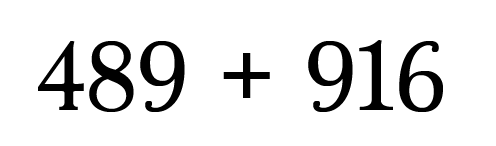
Let me demonstrate what I mean. Suppose I have the addition problem:
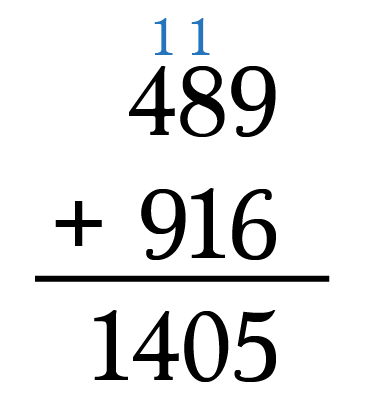
According to the traditional algorithm, all we need do is this:
Which works just fine if I have a couple minutes and a pencil and paper.
Truth is in real life, I usually don’t.
For
example, in high school I worked for a catering company. The operations
manager would often come up to me and ask questions like,
“We have 916 guests seated inside and 489 outside, how many place settings do I need?”
Simple
question, right? But I never had paper to write on and my phone was in
my purse in the office. I was left with only my brain to solve it.
I
could try the algorithm in my head, but that wasn’t very effective. I’d
forget the numbers as I added them and make errors. It turns out the
simple algorithm above wasn’t so handy in real life.
So instead I would start playing with the numbers.
I might begin by thinking, “489 + 916 is the same as 490 + 915, so I’ll just add that sum instead.”
Then I might think, “I can steal 10 more from 915 and add it to 490 to make 500, an even easier number to add.”
So now I have:
That’s better.
Now I’ll just add the hundreds together and tack on a five at the end.
There we go! Add 5 and my answer is 1405.
It took a few seconds, but was still quicker and more effective than going inside for a calculator or paper. And I got the right answer! And my boss was impressed! Double win.
Unfortunately, this process isn’t easy to teach because it is mental math. It isn’t designed to be written down. It isn’t neat and tidy. It’s robust and practical.
To further complicate things, it isn’t the only way of solving the problem. It is just the way that seemed easiest to me at the time. Number sense allows us to have an arsenal of ways to problem solve, including but not limited to the traditional algorithm.
This Isn’t New Math, It’s Number Sense
We call this new math, but it isn’t new at all.
In fact, it has been around for a very long time. It’s called number sense. And it’s the way mathematicians have been thinking about numbers for centuries.
For example, take this story about the famous mathematician Friedrich Gauss.
In
elementary school, little Friedrich was very good at math, and he often
finished his assignments quickly. As a result, he’d get bored and
disrupt the other students. So one day to keep him busy, his teacher
asked him to sum all the whole numbers from 1 to 100.
If
he were doing this the traditional way, as the teacher expected, he
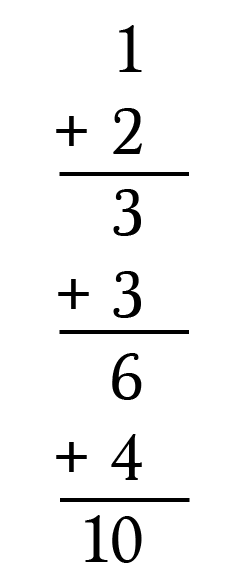
would add each number to the previous making a running total.
As you realize, this process is tedious and time consuming.
But Gauss didn’t think about numbers algorithmically. Instead he thought about them as components of a system.
To his teacher’s dismay, he solved the problem mentally in a few minutes!
How did he do it?
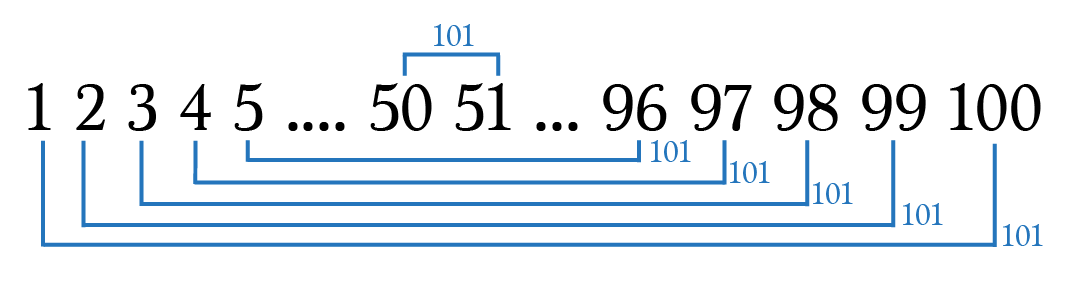
He began by imagining all the numbers in front of him in a long line.
As
he thought about the numbers he discovered a useful grouping technique.
If he paired the very first number with the very last and continued
this process inward, he noticed every pair summed to 101.
In total, he had 50 pairs of 101. So the answer is 50 times 101.
Note: We can complete this multiplication mentally by splitting 101 into 100 + 1 and multiplying the 50 through to obtain 5050.
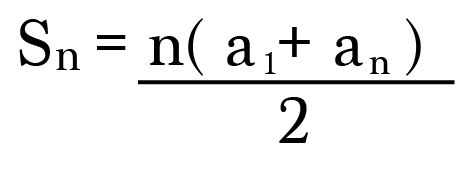
This
beautiful display of numeric intuition, creativity and ingenuity is
taught as the following formula in second year algebra classes, often
without a mention of little Friedrich Gauss.
But I never forget this formula.
Not because I memorized it, but because I remember the story of its origins.
You see (a-1 + a-n) represent the sum of the first and last terms of the sequence, 1 + 100 in our story. And n
represents the number of terms in the sequence, which we divide by 2 to
obtain the number of pairs. Finally, we multiply them together to yield
the total.
The point is we need
stories, illustrations, and context to give the formulas and algorithms
meaning. We desperately need to understand the foundations of our
knowledge. Otherwise math becomes meaningless and forgettable.
What Now?
Befriend math! Be open to new perspectives and ask questions.
The
Common Core math standards are an attempt to expose your child to this
flexible way of thinking. It may not be perfect, but it is in the right
direction.
If
you are a parent finding it difficult to help your child with Common
Core Math or if you are interested in learning math from a new
perspective, pleasefollow my publication Math Memoirs.
If you are interested in learning mental math methods look for the lessons subtitled Mental Math Series.
Allegations of academic fraud prompt disbandment of Awaken 101
Uncertified Preacher's Program Intended to Turn "Teachable" Freshmen
into Influential Students backed by Shelton
Principal secretly awarded bogus credit for unsanctioned program
Donovan Stands Tall
Excellent Student Journalism
This from Sydney Momeyer and Braeden Bowen in the Devil's Advocate:
In its scheduled monthly meeting on Tuesday Oct. 13th, the HCHS
School Based Decision Making Council (SBDM) discussed Awaken 101, a
pilot program designed to discover and develop future leaders, which was
implemented at the start of 2014-15. This class featured Jonathan Smith
as an instructor, a pastor at Crossroads Christian Church.
Principal Greg Quenon
As of 2014,
Smith was not certified to teach. The HCHS SBDM refused Awaken 101 as a
course in February of 2014. The program was not to be recognized as a
course without permission or approval from SBDM. Principal Greg Quenon,
however, sanctioned it as a course and gave credit to enrolled students
who passed the class.
“I bowed to pressure being applied by the parents of the Awaken 101
students and the Awaken 101 personnel,” Quenon said at the Oct. 13th
meeting.
At the Oct. 16th meeting, Quenon elaborated on his previous statement.
“…I have a hard time saying no to people, and this situation alone
has led me to understand the necessity and importance to consult and
listen [to] my council,” he said.
Awaken 101 was originally a program in which the students would not
receive a credit. On HC’s 2014-15 list of course studies, the program is
listed under “Other Elective Programs.”
"Awaken 101 is a futuristic classroom experience for incoming
freshmen who have previously demonstrated both a measure of teachability
and the capacity to influence others,” the 2015-16 course of studies
list detailed. “Awaken 101’s relational and experiential design aims to
serve Henry Clay in the discovery and development of divergent leaders,
who are committed to transforming cultures with a more holistic
approach.”
Since the course was never approved by SBDM, HC social studies
teacher Jody Cabble’s Infinite Campus login (for her Renaissance
Leadership class) was used to give students a grade and an advanced
credit for Awaken 101; Cabble never taught the class and was unaware of
this unauthorized use.
“There was a miscommunication regarding the class being offered to
students for credit because SBDM never approved it, nor was it to be
implemented with school funds,” Cabble said at the Oct 13th meeting. “If
they were receiving credit, who was the teacher of record?”
Though Cabble was unknowingly the teacher of record in the 2014-15,
the 2015-16 school year teacher of record, Smith, did not initially have
any teaching certification, but then received emergency certification
retroactively. He was then considered a .2 teacher. This means, that
through the Fayette County Public Schools Resource department, Smith was
certified to teach one course and one course only. The question arises
as to why emergency certification was needed, when there are plenty of
certified teachers at HC.
“Quenon has not explained to me why Johnathan Smith was so
important,” Associate Principal Laura Donovan said. “But he, [Smith],
will not be returning.”
According to Quenon, the students were aware that they would not be
receiving credit for the course in the beginning, but Jonathan Smith
told the students at the beginning of the course that they would receive
a credit for participating in this program. Quenon also sent out an
email this past summer telling parents of the students how they could
receive credit for the “program.”
“The course was never approved to get credit,” Donovan said. “At the
start of the year, Jonathan Smith told the students he was going to make
it so that they could get a credit for the program. Mr. Quenon then
sent out an email to parents saying that if the students completed an
independent study activity for the program, they could receive a credit.
It was to be led by Jonathan Smith, but the activity never happened,
and students still received credit.”
When queried, students were under the impression they were going to receive a credit for the course on their transcript.
“I did receive a credit,” Julia D’Orazio, participant in the program said. “An advanced one.”
It was decided in a meeting with the FCPS district attorney and
representatives from Central Office on Wednesday, Oct. 15th that the
class should be disbanded.
“It was discussed, and the individuals in that meeting… [felt] that
it would be best for the class not to continue in any form that could be
confused with the continuation of Awaken 101,” Donovan said.
On Friday Oct. 16th, the 2015-16 Awaken 101 students were told that
the class was being disbanded, and were given the opportunity to switch
into an alternative elective class.
Even still, the students, dependent on their choices and
availability, will switch into courses that may or may not have a
weighted credit, and are currently nine weeks into the semester. Awaken
101 was considered a weighted course.
“The students need to be aware that they are switching from a
weighted class to an unweighted class,” Carlos Pena, member of the SBDM
council said. “We need to have them sign a document or have them give
clarification that they are aware of this.”
On Friday afternoon, Quenon called an emergency SBDM meeting solely
to discuss the disbandment of the Awaken 101 course, and whether or not
students would receive a .25 credit for the first nine weeks of the
2015-16 school year. The council voted against it.
HC’s
SBDM Council deliberates. Photos by Braeden Bowen.
“The [course] should be considered void ab initio [void from the beginning],” Jeff Walther, a member of the council said.
On Oct. 19th, the students of the 2014-15 Awaken 101 class were told
that they could not receive credit for the course. The council has
proposed that the students complete an independent study project this
year in order to receive credit. This project, managed by HCHS Academic
Dean Adam Stephens, would be directed by a fully certified and trusted
teacher of HC. Confirmation for this proposal will be discussed at a
later date.
“I was trying to do something for students, but I should not have
overstepped my bounds,” Quenon said to the SBDM council at the Oct. 16th
meeting. “The bottom line here, guys, is that I messed up… I am deeply
sorry that I broke your trust.”
Arne Duncan has been a monumental flop as education secretary.
Why
is the Washington Post drinking his Kool-Aid?
This Salon analysis is certainly much better than my own assessment. I just thought Arne Duncan was Margaret Spellings in drag.
The author does err with his conclusion that "student scores on tests
related to the [common core] standards decline precipitously and will likely continue
to do so." Kentucky's experience, at least twice now, has been that when curriculum is changed the inevitable dip in test scores is followed by a rebound, once teachers are prepared to teach the new standards more effectively. Bryant's effort to trash all things Duncan, runs a bit overboard here. Common core is not the problem. Everything else is.
The fact is the new standards will allow us to compare student achievement from state to state (which is why common core was envisioned in the first place) and lead to a more stable curriculum for students who change schools.This has been a good thing in Kentucky where effort was put into teacher training. Perhaps it has been less so in Massachusetts where it is more questionable that the curriculum is stronger than what they had.
For
some years now, the term “The Village” has circulated throughout the
Internet blogosphere as a shorthand description of the insular life of
the Washington, D.C., policy makers and media mavens. As Heather “Digby” Parton
explained in 2009, the term is a metaphor for how Beltway folks in
policy circles and the press speak with great assurance about what is
understood by “average Americans” without ever actually consulting
anyone outside a tight circle of anointed “experts” or dipping their
toes into the experiential waters of communities very different from
their own.
Although
thoughts attributed to The Village are most apt to be shared in
discussions about economic policy, there is a form of Village
narrowcasting in education policy discussions too.
That’s why, for
instance, you almost always see news articles about education policy
liberally salted with quotes by operatives from a very select few
right-wing and politically centrist Beltway policy shops, such as the
Thomas B. Fordham Institute, the American Enterprise Institute, the
Education Trust, or Democrats for Education Reform.
When reporters
want to “balance” that wonkery with another point of view, they might
get a statement from a teachers’ union representative such as American
Federation of Teachers president Randi Weingarten. But what’s extremely
rare is to encounter arguments being made by people of color in
communities such as New Orleans, Chicago, Philadelphia, or New York City – you know, the people actually most affected by the kinds of policies being talked about.
Maybe
journalists believe ordinary citizens with firsthand experiences can’t
be regarded as “experts.” But even when they look for validated
expertise, their gaze rarely goes beyond the banks of the Potomac.
This
is not to say that those inhabiting the education wing of The Village
are dishonest people, lack credibility, or have any bad intentions – or
that it may be arguable that people who report about education generally
have more journalistic integrity than reporters on other beats. It’s
just that when conversations about something as important as public
education seem extraordinarily closed off to but an elite few, there are
bound to be some completely unsubstantiated claims and atrocious
misperceptions being reported by what normally would be considered
reliable sources.
That’s likely the dynamic that caused Lyndsey
Layton, a normally super-competent education journalist for The
Washington Post, to lay this brontosaurus egg in that outlet.
The subject of Layton’s reporting, U.S. Secretary of Education Arne Duncan, was the bipartisan stud
when the Obama administration debuted but has now devolved into the
bipartisan flop as new bills in Congress seek to do all they can to
neuter the secretary and make sure future secretaries never do what he
did ever again.
Nevertheless, Layton does all she can to prop up
assumptions of Duncan’s accomplishments and laud him as a bastion of
qualities most people agree he has never had.
The result of her
off-target report is that not only does she mischaracterize the painful
flaws of the Obama administration’s education policies – and the
consequences of those flaws for public school children and teachers –
but she also misses the most important story about what this failed
policy leader leaves in his wake.
What Good Did Duncan Do?
First,
let’s look at some grand assumptions Layton makes about what Duncan has
accomplished. Because of Duncan, she seems to imply, “Most Americans
now accept public charter schools as an alternative to neighborhood
schools, most teachers expect to be judged in some measure on how well
their students perform on standardized tests, and most states are using
more demanding K-12 math and reading standards.”
Each of these conclusions would be true only if you ignored a whole lot of context around them.
First,
regarding Americans’ supposed acceptance of charter schools, let’s be
clear that because surveys show people generally have a favorable opinion
of charter schools, that does not mean most people consider them “an
alternative.” The main conclusion of most polling data about charter
schools is that most people don’t know what the hell they are.
After all, only 6 percent of the nation’s school children attend
charter schools, and vast swaths of the country are still relatively
charter-free.
So while it’s true Duncan’s pro-charter policies
have certainly led to more Americans being aware of charter schools,
that’s a far cry from concluding Americans actually see charters as
viable alternatives. In the meantime, as the torrent of bad publicity about charter schools continues to grow and spread, favorability of these institutions is likely to head downward.
Second,
it’s true that more teachers than ever before are having student test
scores used in their performance evaluations. But Layton’s own
contention that teachers “expect” this is refuted in her own reporting
that Washington state “rejected Duncan’s requirement that it use student
test results to evaluate teachers, which experts increasingly say is
not a reliable way to identify good and bad teachers.”
Even in those states where the policy has become the norm, as Education Week’s
Alyson Klein reports, it has often not been fully embraced and will be
quickly dispensed with once Duncan has lost the power he has had to
grant waivers to the No Child Left Behind law. In fact, both versions of
a revised NCLB currently being considered in the House and the Senate
forbid the federal government from enforcing this requirement.
Last,
while Duncan was instrumental in pressuring states to adopt new Common
Core State Standards, there’s not really any evidence the standards are
“more demanding” than what states already had. While that might be true
in Mississippi, others have argued it’s not true for Massachusetts. As an article in The Huffington Post
recaps, some authoritative reviews of the new standards agree
completely they are an improvement over what existed before, while
others find older standards in some states, such as those in California
and Florida, were better than the Common Core.
The fact is no one
really knows what the imposition of new standards will lead to. The
first consequence already observed is that student scores on tests
related to the standards decline precipitously and will likely continue
to do so. But this doesn’t prove the new standards are more demanding.
It just proves they are different.
Who Was the Real Arne Duncan?
Where
Layton is most off base is in her reporting about how Duncan conducted
his job and the widespread perception of him by those who most closely
follow education policy.
The first howler is the contention that
“unfiltered, direct contact has been key in shaping” the way Duncan
views the world. Layton finds this quality in evidence in his routine of
keeping up with a network of “strivers” he has come to known over the
years. But it’s hard to see how regular phone calls to a handpicked
cadre of acquaintances who are already predisposed to agree with him is
the same thing as “unfiltered, direct contact.”
In fact, one of
the chief ongoing criticisms of Duncan has been his tendency to proceed
through every encounter with the public by reciting prepared remarks –
an “impenetrable wall of talking points,” as education media critic Alexander Russo described it on his blog.
When
education journalist Valerie Strauss watched Comedy Central’s Jon
Stewart try to have a conversation with Arne Duncan, she observed on her
blog at The Washington Post, “The effort was an exercise in the futility of conversing with someone who won’t deviate from his talking points.”
It’s really hard to reconcile this image of a caring and considerate Arne Duncan with the same man
who called his critics “armchair pundits” and said education historian
Diane Ravitch, a critic of his, “is in denial and she is insulting all
of the hardworking teachers, principals and students all across the
country.”
This is the man, after all, who derided parents who dared criticize his imposed testing regime as “white suburban moms.”
An
even more unreal image of Duncan Layton conveys in her article is that
“In a town where many like to talk, Duncan is regarded as a good
listener.”
When classroom teacher and frequent Duncan critic Anthony Cody
had what was supposed to be a sit-down with the secretary, what he
described was a carefully scripted phone call where Duncan himself
consumed half the allotted time, and Cody and his colleagues were unable
to squeeze in what they planned to talk about.
“The funny thing
about the conversation,” Cody recalls, “was that the whole time, they
seemed to think we had questions, and their job was to answer them. We
had actually approached the conversation from a different place. We
thought perhaps they might want to ask us questions, or hear our ideas about how to improve schools.”
More recently, Duncan showed off his tin ear again during a Twitter chat. As one participant in that dialogue observed on her blog,
the chat was entitled “Parental engagement,” but “he didn’t ‘engage’
much with the parents who were asking him the tough questions regarding
his education policy that affect their kids. In fact, Duncan didn’t say
much.”
But more serious than these personal interactions, Duncan’s
tendency to ignore critics, regardless of their stature, was a
significant reason why his policies ultimately failed.
When the
Obama administration introduced its “Education Blueprint” in 2010,
research experts at the National Education Policy Center immediately warned
the policies guiding the Department of Education were poorly grounded
in research or not based on any objective studies at all. Later in his
tenure, Duncan was warned numerous times
that using student test scores to evaluate teachers was inaccurate and
unfair, yet he persisted in ignoring these warnings. Every time experienced educators challenged Duncan to question his agenda and reconsider policy directions, he responded by … continuing down the same course.
This deafness to expertise, more than any of his deficiencies, is likely why, as Ravitch
concludes in here response to Layton’s piece, “It will take years to
recover from the damage that Arne Duncan’s policies have inflicted on
public education. He exceeded the authority of his office to promote a
failed agenda, one that had no evidence behind it. The next president
and the next Secretary of Education will have an enormous job to do to
restore our nation’s public education system from the damage done.”
The Biggest Failure of All
Among the “damage” Ravitch refers to is what Duncan has done to affect meaningful, positive legislation in the future.
If Layton happened upon the New York Times
report on what is currently happening to education policy in Congress,
she would have seen the ultimate legacy Duncan leaves behind in the
headline “Lawmakers move to limit government’s role in education.”
As
the article explains, Congress, in its efforts to rewrite NCLB, has
“moved to substantially scale back the federal government’s role in
education.” The impetus for this scaling back is bipartisan and shared
in both the House and the Senate. And should a new version of NCLB pass,
it will limit the federal government’s role in our nation’s schools.
What’s
particularly unfortunate about that policy direction is that the
federal government historically has had a mostly positive influence in
public schools. As the article reminds us, what we now call NCLB was
“initially passed in 1965 as the Elementary and Secondary Education
Act,” a law that “was originally designed to protect the nation’s
neediest students, and that the federal government must play a
significant enforcement role to ensure that poor students, racial
minorities and students with disabilities all receive an equal
education.”
Because of that act, millions upon millions of
impoverished children have had resources funneled to their schools
through programs like Title I. Students who do not speak English as
their first language have had funds sent to their schools to pay for
specialists. Students who have physical disabilities, social-emotional
problems and trouble with their learning and intellectual development
have had more access to education opportunities and better supports in
their schools. More girls and young women have been provided
opportunities to play sports and experience a full curriculum.
Sure,
this federal mission has not always been fully funded or adequately
implemented. But that was the goal, and it was the goal NCLB took our
attention away from and the goal this blundering oaf of a secretary
refused to take up as his primary job, even though everyone outside his
inner circle clamored he do so.
So the biggest tragedy of Arne
Duncan is not only the millions of students and families ill-served
under his tenure but the millions that will likely be ill-served in the
future because it looks like his self-righteous, narrow-minded zeal will
leave the federal government’s role in education marginalized for the
immediate and foreseeable future.
You would think people who work in Washington, D.C., would get that.
Jeff Bryant is Director of the Education Opportunity
Network, a partnership effort of the Institute for America's Future and
the Opportunity to Learn Campaign. Jeff owns a marketing and
communications consultancy in Chapel Hill, N.C., and has written
extensively about public education policy.
In recent years, education policy wonks have been frustrated in their attempts to direct the best teachers to those students who are most in need - most typically in rural or inner-city schools. But they understand that teachers are not multi-million dollar athletes who can simply be traded to another team. They choose to teach where they do for a host of reasons. And most would rebel against any superintendent who tried to send them miles from their suburban homes. In an effort to sidestep that problem, Montana Senator Jon Tester is hoping to provide incentives that might overcome such reluctance.
Legislation proposed
by Senator Jon Tester of Montana could ultimately help rural schools in
Kentucky.
If Tester's Rural Educator Support and Training Act
becomes law, college students who agree to teach in rural schools will be able
to receive money to put toward their education.
Former elementary principal Richard Day, now an associate professor of
educational foundations at Eastern Kentucky University, says it's often
difficult to attract teachers to rural schools.
"It's a persistent quandary, and something we've seen throughout the
history of education in Kentucky," he says. "It's something that
we've not solved."
Nearly two-thirds of the teaching jobs in Kentucky are in rural or town
schools. According to the National Center for Education Statistics, 70 percent
of students nationwide attend city or suburban schools – but that's only the
case for 38 percent of public school students in Kentucky.
"Under my bill, students pursuing degrees in education or school
administration who contract to work in rural schools for at least three years
can apply for scholarships to help pay for part of their education," he
says.
The bill would also benefit experienced teachers and administrators who move to
a rural district. If they work in a rural location for five years, they could
apply for $17,000 in student loan forgiveness. Day says the proposed incentives
may, on a limited basis, convince teachers to set their sights on a rural
school.
"They teach where they teach for a host of reasons, many of which are
cultural," says Day. "What Tester is doing is basically trying to
sidestep that problem and still address the main issue. You do that by
incentivizing the thing you want."
Legislation proposed by Senator Jon Tester of Montana could ultimately help rural schools in Kentucky.
If Tester's Rural Educator Support and Training Act becomes law, college students who agree to teach in rural schools will be able to receive money to put toward their education.
Former elementary principal Richard Day, now an associate professor of
educational foundations at Eastern Kentucky University, says it's often
difficult to attract teachers to rural schools.
"It's a persistent quandary, and something we've seen throughout the
history of education in Kentucky," he says. "It's something that we've
not solved."
Nearly two-thirds of the teaching jobs in Kentucky are in rural or town
schools. According to the National Center for Education Statistics, 70
percent of students nationwide attend city or suburban schools – but
that's only the case for 38 percent of public school students in
Kentucky.
"Under my bill, students pursuing degrees in education or school
administration who contract to work in rural schools for at least three
years can apply for scholarships to help pay for part of their
education," he says.
The bill would also benefit experienced teachers and administrators who
move to a rural district. If they work in a rural location for five
years, they could apply for $17,000 in student loan forgiveness. Day
says the proposed incentives may, on a limited basis, convince teachers
to set their sights on a rural school.
"They teach where they teach for a host of reasons, many of which are
cultural," says Day. "What Tester is doing is basically trying to
sidestep that problem and still address the main issue. You do that by
incentivizing the thing you want." - See more at:
http://www.publicnewsservice.org/2015-10-20/education/one-senators-plan-to-attract-teachers-to-rural-schools/a48586-1#sthash.XCFjFplf.dpuf
One Senator's Plan to Attract Teachers to Rural Schools
Incentives are being proposed to attract teachers to rural schools in Kentucky and across the country. Credit: Greg Stotelmyer.
October 20, 2015
FRANKFORT, Ky. – Legislation proposed by Senator Jon Tester of Montana could ultimately help rural schools in Kentucky.
If Tester's Rural Educator Support and Training Act becomes law, college students who agree to teach in rural schools will be able to receive money to put toward their education.
Former elementary principal Richard Day, now an associate professor of
educational foundations at Eastern Kentucky University, says it's often
difficult to attract teachers to rural schools.
"It's a persistent quandary, and something we've seen throughout the
history of education in Kentucky," he says. "It's something that we've
not solved."
Nearly two-thirds of the teaching jobs in Kentucky are in rural or town
schools. According to the National Center for Education Statistics, 70
percent of students nationwide attend city or suburban schools – but
that's only the case for 38 percent of public school students in
Kentucky.
"Under my bill, students pursuing degrees in education or school
administration who contract to work in rural schools for at least three
years can apply for scholarships to help pay for part of their
education," he says.
The bill would also benefit experienced teachers and administrators who
move to a rural district. If they work in a rural location for five
years, they could apply for $17,000 in student loan forgiveness. Day
says the proposed incentives may, on a limited basis, convince teachers
to set their sights on a rural school.
"They teach where they teach for a host of reasons, many of which are
cultural," says Day. "What Tester is doing is basically trying to
sidestep that problem and still address the main issue. You do that by
incentivizing the thing you want."
Greg Stotelmyer , Public News Service - KY
- See more at:
http://www.publicnewsservice.org/2015-10-20/education/one-senators-plan-to-attract-teachers-to-rural-schools/a48586-1#sthash.WgGgX9mi.dpuf
Eastern Kentucky University leaders discussed security on campus Monday.
Since February, they have dealt with two
threatening messages on bathroom walls. The most recent of those threats
caused some professors to cancel classes, and caused athletics leaders
to move a home football game off campus.
Since the threat, university leaders have increased the number of uniformed officers on campus.
"I can tell you today walking around, and last
week, it's a safe campus. And the investigation is ongoing, and we hope
we'll find who did this, and make sure it doesn't happen again,"
explained Eastern Kentucky University's President Michael Benson.
Benson talked with the Board the Regents Monday afternoon about security.
"We know where our weaknesses are, and how we're
gonna improve. We've got the full board's support to move forward with
any plans necessary to ensure that our campus is safe," Benson said, "we
want students to be aware, and if you see something, say something. To
kinda be in some ways self-policing, self-governing. To make sure they
take all the precautions necessary to make sure they feel safe. Walk
with a friend late at night, but campus is safe. This is a safe place.
We wouldn't be here if it weren't, and we'll continue to do those things
necessary to make sure students feel even safer."
University leaders are offering a reward for any
information that can lead to an arrest and conviction in the case.
President Benson says a lot more tips are coming in on the case.
Twenty years ago, a group of researchers began tracking the
personalities of 1,420 low income children in North Carolina. At the
time, the goal was simple: to observe the mental conditions of kids
living in rural America. But then a serendipitous thing happened.
Four years into The Great Smoky Mountains Study of Youth,
the families of roughly a quarter of the children saw a dramatic and
unexpected increase in annual income. They were members of the Eastern
Band of Cherokee Indians, and a casino had just been built on the
reservation. From that point on every tribal citizen earned a share of
the profits, meaning about an extra $4,000 a year per capita.
For
these families, the extra padding was a blessing, enough to
boost household incomes by almost 20 percent on average. But for the
fields of psychology, sociology and economics, it has been a gold mine,
too. The sudden change in fortunes has offered a rare glimpse into the
subtle but important ways in which money can alter a child’s life. The
dataset is so rich that researchers continue to study it to this day.
"It
would be almost impossible to replicate this kind of longitudinal
study,” said Randall Akee, a professor at the University of California,
Los Angeles, who studies the impact of changes in household income.
“Especially for a sample this large. This is the sort of circumstance
you dream of as a researcher."
Seizing the opportunity, Akee,
along with a team of other researchers, recently revisited the data to
analyze each child’s personality both in the years before the casino was
built and in those after.
As part of the original study, the
children and parents were asked a series of questions, designed to
measure, among other things, a number of personality traits. The same
questions were posed every other year, for a decade. Akee's goal was to
observe any changes—positive or negative—resulting from the extra
household income. Their findings, published by the National Bureau of Economic Research last month, are nothing short of remarkable.
"This
was hugely important to the development of the children, to their
wellbeing” said Akee. "And the effect wasn’t small either—it was
actually fairly large."
Not only did the extra income appear to
lower the instance of behavioral and emotional disorders among the
children, but, perhaps even more important, it also boosted two key
personality traits that tend to go hand in hand with long-term
positive life outcomes.
The first is conscientiousness. People
who lack it tend to lie, break rules and have trouble paying attention.
The second is agreeableness, which leads to a comfort around people and
aptness for teamwork. And both are strongly correlated with various
forms of later life success and happiness.
The researchers also
observed a slight uptick in neuroticism, which, they explained, is a
good sign. Neuroticism is generally considered to be a positive trait so
long as one does not have too much of it.
"We're talking about
all sorts of good, positive, long-term things," said Emilia Simeonova, a
professor at Johns Hopkins University who studies the economics of
health, and one of the paper's co-authors. "There are very powerful
correlations between conscientiousness and agreeableness and the ability
to hold a job, to maintain a steady relationship. The two allow for
people to succeed socially and professionally."
Remarkably, the
change was the most pronounced in the children who were the most
deficient. "This actually reduces inequality with respect to personality
traits," said Akee. "On average, everyone is benefiting, but in
particular it's helping the people who need it the most."
Why
exactly this happened with the children neither Akee nor any of his
co-researchers can say with absolute certainty. Not even Jane Costello, a
professor at Duke University who was part of the team that initiated
the original study and co-authored the recent paper can say. But they
have a few ideas, based on observable changes in the families after the
casino was built and the extra money started to flow in.
They
know, based on the interviews with parents, that the relationship
between spouses tended to improve as a result. They also know that the
relationship between the parents and their children tended to improve.
And they know that parents tended to drink less alcohol.
"There
is a lot of literature that shows in order to change outcomes among
children you are best off treating the parents first," said Simeonova.
"And these are really clear changes in the parents."
There's also
the question of stress, which the extra money helps relieve—even if
only a little. While the added income wasn't enough to allow parents to
quit their jobs, it's a base level that helped with rent and food and
other basic expenses. That, Akee said, is powerful enough itself.
"We
know that the thing poor couples fight about the most is money," he
said. "Off the bat, this means a more harmonious family environment."
And
some of the families, given the boost, even moved to areas with
slightly better census tracts in terms of both income and education.
They were, in other words, able to expose their children to a different
group of peers.
For the most part, scientists agree that the
window for improvement in a child's cognitive abilities is short-lived.
By the age of about 8, children have set themselves on a path, Akee
said. What comes next happens, more or less, within the confines of the
limits that were created in their early years.
One's personality, on the other hand, is malleable well into adolescence. What's more, the changes tend to be fairly permanent.
"All
of the evidence points to the idea if they change in the teenage years,
they will stay changed forever," said Akee. "In this case, the kids
will likely maintain a different level of conscientiousness and
agreeableness for life."
Experts have known about the power of
intervention for some time. A lot of previous research has shown that
educational interventions can have sizable impacts on personality traits
and, in turn, life outcomes. But rarely, if ever before, have
researchers been able to observe the impact of a change in income across
such a large group.
The takeaway isn't that casinos are
inherently benevolent institutions. But rather that money—even modest
sums—can be a pretty powerful thing. And for reasons most would
likely overlook.
"We
know that low income kids are worse off in a number of ways, in terms
of cognitive abilities and behavioral disorders, than their counterparts
in much more affluent areas," said Simeonova. "Now we have a sense of
what even just a little money can do to change these things, to change
their lives."
The Jefferson County Board of Education is offering mixed reactions
to the sudden resignation of the district’s chief academic officer.
Dewey Hensley slammed the district last week in a letter announcing his resignation. He’d led the district’s academic planning efforts since 2012.
In
the letter, Hensley lamented the district’s “lack of concurrency
between our strategic plan and our actions,” and went on to claim it’s a
“challenge to be heard above the noise of indecision, the circling buzz
of perception and the hammer strikes to fabricate an image.”
He also claimed the district fails to adequately invest in students who live in poverty.
He claimed he learned after an exchange with Hargens and board member
Diane Porter that he was expected to be accountable for results, “but
secondary in inputs.”
“This makes me a scapegoat, not by chance, but by design,” he wrote.
At a Board of Education meeting Monday night, Superintendent Donna Hargens declined to directly respond to Hensley’s claims.
“We’re
working hard for our students, that’s all I have to say,” she said
before proceeding to fill her plate with a helping of baked chicken from
the Westport Middle School cafeteria, where the board meeting was being
held.
And Porter, who represents District 1, said there was no
private conversation among the three individuals. Rather, she pointed to
an annual conversation between board members and district
administration regarding yearly test scores. She declined to answer
questions regarding the specifics of that meeting that may have led
Hensley to feel frustrated.
Board member Chris Brady, who
represents District 7, said Hensley’s frustrations are echoed elsewhere
in the district “from time to time.”
He pointed to a plan to
rework the district’s alternative school program as evidence that
non-inclusive strategy development can hinder a school district like
Jefferson County Public Schools.
“That particular type of plan,
where you’re walled off and you do things on your own and try to operate
in a vacuum, is not really in agreement with what we’re trying to do
with the district,” he said.
Brady also refuted other claims made
by Hensley. He argued the district has “spent quite a bit of time and
effort” attempting to address underperforming schools and struggling
students.
Lisa Willner, a board member representing District 6,
said her observations from within classrooms and schools don’t align
with the claims raised by Hensley. And she doesn’t believe Hensley was a
“scapegoat” for the district, as he mentioned in his letter.
“Hensley
was the architect of many of the innovations happening in the schools,
so I don’t really understand the comment,” she said.
Board member
Stephanie Horne, from District 3, offered little in response to
Hensley’s resignation other than agreeing there is a lack of investment
in schools “across the board.” She said she was “surprised and saddened”
to hear of Hensley’s resignation.
Chuck Haddaway, who represents
District 4, said he, too, was surprised to hear of Hensley’s resignation
and the frustrations he expressed his letter.
“I didn’t know he
was feeling that way, and for it to be thrown out there like that, I
would like for him to elaborate a little more,” he said “Because if he
saw those things, I would like to know it about it as well.”
He said he has not heard similar concerns from other administrators within the school district.
School
Board chairman David Jones Jr., who represents District 2, said
Hensley’s resignation came as a surprise. He said he’d had no previous
conversations with Hensley regarding the administrator’s unhappiness
with the district.
He declined to respond to the specific claims Hensley expressed in his letter.
“I’m not going to respond to the comments of any one former employee,” Jones said.
But
he stressed that it’s difficult for a large, urban school district like
Jefferson County Public Schools to allocate resources and make changes
that bring positive academic growth from students.
“Those are really, really high priorities for us,” he said. “But it’s a lot of work.”
When
asked why he believes Hensley specifically mentioned Porter in his
resignation letter instead of himself, the board chair, Jones offered
little explanation.
“People who leave can explain themselves, and Dr. Hensley already has explained himself,” he said.
Board
member Linda Duncan, from District 5, said Hensley’s resignation came
as a surprise, though she added that “so much of what he said is
absolutely on target.”
“He hit the nail on the head on so many
things,” she said. “I’ve heard it from all over the district at various
levels, from our administrators, as well as our retired people and our
teachers and staff.”
For instance, Duncan said she often hears
concerns regarding the district’s decision-making practice, that it’s
too “top-down” and that little input is considered before a plan is
adopted.
“The process (Hargens) uses for gaining input from others
before decisions are made has to be adjusted so people have the chance
to build a decision, not hear about a decision and react to it,” Duncan
said.
The move raises questions about the use of the teachers’ public email accounts for political purposes.