Friday, June 05, 2015

Amid more bad news for Bryan Station HS, Henderson Out as Principal

Records show increase in fights at Bryan Station

Updated: TELL Survey data (bottom)

Yesterday the Fayette County Public Schools posted a new vacancy for the principalship of Bryan Station High School. Principal Mike Henderson has retired from the beleaguered school. 

One FCPS administrator told KSN&C that learning at Bryan Station High School was "stagnant" and that "there are serious safety concerns" and a change in leadership was "completely necessary." Students complained to the administrator that kids "do whatever they want up there. They run the halls all day."


 This from WKYT:
Erin Charles has watched the video more than a dozen times and it has broken her heart every time.
Last month, someone sent her video footage of her daughter in a fight at Bryan Station High School.
"When I saw that, I felt like I couldn't help her. I felt scared for her and I felt like the school let her down," Charles said.

The video shows a student approach Charles' daughter in the hallway during a class change at Bryan Station on May 18. Her daughter, realizing what's about to happen, immediately turns toward the student and then the fight breaks out. The two girls end up on the floor with other students. Moments later, staff is seen separating the students.

That fight was one of 22 assaults at Bryan Station High School this past school year, according to data obtained by WKYT through an open records request.
The number of fights at Bryan Station surpassed the total amount of assaults at all other Lexington high schools in the 2014-2015 school year:
  • Bryan Station High School: 22
  • Lafayette High School: 7
  • Henry Clay High School: 4
  • Dunbar High School: 4
  • Tates Creek High School: 4*
  • Martin Luther King Jr. Academy: 13
Records also show Bryan Station and Dunbar High School both reported 21 incidents of disorderly conduct, which was significantly more than the other high schools this school year. Eight threats also were reported at Bryan Station.

Charles was upset because she felt like school staff let her daughter down. The video does show staff running to break up the fight, but it's well after the scrum has started. Charles also says a second fight broke out in the principal's office and her daughter was attacked a second time.

School officials would not discuss Charles' case in particular. Generally speaking, a school administrator says they have made efforts to crack down on fights in schools, including the creation of teams to intervene. Trying to stop fights, however, can be challenging.


Former principal Mike Henderson
"Every single one of those numbers, there's a back story, a very complicated story behind those numbers," explained Vicki Ritchie, the director of school improvement and innovation for Fayette County Schools. Ritchie, who oversees Bryan Station, said it's "complex and complicated work to figure out what is the cause of that, what's the root cause of that."

Ritchie said there has been a focus on school security at Bryan Station. There are teams and programs to promote best practices, like PBIS- Positive Behavior Intervention Supports which pulls ideas from staff and students.

"We've seen over several years that sometimes when you put things in place, it will be working," she said. "I know some of those numbers have taken some dips over a couple of years, one number might go down and it might jump back up."

The number of assaults at Bryan Station High School did dip two years ago.

There were 15 assaults in the 2013-2014 school year, a decrease from the 19 assaults reported in the 2012-2013 school year.

Jon Akers, longtime educator and director of the Kentucky Center for School Safety, said there are ways to decrease the number of fights in schools. Among other things, Akers said school staff has to be more vigilant.

"Are you telling the kids what your expectations are?" Akers said. "If you fight, you are going to get busted and you're going to jail. It's as simple as that. You've got to flex strong if you want to keep fighting out."

Akers also said there is some strategy involved in preventing fights.

"Is it active supervision instead of passive where they are just standing up against he wall?" he asked. "Are we out in the hallways, are we spread out? Are we talking to kids? Are we moving kids? Are we keeping eye-to-eye contact with them?"

Ritchie said they have recently adjusted how the flow works when classes change and hundreds of students are filtering though the halls.

"If you are in the hallway, you can hear it," she said. "There's a different sound to that."

Ritchie explained when talking about fights at school. She also said the district works each assault case individually, and there's no one solution.

"Our goal is to not impede their education but to send that message very clearly that this is not appropriate behavior and it will not be tolerated," Ritchie said. "Trying to sift those down and treat every situation differently is a very serious charge."
 WKYT online poll

Tell Survey Results 2015 (selected)


State Board Outlines Target Dates for Decision on New Commissioner

No decision on when the public will learn finalists' names


“I want to stress how extremely important proper vetting is and that it is done well, especially if we are going to make names public at some point. We had a kind of embarrassing situation a few years ago (and) I don’t want that to happen again.”

--KBE Chair Roger Marcum


This from Brad Hughes at KSBA:
The successor to Education Commissioner Terry Holliday could be named a day or two before his Aug. 31 retirement date. But to achieve that goal, members of the Kentucky Board of Education are going to have a “very intense summer, a really busy late summer.”

Late Wednesday, KBE members signed off on a tentative schedule for the search submitted by Greenwood/Asher & Associates of Miramar Beach, Fla. The timetable calls for the board to take a first look at prospective applicants on Aug. 5; meet face-to-face with up to 12 semi-finalists Aug. 14-15; and then conduct a second round of more intensive interviews with the board’s final candidates Aug. 28-29. At Wednesday’s session, it was noted that the board could make a selection Aug. 29.

The question of whether an interim commissioner will be needed to oversee the Kentucky Department of Education between Holliday’s departure and the start day of the new agency CEO remains undecided.

KBE Chairman Roger Marcum of Bardstown said the board would discuss that issue at its August meeting.

“I don’t know (about needing an interim, but) it sounds like we are going to have a period of time there,” Marcum said. “I think we’ll have a better idea after the meeting.”

When former Commissioner of Education Jon Draud resigned in 2009, two KDE staff members served as interims (one retired several months into the search that led to Holliday’s hiring.) An interim also served when former commissioner Gene Wilhoit stepped down in 2007.


Commissioner traits finalized; Kentuckian an issue

During Wednesday’s meeting, the board finalized the list of important candidate characteristics it drafted at its May 7 meeting (Background story here.) An online public survey and search firm interviews with a dozen leaders of state education organizations endorsed the priorities, according to Marcum and consultant Betty Asher.

“Most of them were in agreement with the traits that you have identified that the new commissioner needs to do and must possess,” said Asher, citing three common themes from her interviews: the need for the next commissioner to be attentive to strong relationships with all stakeholders; adamant support for maintaining common core standards; and a person who could balance the state’s “uncertain political environment” with a contested gubernatorial election in November.

Asher also said leaders she interviewed had a lot to say about whether the next commissioner needs to be a Kentuckian, which would be ideal but not a deal breaker.

“They unanimously said they want the best person for the job. And whether (he or she) comes from Kentucky or elsewhere would be perfectly alright,” she said.

Marcum, who said he read every comment posted by citizens in the online survey, found a recurring theme.

“Folks are very concerned that our next commissioner knows Kentucky. The board has made it clear that’s a priority,” he said.

“Some stated it in terms of that it needed to be a Kentuckian. If it’s a Kentuckian who is the best qualified candidate, I would agree with them,” he said. “I don’t want to eliminate folks from out of state who would have an interest in this position who might be the best qualified, but I want them to have what Commissioner Holliday came to this job with, and that’s an extensive knowledge of Kentucky’s past in education and a good bit of knowledge about what we plan on doing going forward. If they are strong candidates -- in state or out of state -- they will have that level of knowledge. That’s all about coming prepared to do the work.”


Next steps, including vetting finalists

Consultant Jan Greenwood said the formal start of the search will move very rapidly following Wednesday’s meeting, with advertisements and other formal announcements of the search. She said that several of the K-12 group leaders interviewed on the candidate traits offered names of potential contacts. She and Asher said they will spend most of this month and July on the phone “building the pool” for the board to consider at its August meeting.

During a discussion of the different ways to vet applicants, Marcum underscored that part of the process.

“I want to stress how extremely important proper vetting is and that it is done well, especially if we are going to make names public at some point,” he said. “We had a kind of embarrassing situation a few years ago (and) I don’t want that to happen again.”

In 2007, the KBE serving at that time hired an Illinois superintendent to succeed Wilhoit. But Barbara Erwin resigned before beginning the job after news media reports exposed errors in her resume and brought attention to leadership issues in her previous employment.

Greenwood said candidate vetting has changed in recent years, including the option of using firms that specialize in “deep” background checks by former FBI investigators. However, she cautioned that some of those options could run as much as $25,000 over the already contracted amount of $80,000 for her firm’s services.

This from the Kentucky School Advocate:


Roger Marcum
In Conversation With…features an interview between a leader or figure involved in public education and a representative of the Kentucky School Advocate.

Roger Marcum is chairman of the Kentucky Board of Education, which has launched a national search for a new education commissioner following Commissioner Terry Holliday’s April 1 announcement that he will retire Aug. 31.

Q: Could you outline the major steps involved in the search for Kentucky’s next education commissioner?

A: At its meeting May 7, the board drafted a list of characteristics and criteria that it would like to see in our next commissioner. That list should be ready this week (week of May 11) to share with the education community for its input and feedback before we draft a final copy. We would then share the list of characteristics with the search firm.

The second step was identifying a search firm. A subcommittee made up of board of education members and staff of the Kentucky Department of Education reviewed the four proposals we received and recommended that Greenwood/Asher and Associates, the firm used when Dr. Holliday was hired, make a presentation to the board. The board voted unanimously to hire that firm.

Q: Is it likely a commissioner will be hired before Dr. Holliday leaves Aug. 31?

A: We are working with the search firm on a timeline and a process for moving forward. The board’s preference would be to have someone in place by Aug. 31 or soon after. But board members have made it clear they are going to take however much time is necessary to make sure we get the right person. We think getting this decision right is more important than just getting someone in place by a certain date. Which leaves us with the possibility of needing to appoint an interim commissioner. I would hope that would not be necessary but that all depends on how well this process goes. Many things could extend us beyond Aug. 31.

Q: What kinds of things?

A: Vetting the candidates. We want to make sure each candidate has been thoroughly vetted so there are no surprises for us. We also want to give the education community enough time to provide feedback and input about what we should be looking for in a new commissioner.

Q: How long will the education community have to respond?

A: I certainly think by the end of this month or early June should give folks adequate time. We plan to do outreach through the website, through all of the “K” education organizations, and through the news media.

Q: An online survey will also be a part of the process for collecting input?

A: Yes, we are going to put out this draft of 12 to 15 criteria that the board came up with and ask the education community to tell us what it sees as priorities. Each board member sent in three to five criteria that they felt were most important.

Q: Was there overlap among board members’ priority criteria?

A: Yes, and I think that says a lot in regard to the board being on the same page in regard to where we are in terms of education reform and where we would like to go. We also included some criteria used during the last search for a commissioner, because lot of that criteria is still applicable. But there are some things that we found that needed to be added, too, including the emphasis on a more balanced assessment and accountability system that leads to results and students being not just college and career ready but also globally competent, experiencing deeper learning than their classroom experiences. This is a priority with the board as part of the Kentucky Rising initiative (a statewide cradle to career strategic plan.) We want someone who has some knowledge and experience in that area and also a willingness to pursue the vision.

Q: Will the desire to have someone with experience leading an initiative like Kentucky Rising narrow the pool of applicants?

A: Yes, quite a bit. Especially since I don’t know of any state that has taken this on. What is most important, though, is that they share the vision of Kentucky Rising and are willing to take Kentucky in that direction.

Q: You have said that considering a candidate’s potential for future success is important. As you pointed out, Dr. Holliday was serving as a district superintendent before he came to Kentucky.

A: Yes, and he has become not only a statewide leader but a leader nationally. He is well-respected across the country as was Gene Wilhoit, the commissioner before, so some of this is about potential and willingness to step up to that increased role not only at the state but at the national level. Several board members feel it is important that we maintain that national presence that we have had under Dr. Holliday’s leadership, under Gene Wilhoit and back to Dr. Boysen’s leadership in the beginning of the Kentucky Education Reform Act.

Q: So we don’t want to lose our status as a leader in education?

A: It helps the morale of our educators and students to know that Kentucky is well-respected across the country. And certainly it is nice to know that leaders in our state might be impacting not just the quality of education for the children of our state, but for all of the children of the United States.

Q: Communication skills were at the top of the initial list of criteria. Can you explain why?

A: I think that it is important in any leadership position. It is not just the ability to have the folks you are trying to lead understand what you are communicating but also getting the buy-in and willingness to do what is necessary to make the vision become a reality. The board emphasized the ability to listen to those who are trying to implement that vision – superintendents, principals, teachers, parents, other partners in education and the student voice. It is important that the commissioner have the ability to understand not only what they are saying, but why they are saying it.

Q: How important is the candidate’s track record in working with the state legislature and other state leaders?

A: We discussed that at our board meeting and it will be given consideration, especially since we have a two-party General Assembly, with the Republican-led Senate and Democratic-led House. The ability to work with both parties is important, while at the same time not compromising on those things we are trying to accomplish for Kentucky’s kids. More resources will be needed to make Kentucky Rising a reality, and not just a vision.

Q: Board members met informally to float names of potential candidates. How many people were mentioned?

A: It wasn’t a large number, and it was not a very fruitful discussion. We are going to need to wait and see what kind of interest we have in the position and how successful the search firm will be in recruiting.

Q: Are there qualities that Dr. Holliday possesses that you will look for in the next commissioner?

A: Yes, there’s no question. He had the vision for how to move forward with the implementation of Senate Bill 1 in 2009 and do that with pretty much no additional resources. He had done extensive study on the reform effort in Kentucky and knew a lot about what we had already done and what we were hoping to do. That helped him hit the ground running. He has laser-like focus, and even his critics would say he is incredibly hard-working. And even though he was coming from a superintendency in North Carolina, he became a pretty prominent national figure as well. Those are all things we would like to see in next commissioner.

Q: Commissioner Holliday had a sometimes rocky relationship with school superintendents. What will you look for in a candidate in this regard?

A: It is important that we hear from Kentucky superintendents about what they are searching for in this commissioner. At the May 7 meeting, Tom Shelton, executive director of the Kentucky Association of School Superintendents, provided a list of characteristics that they had compiled from his visits to co-ops across the state. I think most of what we are looking for there is with communication. As we know, superintendents are local leaders and much of the perception of local teachers, parents and others involved in local education about what is being done at the state level is formed by the relationship between the superintendent and the commissioner.

One of the things I am hearing as I go to different co-op meetings and share the search process is that they believe we should be considering implementation fatigue among educators. I have said to superintendents at these meetings that early on with KERA we were also talking about implementation fatigue so I do understand. One of challenges for the commissioner is how do you balance moving forward with the vision while still considering that concern about implementation fatigue so that people feel they can move forward with progress and that what we are doing is of quality and is sustainable.

Q: But won’t it be difficult as long as there are no changes in the assessment and evaluation systems?

A: One of the things I see changing, or at least I hope will change, is a more balanced assessment and accountability system. That really drives what happens with instruction and drives how resources are allocated. By a more balanced system, I mean more emphasis on formative assessment and less on summative assessment. Summative assessment won’t go away completely, but more emphasis on assessment at the classroom level that will drive the kind of instruction that leads to deeper learning. A starting place for this is the next generation science standards, because if you look at those science standards, they certainly can’t be fully assessed with pencil and paper testing. You have to demonstrate what you can do with science.

NKU faculty not happy with top brass, salaries

This from the Enquirer:
A segment of Northern Kentucky University's faculty is increasingly unhappy with the school's bosses, especially since wages have been stagnant for more than five years and it's become common knowledge that top NKU officials took an expensive trip to Sri Lanka last fall.

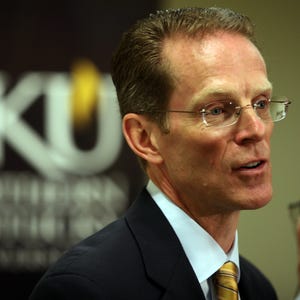
NKU President Geoff Mearns
These low ratings came via the latest annual survey of faculty obtained this week by The Enquirer through an open records request.

On a scale of zero to four, with zero equating to "very negative" and four equaling "very positive," NKU President Geoff Mearns received a rating of 2.05 for leadership, 2.19 for management and an overall score of 2.17. Sue Ott Rowlands, the school's recently appointed provost and executive vice president for academic affairs who led that trip to Sri Lanka, received an overall rating of 1.86.

In fact, only three of the top 13 administrators received an overall grade above 3.0, which indicates a positive rating. Five had ratings below 2.0, indicating "negative" ratings. Most of the rest hovered between 2.0-2.5.

One commenter wrote that Mearns, who took over at NKU in August 2012, is "arrogant" and "has a negative, even hostile, relationship with the faculty."

"I have never seen faculty and staff morale as low as it is currently," the commenter wrote.

Mearns, in Frankfort Wednesday for his monthly meeting with university presidents from around the state, told The Enquirer that he understands why the marks were low.

"Do I think this is a fair representation of the feelings of all the faculty? Perhaps," Mearns said. "And am I concerned that morale is low and what impact that may have on the educational experience? Yes, of course.

"This just reinforces the understanding of the anxiety on campus about the challenges we have had with our budget and financial constraints that have prohibited us from providing appropriate and deserved salary increases for our faculty and staff."
There hasn't been an across-the-board raise for faculty at the school since before 2010, although there was a 1.5 percent merit increase for some faculty and staff in 2014, and a one-time small bonus in 2011. (School officials note that administrators also have not received raises since 2010.)

In addition, the written comments attached to the survey consistently mentioned the heavy workload, which is normally four classes per semester in the fall and spring. That's higher than many other state universities.

The survey, distributed to the school's 600-member faculty, was conducted between February and March. Professors and instructors are allowed to anonymously rate school administrators, including Mearns and other top officials. More than 100 faculty members submitted surveys on Mearns and Ott Rowland, while other administrators didn't get as much response. NKU currently enrolls more than 15,000 students.

Some survey participants complimented Mearns on his leadership and his public stances on student funding, which lags behind that of other regional universities in Kentucky, and is considerably behind that at the state's flagship schools, the University of Kentucky and the University of Louisville.

"President Mearns is fighting hard and doing everything he can to put NKU on equal footing with our benchmark institutions in the state," one commenter wrote. "I appreciate his assertiveness in dealing with the major roadblock to our progress as a university."

NKU Faculty Senate President Steven Weiss said that he met with Mearns personally to go over the survey, adding that "administrators are never evaluated well."

"I read President Mearn's evaluation and thought it sounded just like things the faculty said about the previous president (Jim Vortruba)," said Weiss, a professor of communication at the school. Weiss has been at NKU for 20 years and has been involved in faculty/administration relations at four different schools.

"If we had a healthy state appropriation and our financial picture was better, the reviews certainly would be better," Weiss said. "But while a lot of that isn't their fault, the faculty have a way of directing that at the people in charge of the school."

One issue mentioned consistently in the survey was a trip taken by Ott Rowlands and several faculty members and administrators to Sri Lanka in September 2014. The school spent more than $31,000 on the trip, according to records obtained through an open records request. It also included a professor from Virginia Tech, where Ott Rowlands last worked, as well as a private NKU booster who paid her own way.

The trip included several stops at different universities and cultural centers in the island nation off the southeast tip of India. Included in expense reports were several expensive dinners and accommodations at exclusive hotels, according to the records.

One commenter said that Ott Rowland has been "excessively irresponsible" in her first year at NKU. "The fact that that she spent thousands and thousands of dollars, only making it public after the fact, on the trip to Sri Lanka at a time when departments are giving back money and faculty haven't had a raise in three years is astounding."

But Mearns defended the trip, saying it "jump-started" a partnership with the academic community in that country and that the study-abroad program at NKU could thrive under new agreements.
International partnerships are a major goal of the university. Administrators and faculty plan another trip later this year to officially sign agreements with the University of Jayawardenapura while other agreements with the University of Colombo have already been inked.

"I do understand why some are concerned if this was a prudent investment, given our current situation," Mearns said. "But we need to make continuing investments to improve our educational experience. And in this instance, we have had good returns in a relatively short period of time."
Said Weiss: "I really don't know a lot about that trip, but I don't think that our administration is responsible for a lot of our financial problems, and Sri Lanka certainly didn't add to those."
 Hat tip to Mike.

Bryan Station High teacher Levi Evans says district isn't doing enough to help school

And he isn't alone


This from the Herald-Leader:
A Bryan Station High School teacher has told the Fayette County school board that the district's failure to provide enough resources for a behavior management plan meant that "disruptions, disengagement and acts of violence and aggression are far too common at our school."

Levi Evans
Also, morale at the school is low because district officials haven't supported Bryan Station's efforts to become a school of innovation, Levi Evans said.

"Give us the resources to fully implement the solution," Evans told the school board last week.
Whether the district is doing enough to help Bryan Station is a question others are asking, including state Education Commissioner Terry Holliday, the NAACP and even some school board members.
This week, district officials updated the school board on their attempts to address the needs at Bryan Station and other low-performing schools.

Evans spoke to the board May 26, the same night the board, in adopting a $438 million tentative budget for 2015-16, set aside $620,000 to help Bryan Station and other low-achieving schools. An NAACP official said the amount wasn't enough.

Kentucky Education Commissioner Terry Holliday noted in a recent letter that a state diagnostic review cited for the second year in a row the district's lack of support for Bryan Station, the only school in Fayette County the state designates as persistently low-achieving.

Acting Superintendent Marlene Helm said Wednesday that she and board members John Price and Daryl Love planned to meet with Holliday and his staff to find out more about their concerns.

Board members Wednesday approved recommendations from senior administrative services director Kyna Koch on how to distribute the $620,000 to Bryan Station and the other low-performing schools.
Bryan Station High and eight other schools will get an additional staff position to focus on math, reading or English-language learners. In addition, all of the schools will get $10,000 each.

Bryan Station also will get $3,500 to address any findings that might result from an upcoming safe schools audit by the Kentucky Center for School Safety.

Koch said Wednesday that grant money also might be available for Bryan Station and the other schools. When the school board approves the final budget in September, Koch said, the board would have a list of the lowest-performing schools' unmet needs, in case additional money is available.
Price, the board chairman, has said board members also will look for money for low-performing schools in the 2016-17 budget, a process that could begin as early as December.

Evans, in his comments at the May 26 board meeting, said that investing more money at Bryan Station might mean making some tough choices. "But that is the equitable thing to do and the right thing to do."

In May, school administrators promised "serious" discipline after a student burst into a Bryan Station biology class to attack another student and was followed by a crowd of others with cellphones to record the incident.

Evans, who teaches English language learners, told the board that teacher morale and student conduct "are two very serious and related areas of concern."

"Both contribute greatly to the achievement gap" between low-income, disabled and minority students and other students, Evans said.

There are elements of a behavior management plan in place, and that might be enough at some schools, Evans said, but it hasn't been enough at Bryan Station.

The board needs to provide enough resources "to robustly implement" a behavior management plan.
"Half measures are not going to move the needle," Evans said.

Two years ago, he said, teachers, parents and students were excited to be a school of innovation and designed a new schedule to better meet the needs of diverse learners.

"Unfortunately, the momentum has stalled," said Evans. The people from the district who sold the school of innovation idea haven't "been seen much at Station."

The hope that parents, teachers and students could lead a new change is unfulfilled, he said.
"As a result, morale is very low," said Evans, who is the school's Fayette County Education Association representative.

Helm and school board members Doug Barnett and Love said Wednesday that they want checks and balances to make sure the help the district gives Bryan Station is working.

"We want to make sure that we are doing this in a very focused way," Helm said.

Read more here: http://www.kentucky.com/2015/06/04/3884871/bryan-station-high-teacher-says.html#storylink=cpy

Thursday, June 04, 2015

Done Already?

FCPS Screening Committee starts work on Tuesday and finishes on Wednesday

Once again it appears that a screening committee (or perhaps, the FCPS Board) has blindly trusted their search firm to fully vet candidates. This is almost always a mistake. I say this because of the short amount of time taken by the committee to complete its work, which did not allow for any serious vetting.

Experience suggests that most search firms promise big, but deliver little. "Just let us handle it," they will tell the Board chair. "That's what you pay us for." But we have seen firms that only check with a candidate's listed references - folks who could be relied upon to provide a positive spin for the candidate. They do not always call off that list and make inquiries of a candidate's critics. And any superintendent who has ever made tough decisions has critics. We have seen cases where big problems with a candidate went undiscovered by the search firm when even a quick Google search would have produced cause for doubt. Search firms greatly prefer secrecy to openness. They will say it's because they don't want to scare off good candidates. But I wonder if it is not really to make their work easier by eliminating oversight of what they do - or do not do.

Since the committee is comprised of good folks, I'm wondering if the members were constrained from digging into anything. If so, it's a shame, and it underserves the public interest.


This from the Herald-Leader:
The Fayette County Schools superintendent screening committee issued a statement Wednesday night saying it had finished its work and would give the school board a list of candidates in closed session.
The statement said the committee received 57 applications "reflecting diverse backgrounds and professional experiences."

The school board is trying to find by July a replacement for Tom Shelton, who resigned as of December. School board members do not have to take the screening committee's recommendation into consideration.

The screening committee members are teacher representatives Meribeth Gaines and Jessica Hiler, school board member Daryl Love, principal representative Kate McAnelly, parent representative Sharon Mofield-Boswell, and classified employee representative Julane Mullins

Read more here: http://www.kentucky.com/2015/06/03/3883147/fayette-superintendent-screening.html#storylink=cpy

Tuesday, June 02, 2015

Screening committee meets this week


 Review of
Fayette County superintendent candidates begins

This from the Herald-Leader:
After more than a week of screening and interviewing by the Fayette County school board's executive search firm, the superintendent screening committee will begin its work Tuesday.

"McNamara Search has made significant progress in vetting applications against the qualifications identified and profile developed by our community," school board chairman John Price said in a message to families. "It is now time for the representatives elected by employees, parents and community members to begin reviewing application files."

The school board is searching for a replacement for Tom Shelton, whose resignation was effective in December.

The screening committee members are teacher representatives Meribeth Gaines and Jessica Hiler, school board member Daryl Love, principal representative Kate McAnelly, parent representative Sharon Mofield-Boswell, and classified employee representative Julane Mullins.

The group will meet in closed session at 9 a.m. Tuesday and 1 p.m. Wednesday. Committee members also will begin their individual review of application files.

Price said state law is specific about the makeup, selection and responsibilities of the superintendent screening committee. After considering all applicants, the committee will make a recommendation to the school board about which candidates they think are the best fit for the school district. The school board will receive all of the application files.

"While the input and insight of the screening committee is valuable, state law does not require that we hire from among the recommendations of the screening committee," Price said.

He said after the screening committee meets this week, the timetable for the next steps remains flexible.

The board will conduct a round of interviews with semifinalists via the Internet before selecting finalists to bring to Lexington for a round of public interviews.

"We want to give the screening committee adequate time to complete its work, while also moving with deliberate speed in order to name a new superintendent prior to July 1," Price said.

McNamara Search needs time to complete its background checks on top candidates, Price said.

The board hired Lexington's McNamara Search after terminating its contract with the Illinois-based Proact Search when questions were raised about Proact's CEO.

"As we have said multiple times, our top priority is finding the very best superintendent to meet the needs of our students, employees, families and community," Price said. "If we do not find the right candidate, we will not rush this process."

The NAACP and other groups have called for school district officials to hire a superintendent with experience in closing the achievement gap between low income, minority and disabled students and other students.

Kentucky's funding for higher education among worst in the nation, KCEP director says

This from Pure Politics at cn/2:
Per-student funding in Kentucky is falling behind other states per a recent report, and the news has the Kentucky Center for Economic Policy worried about the future for economic growth.

Jason Bailey, director of KCEP, said the report from the Center on Budget and Policy Priorities has some troubling indicators.

“We could drive the gap between those who are better off in Kentucky and those that aren’t even wider,” Bailey said. “It’s not what education should be doing. Education should be creating an opportunity for everyone.

“We’re getting away from publicly funded higher education and we’re becoming more like private universities.”

According to the report, Kentucky is one of three states cutting higher education over the last two years, and the state also has the highest funding cut per student in the nation.

With a 3.9 percent increase in tuition in 2015, Kentucky joins five states for the highest increase in costs since last year.

Bailey, who runs the progressive think tank, said the funding woes are part of a long-term trend in the state.

“If you look back from 1998 tuition has tripled in Kentucky,” Bailey said.

With little left to cut in the state budget, Bailey said the state needs to look to the revenue side to find resources.

Bailey was one member of the nearly two-dozen Kentuckians on former Lt. Gov. Jerry Abramson’s blue ribbon tax reform commission, and he said the state should go return to the topic as a possible funding solution.

“We have a structural problem with our tax system in Kentucky where revenues don’t keep up with growth in the economy, and that creates a growing gap between the resources we have to pay for things like education and the resources we need to even sustain what we already have,” he said. “We have to look at our revenue stream.”